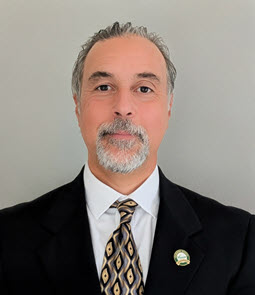
Burak Tanyu, Ph.D., C.Eng, F.ASCE, a tenured full professor and director of the Sustainable Geo-Infrastructure research group at George Mason University, Fairfax, Virginia, has been named a fellow by the ASCE Board of Direction.
Tanyu has over 22 years of experience in practicing and teaching geotechnical engineering. After earning his Ph.D., he joined Geosyntec Consultants, where he worked in the Chicago office for nearly a decade. During his tenure, he contributed to a wide range of geotechnical and geoenvironmental projects across the East Coast, Midwest, and West Coast. Notable projects included investigating one of Pennsylvania’s largest landslides, designing and constructing mitigation measures for a 3.5-mile embankment supporting a 400-acre dam in Michigan, and designing a residual waste landfill in Ohio on a 65-foot-deep, 100-acre liquefaction-prone site.
He co-authored two Federal Highway Administration manuals, one on Earth Retaining Structures and another on Micropiles, both later adopted by the National Highway Institute (NHI) for nationwide short courses. He developed and taught these courses for DOT agencies and ASCE across the U.S., earning two NHI teaching excellence awards.
In 2011, Tanyu transitioned to academia, joining the Civil, Environmental, and Infrastructure Engineering Department at George Mason University. He initiated GMU’s geotechnical engineering program, developed courses, established a research group, and created the department’s first teaching and research laboratories. Under his leadership, SGI emphasizes applied research, consistently taking projects beyond the laboratory. Over the past decade, the team has designed and constructed a bridge, a roadway, and two full-scale test sites, translating academic findings into practice.
Tanyu’s research contributions include:
- Evaluating recycled concrete aggregate in roadways with drainage systems and in MSE walls with woven geotextiles and PVC-coated polyester geogrids.
- Developing guidelines for designing unbound base layers with reclaimed asphalt pavement and implementing field quality control measures.
- Characterizing and creating design guidelines for using expanded polystyrene as elastic inclusions for integral bridge abutments.
- Introducing a new methodology to test the contribution of geosynthetics to reinforce and stabilize soft ground conditions.
Several outcomes of his research have influenced Virginia DOT specifications. Tanyu also helped define boundary conditions for the composite behavior of geosynthetic reinforced soil structures, leading to updates in Section 11.10 of the AASHTO LRFD Bridge Design Specifications. He has co-authored over 80 publications and delivered more than 70 professional presentations.
Beyond research, Tanyu actively serves the profession. He chaired the Geo-Environmental Processes Committee of the Transportation Research Board for six years and currently serves as Director of Academic Outreach for the ASCE National Capital Geo-Institute Chapter. He is an associate editor for ASCE’s Journal of Geotechnical and Geoenvironmental Engineering, Journal of Geological and Geotechnical Engineering, and Journal of Innovative Transportation.