The ABCs of Water Reuse, by Carollo Engineers Inc. (Independently published), 2025; 55 pages, $9.99.
Plenty of fellow Gen Xers have fond memories of educational entertainment during our formative years in the 1970s. I can’t be the only person who can still recite the preamble to the Constitution word for word, thanks to Schoolhouse Rock (a series of short animated singalongs that taught lessons about history, grammar, math, and science). And certain Sesame Street songs teaching the alphabet (think C is for Cookie sung by Cookie Monster) are similarly tattooed on our brains to this day.
The basic idea is that new concepts can be effectively absorbed through repetition, a simple and straightforward presentation, and, yes, a little dose of childlike levity. And water engineering consulting firm Carollo Engineers Inc. is betting that it can work well for adults too – and on a more complex issue, such as the increasingly urgent issue of water reuse.
Further reading:
- In Earth’s human era, we must take bold steps, rethink infrastructure, authors write
- Author chronicles disturbing route that made ‘forever chemicals’ a societal menace
- Texas utility launches landmark water reuse project
The ABCs of Water Reuse, developed and independently published by the company, borrows heavily from an illustrated educational approach that will be instantly familiar to many from their childhood books – except that in place of “A is for apple,” here instead “A is for aquifer.” This simple approach allows the authors to explain and reinforce many principles associated with water reuse, and in so doing advocate for this key technological and policy approach to achieving better water security.
With just two pages devoted to each letter, the definitions and explanations skew short, simple, and accessible by design, even when covering inherently technical information in sections such as M (membranes), I (indirect potable reuse), or X (xenobiotics). Others cover different aspects related to water reuse, from B (covering the problems with bottled water) to J (the jobs Carollo cites that can be created via major water efficiency projects).
Partly due to needing 26 different entries, and no doubt partly by design as well, the book’s lettered sections contain a fair amount of repetition of the most important concepts. These include understanding the centrality of aquifers and groundwater; the concept and applications of nonpotable reuse, such as irrigation, data center cooling, and others; and perhaps most importantly, IPR.
Whereas direct potable reuse sends purified water directly back into the drinking water supply, IPR takes purified recycled water and returns it to aquifers, lakes, and rivers, where it helps reestablish natural flows and improve habitats while also receiving additional purification through natural processes before it eventually ends up as drinking water again.
While it is worth noting that as a firm devoted entirely to water and wastewater issues, Carollo certainly stands to benefit from greater adoption of water reuse technologies, it is also difficult to dispute that the nation – and the world – badly needs to do more in this area. (In other words, while the book may indirectly benefit Carollo, there’s not really a credible movement arguing for less water efficiency and reuse.)
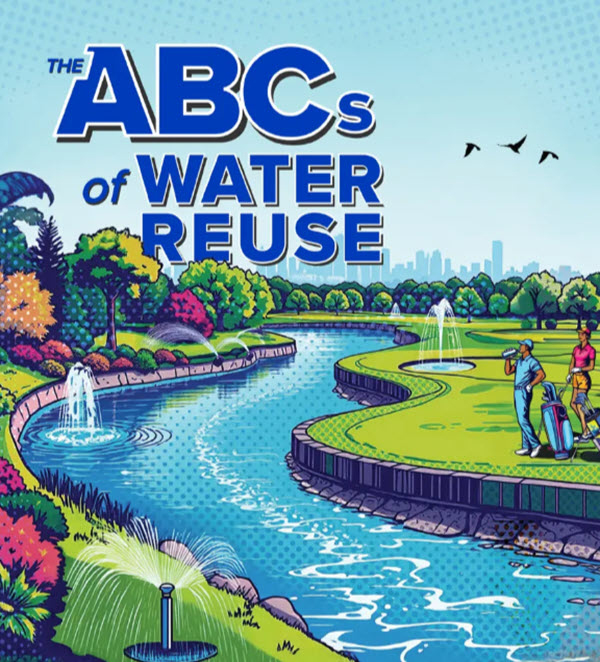
Carollo notes that utilities in states across the country, as well as from other countries, are using the book to help educate their communities, elected officials, and others – precisely the company’s intent in creating the publication.
The ABCs of Water Reuse is eye-catchingly illustrated, written to be broadly understandable by virtually anyone, and available as a free download in addition to a print book. And it represents a unique addition to the existing literature and ongoing effort to educate the public about some of the most important tools available to ensure access to our most precious natural resource at a time when it is increasingly needed.