Industrywide guidance for implementing smart sewer approaches is coming.
A new study will help utilities identify opportunities for optimizing their systems and determining whether investment in sensors, communications, and real-time controls would be a better approach to adapt to changing conditions and more fully utilize existing sewer capacity.
Further reading:
- Winter is here; how can we protect wastewater, sewer infrastructure?
- Using software to streamline wastewater network design in impoverished areas
- ‘Vast opportunity’: Captured stormwater could be urban boon
The 24-month investigation, funded by The Water Research Foundation and led by Carollo Engineers – with support from HydroDigital – will bring together a multidisciplinary team of engineers and partner utilities across the U.S., the United Kingdom, and Canada.
Implementing a Smart Sewer System to Optimize Capacity to Reduce Surface Flooding and Sewer Overflows will compile use cases, best practices, and cost considerations associated with smart sewer technologies. The research aims to support utilities in addressing overflow and flooding challenges.
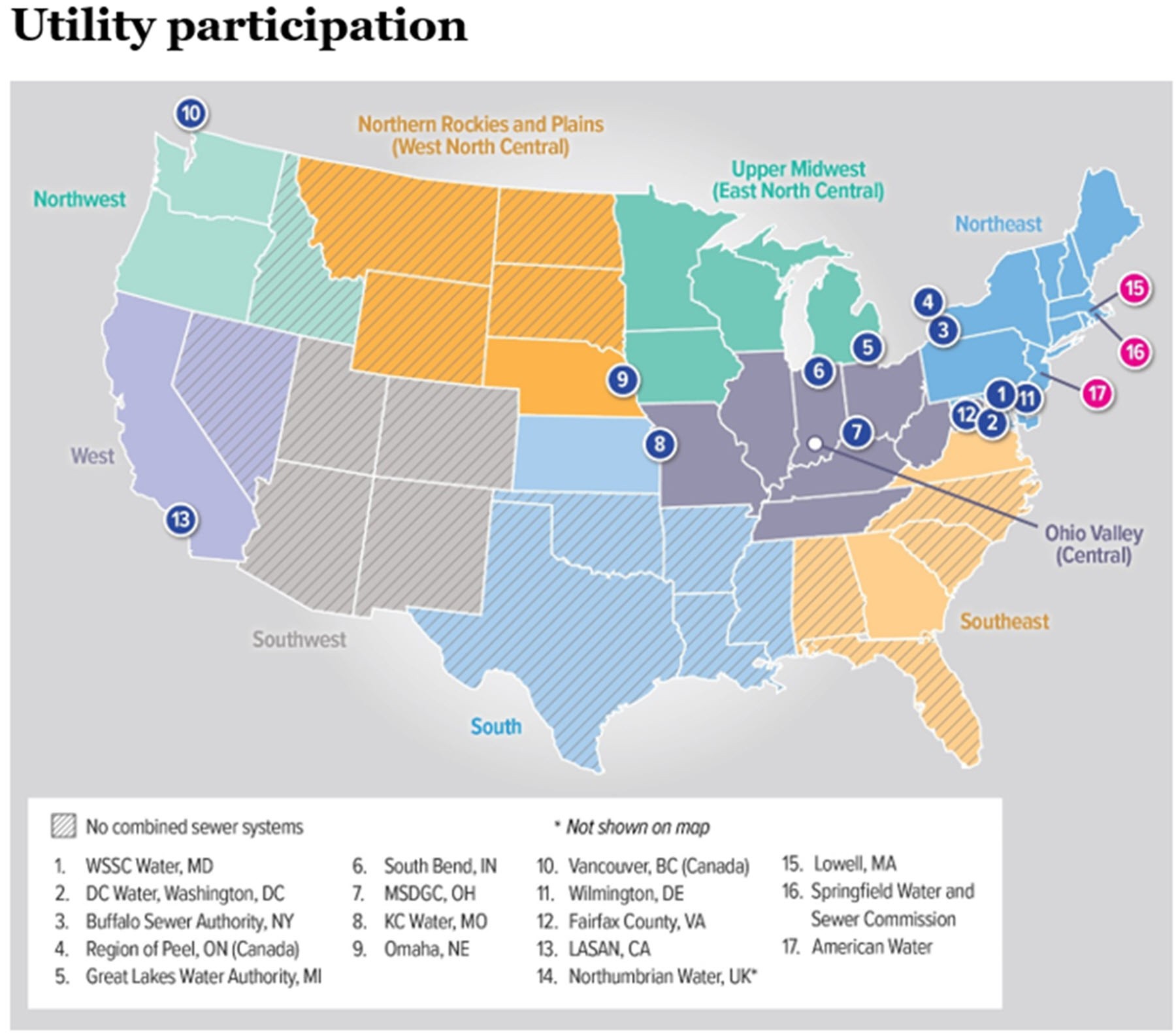
The study includes 17 participating utilities representing a range of geographic regions, system types, and utility sizes. (Courtesy of Carollo Engineers)
“When smart sewer technologies are applied, utilities can improve how they manage and control their infrastructure – optimizing what they already have,” said Eric Harold, vice president of Carollo Engineers and the principal investigator of the study.
The research, which is underway, will also deliver recommendations to help utilities integrate smart sewer approaches into their capital planning, potentially reducing the need for large infrastructure investments.
Ensuring the guidance is utility-facing is a core priority of the research team.
“When you think about the utility of the future, digital capabilities will clearly be part of it,” said Harry Zhang, Ph.D., WRF research principal on integrated water and stormwater. “Each utility is at a different point in its digital progression. Our hope is that this research can help utilities understand where they are in this journey and better define the value proposition of smart sewer investments.”
Smart sewer capabilities
Luis Montestruque, Ph.D., co-founder and CEO of HydroDigital and co-principal investigator of the study, said smart sewer tools allow utilities to continuously monitor conditions across their infrastructure systems and respond to storm events by dynamically managing system capacity.
“These applications allow utilities to better adapt to increasingly variable rainfall patterns, which can affect different parts of a city’s infrastructure at different times,” Montestruque said. “During cloudburst events, intense rainfall can suddenly affect one section of a city, overwhelming the sewer system in that area. The idea of a smart sewer is to recognize where capacity still exists in the network and use it to relieve the parts that are overburdened.”
Advances in smart sewer systems have been enabled by innovations in sensor technologies, cloud computing, and machine learning. More recently, Montestruque said the integration of digital twins is further transforming how hydrologic models are applied in practice.
“A full smart sewer integration is a system composed of three stages,” he said. “The first – what we call ‘turning on the lights’ – uses sensors to understand what is happening across the network in real time. In the second stage, a digital twin is combined with forecasting tools to predict how the system will perform in the near future. The third stage applies real-time optimization algorithms to identify the best operational strategy for the assets on the ground.”
A key piece to this framework is the use of communications technology.
“Once information becomes available, a utility needs to act on it – ideally before projected conditions can occur,” Harold said. “In some cases, the response is automated. In others, the information is relayed to an operator to inform a decision such as opening a gate, activating a pump, or taking other steps to utilize available capacity.”
Overcoming barriers
In developing the guidance, the research team will outline approaches for addressing barriers that have traditionally limited smart sewer adoption.
According to Montestruque, utility reservations include uncertainty about their organizational readiness and whether they have the skilled workforce necessary for managing advanced digital tools. Another concern – particularly among operators with decades of experience managing collection systems – relates to transparency and trust.
“They want tools they can trust, and it often depends on understanding how the technology generates recommendations or, in the case of automation, how it makes control decisions,” Montestruque said.
Questions also arise around governance and ownership – specifically, which department within a utility is ultimately responsible for managing smart sewer systems. “We view this as a challenge but also an opportunity to break down silos between departments and rally the organization around the technology,” Montestruque said.
To help utilities work through these barriers, the study will also document a range of real-world smart sewer use cases. Examples will range from early adopters that first embraced smart sewer technologies in the 2000s to utilities that are just preparing to implement these approaches.
“Through these shared experiences, utilities can gain perspective for getting started, planning and designing a smart sewer system, and – through examples of trial and error – how these systems are best utilized,” Montestruque said.
Another obstacle relates to the challenge of clearly demonstrating the value of smart sewer approaches, especially when compared with more conventional solutions.
“Traditional gray infrastructure is relatively easy to design, predict, and justify,” Harold said. “A large underground tunnel has a specified capacity – its performance is tangible. Smart sewer technologies can deliver comparable value by improving how systems are managed, but it can be more difficult to quantify.”
Accepting smart sewer technologies also requires utilities to embrace a different approach than what they might be used to.
“It’s a change management challenge, and it requires buy-in from operators, procurement and engineering teams, and maintenance staff,” Harold said. “This is where we see our study becoming really useful. The guidance can provide a framework to help utilities work through their questions and learn from other utilities that have already made decisions.
“Our goal is to develop a clear and defensible process for how these tools are selected and implemented. We want to lower the barriers to adoption and highlight opportunities where they’re going to have the most chance for success.”
AI and ML applications
The research team will also evaluate how evolving technologies can be applied within smart sewer systems, with particular attention to the role of artificial intelligence and machine learning in enhancing applications.
“Machine learning has been shown to be very effective at predicting how a watershed will respond under specific conditions,” Montestruque said. “For example, data-driven machine learning models can be used to predict runoff based on rainfall forecasts and then integrated with hydraulic models to support real-time digital twins.”
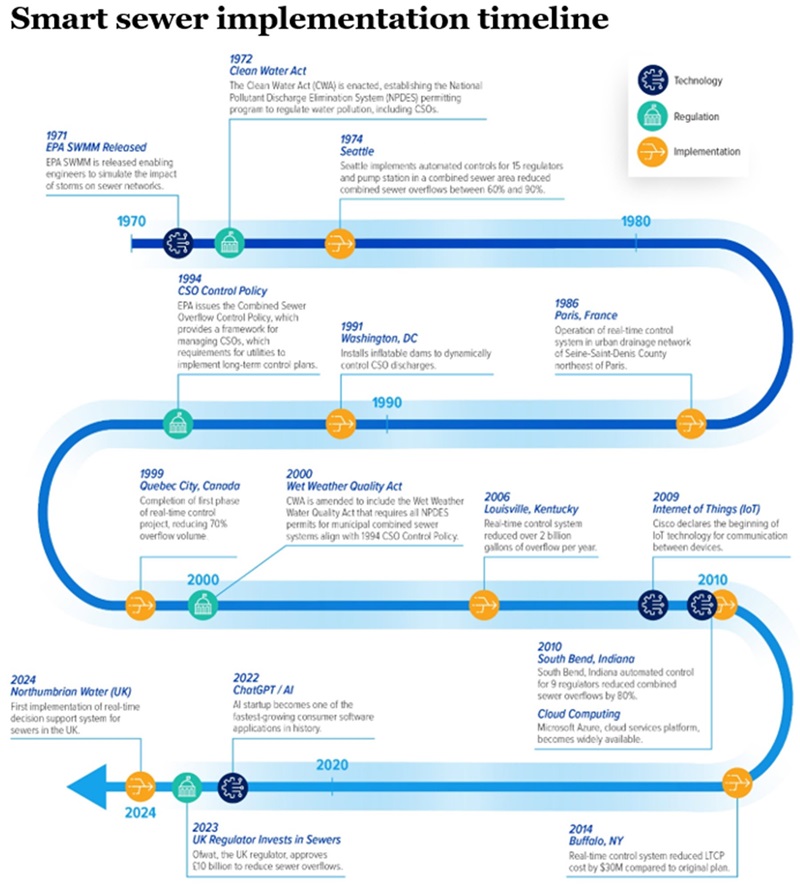
Montestruque also anticipates benefits from the integration of AI and particularly with large language models, which offer the potential to improve access to smart sewer tools.
“Traditionally, adoption has largely been limited to utilities with the funding, resources, and skilled labor to manage these systems,” he said. “However, large language models could help change that by providing the means to interface with them in a much more natural way. We are already starting to see utilities take advantage of that.”
By combining lessons from established implementations with forward-looking analysis, the WRF project aims to support utilities at every stage of their digital journey – from those just beginning to explore smart sewer concepts to those seeking to scale and refine mature systems. The outcome will be a practical, utility-facing guide with case studies, strategies, and tactics to help utilities scope capital and operational programs for smart sewer systems, tailor their control strategies for sewer overflows, and meet regulatory requirements.

Get ready for ASCE2027
Maybe you have big ideas like the ones discussed in this article. Maybe you are looking for the right venue to share those big ideas. Maybe you want to get your big ideas in front of leading big thinkers from across the infrastructure space.
Maybe you should share your big ideas at ASCE2027: The Infrastructure and Engineering Experience – a first-of-its-kind event bringing together big thinkers from all across the infrastructure space, March 1-5, 2027, in Philadelphia.
The call for content is open now through March 4. Don’t wait. Get started today!