 Schneider Electric
 This article is the first in a series looking at artificial intelligence’s impact on civil engineering and related fields.
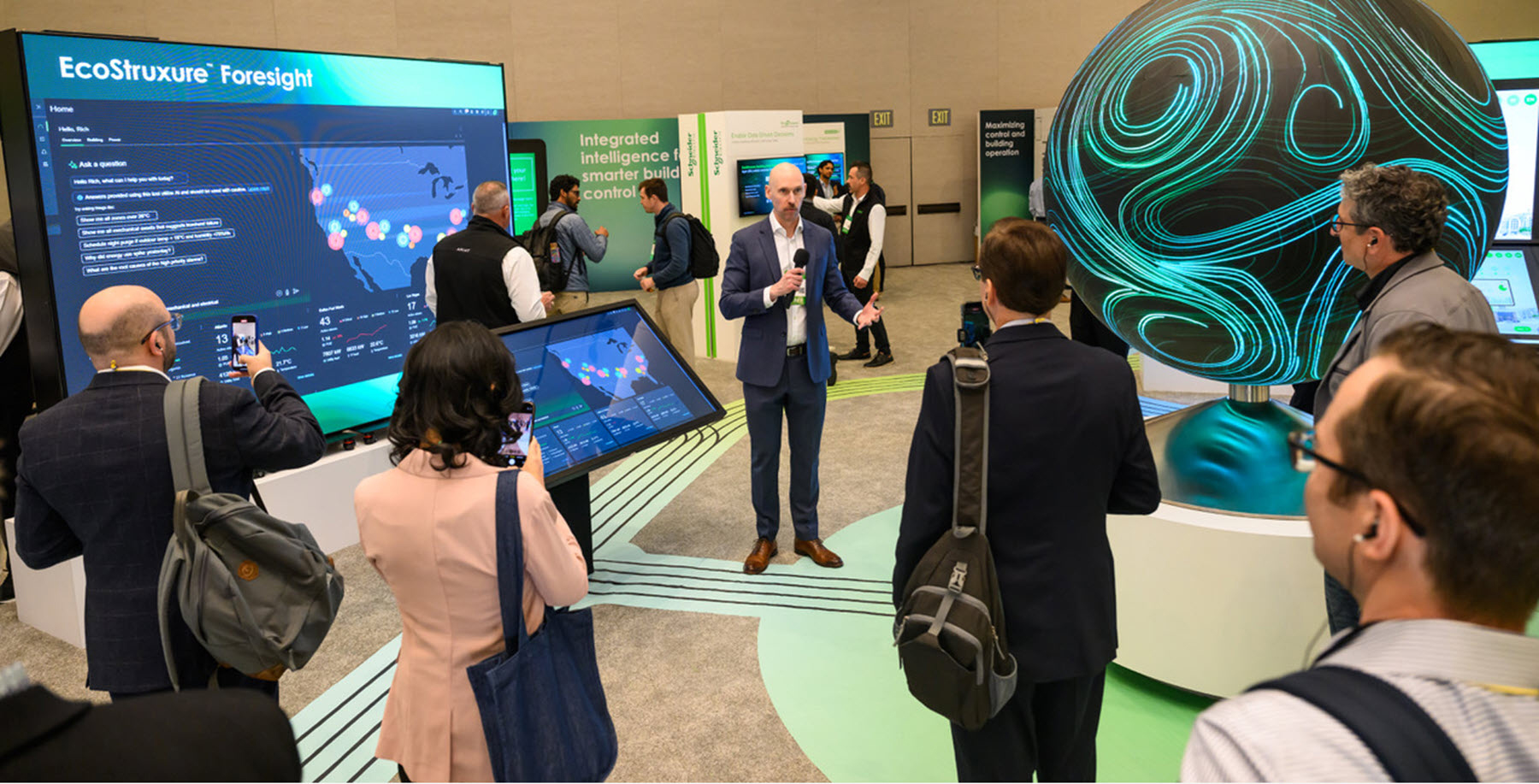
The 2025 North America Innovation Summit provided a window into how artificial intelligence is rapidly transforming the architecture, engineering, and construction industry.
Schneider Electric, host of the recent Las Vegas summit that welcomed more than 2,500 business leaders and market innovators from various industries, is leveraging AI to detect anomalies between electrical and mechanical systems. The company strives to predict failures before they happen – or quickly diagnose and repair them when they do.
Further reading:
- When intelligence is artificial, what happens to ours?
- How civil engineers can strike the AI balance
- A new AI-powered tool could speed up road assessments
“We are cutting the time to resolution down by 90%,” says Sadiq Syed, senior vice president of Schneider’s digital buildings line. “So that’s the golden window, when an asset is down in a critical environment like a data center or a hospital, where every minute is an impact either to a patient life or (a service level agreement) for a critical service.”
Schneider, based in France and with its North American headquarters in Boston, is also developing “AI at the edge” technology with dynamic heating, ventilating, and air-conditioning optimization, which uses AI to manage heating and cooling levels based on usage patterns and occupancy levels.
“It’s not a static thing that it changes set points once a day,” Syed said. “No, it is real time. It’s detecting, monitoring, and adapting. And there’s a lot of AI there, a lot of learning models that are enabling that. And we’ve noticed that in some cases, we have seen energy savings of upwards of 15%.”
Global consultancy Arup is using AI in work with The Nature Conservancy and collaborators in Florida around smart watershed management.
“Our hydrological modelers are looking at how water behaves in existing stormwater infrastructure under a variety of scenarios,” said Gideon D’Arcangelo, Arup’s Americas digital services leader. “And then we can analyze ways to hold back, divert, and route water during deluges or during storms to reduce the impact of pollution in the sensitive coastal ecosystems.”
Arup also uses AI for mass energy modeling to assist clients who want to decarbonize properties. AI can “calculate all the various design options to achieve net zero in a design,” D’Arcangelo said. “There’s billions – way too many to deal with.”
A genetic algorithm allows the program to reduce those billions of “possibles” to a few thousand “viables,” which are ranked according to key parameters related to cost and efficiency. The algorithm is transforming tasks that would take months to accomplish into work that can be done in hours.
ChatGPT for the enterprise
Beyond the computational power AI can bring directly to projects, the technology is also poised to transform how firms operate internally.
“Conventionally, small offices were very lean and agile,” said Robert Otani, P.E., M.ASCE, chief technology officer and managing principal in Thornton Tomasetti’s New York City office. “And you developed your staff a lot quicker because they were all in one room. But if you think about it, the total intelligence of the firm is only based on the knowledge of the people in that one room.
“We’re a 2,000-person firm with over 40 offices. So if you do it right and if you have those connectors, you can really scale that pool of knowledge in an expansive way.”
Firms in the AEC space are turning to AI to help surface the voluminous information – emails, local policies, and regulations – that a typical engineering project entails. “These projects have thousands upon thousands of touchpoints, thousands of participants, thousands of different angles, if not hundreds of thousands,” D’Arcangelo said. “Applying a large language model to a big project gives you a way to have a conversation with the project and find out what kind of information you need within the domains of the project.”
Arup, for one, applied an LLM to a project dataset so engineers and designers could query a major project the firm is working on in Toronto, the Eglinton Crosstown West Extension.
Jay Wratten, digital lead at WSP’s U.S. headquarters in New York City, says firms spend a lot of time on “dashboards and reporting.” Project-specific AI programs could help teams move through large amounts of information more efficiently.
“I think one of the early rollouts of agents you’re going to see are project specific,” he said. “Agents that know what’s going on in a project, and you can simply ask, ‘Where are we at with this?’ How much time in our industry is spent answering the question of: ‘Where are we at with this?’”
Wratten says that often individual engineers are not experts in all the domains requiring their expertise. “He or she might be out in the field and see something during a site visit that they don’t necessarily know about, as an expert, but they know a little bit about,” he said. “What if we had an agent that was an expert that could help them?”
AI could augment engineers’ knowledge in many domains. A mechanical engineer could, for instance, real-time query an AI agent with an electrical engineering question if the electrical engineering expert was unavailable.
Beyond that, Wratten notes we might eventually see two AI agents communicating with each other. “If you were to poke your head above the ceiling, you’ll notice there’s a lot of empty space up there between that and the slab,” he says. “Why is that? Well, it’s because we set layers for different things, and we try to stack them because trying to coordinate all that stuff in 3D never happens.
“Well,” he continued, “what if you had the mechanical and the electrical agent talking to each other and negotiating? What can I move so that we can squeeze that ceiling down?”
We might not yet be at the point where an AI “employee” is listed on a firm’s organizational chart, sitting in on important meetings and answering questions when asked. But having access to an agent would allow firms to conduct what Alastair MacGregor, who leads WSP’s property and buildings business line, calls a “pre-mortem.”
“When we’ve tried to do this before, where have we stubbed our toes?” he said. “What has led to the biggest cost overruns? What has caused schedule delays? We’ve looked around the globe. What did people do to solve it?”
Preserving institutional knowledge
Easily accessing mountains of information is one benefit that firms are beginning to take advantage of. But this sets up a second – the ability to tap into the institutional knowledge of the real source of a firm’s expertise: its people.
“The amount of information these big projects generate is massive,” Wratten said. “And think about how much of that knowledge walks out as institutional knowledge when someone leaves a project. Happens on every job.”
“We may have taken two, three, four years to design and then construct the project,” MacGregor added. “And then, in traditional practice, we’re on to the next project. And all that knowledge – Why did we do this versus that? – the person who’s taken over the project would love to know. There was probably a lot of thought and insight that was put into that decision.”
“For experienced engineers, everything is buried in our head,” Otani said. “And unless someone asks a question and we write it down, it stays in our head.”
Otani described veteran Thornton Tomasetti engineer Mike DeLashmit as “an expert’s expert type of guy,” who for years served as an in-house resource other engineers could contact. He received questions from his colleagues and emailed back highly detailed responses. Six months before he died, he had given the firm access to seven years’ worth of email responses.
With his family’s blessing, the firm used an in-house LLM to create a permanent repository of some of his knowledge. The firm also set up a scholarship in his name, the Mike DeLashmit LiFE (Legacy in Field Engineering) Endowed Scholarship.
“We’re not there yet, but imagine if we took all of our projects and were able to extract the intelligence out of those projects and then give that knowledge to younger engineers or any engineer, for that matter, when they need it,” Otani said. “That’s incredibly powerful.”
Get ready for ASCE2027
Maybe you have big ideas regarding artificial intelligence. Maybe you are looking for the right venue to share those big ideas. Maybe you want to get your big ideas in front of leading big thinkers from across the infrastructure space.
Maybe you should share your big ideas at ASCE2027: The Infrastructure and Engineering Experience – a first-of-its-kind event bringing together big thinkers from all across the infrastructure space, March 1-5, 2027, in Philadelphia.
The call for content is open now through March 4. Don’t wait. Get started today!