 ONNI Group
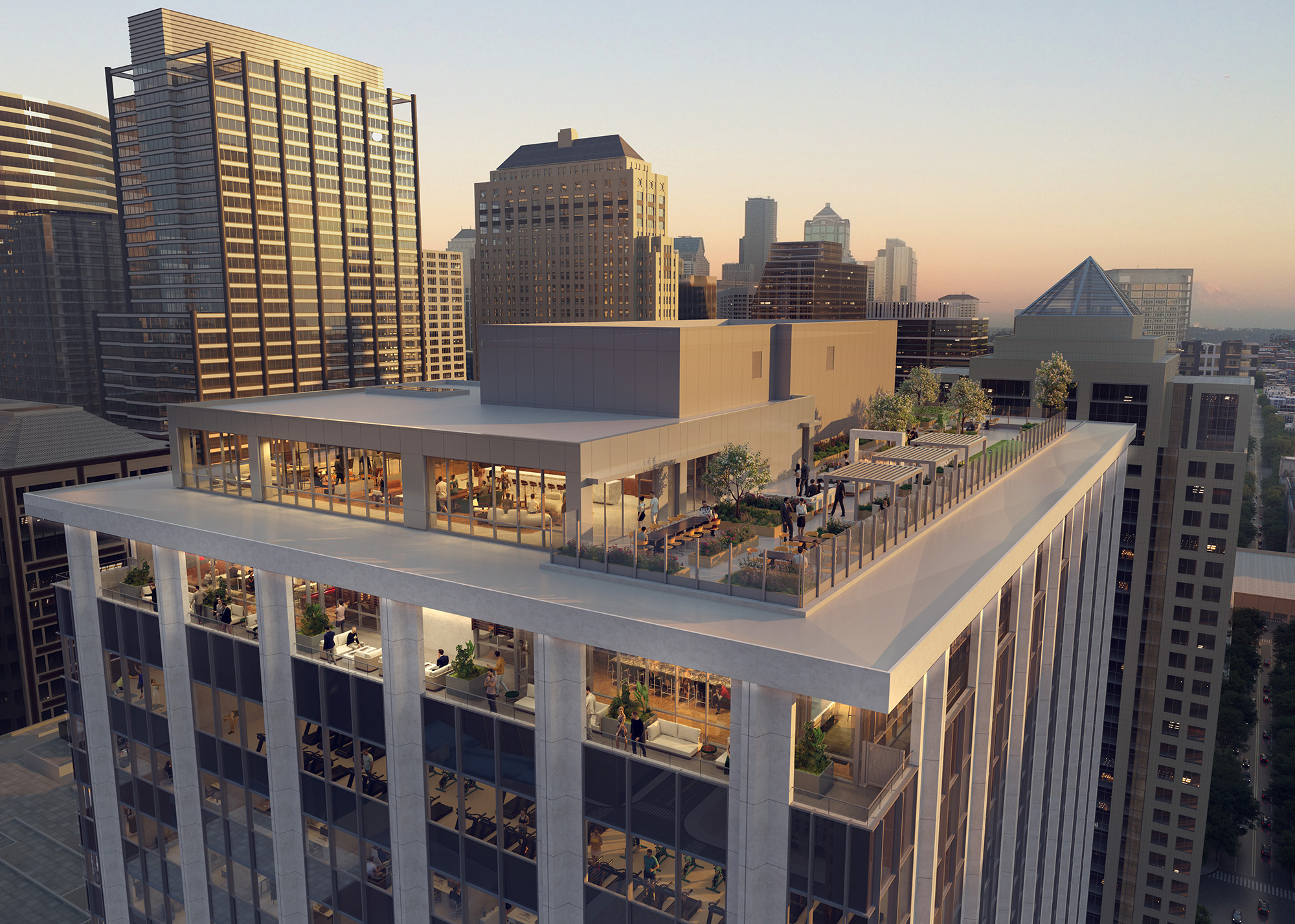
 Mechanical areas on the top levels of the former Illinois Bell headquarters building in Chicago became amenity spaces.
Cities across North, South, and Central America are grappling with challenges that range across “demographic pressures, climate change, socio-economic inequalities, and infrastructural fragility,” according to the recent report Density and Resiliency Across the Americas.
Published in 2025 by the Council on Tall Buildings and Urban Habitat (recently rebranded as the Council on Vertical Urbanism), the report highlights articles and papers that explore architectural and engineering projects in the largest cities in the Americas, such as Toronto, Chicago, and Buenos Aires, Argentina, as well as midsize cities such as Monterrey, Mexico, and even small communities like Florida’s Babcock Ranch. On some topics, the authors also discuss instructive projects in Europe and Asia.
Adaptive downtowns
Office parks and central business districts have not proved to be resilient in the aftermath of the COVID-19 global pandemic, according to one article in the report, “Moving on from Monoculture – The Opportunity of Adaptive Reuse Downtown,” by Sara Beardsley, an associate principal; Paul Schlapobersky, a principal and director of planning and urban design; and Jennifer Kleckner, a project architect, all from the Solomon Cordwell Buenz architecture firm. Tall, downtown office buildings were especially emptied out by the pandemic and the subsequent shift to people working more from home. While the most prestigious Class A office towers are still desirable locations for business, most other tall office buildings are not recovering, the SCB authors noted.
Further reading:
- Could continental-scale mapping be the solution to infrastructure inequality?
- Open-source simulation software boosts earthquake resilience
- Community resilience starts with people
At the same time, the “near-desperate need for tens of thousands of new dwelling units in the cities of the United States seems to offer a market-driven solution to the problem of non-Class A, underused, or empty city office buildings,” they wrote. Unfortunately, a “hulking office building with the deep floor plates and inoperable windows” can be prohibitively expensive to convert into residential properties and many cities have been slow to amend zoning laws or building codes to encourage such adaptive reuse.
Still, “the empty office building conundrum confronting American cities has generated a special opportunity to create a considerably better condition than pre-2020,” the authors argued. Indeed, they suggested, the pandemic might someday “be seen as the catalyst for the next iteration of the North American city … posing great opportunity.”
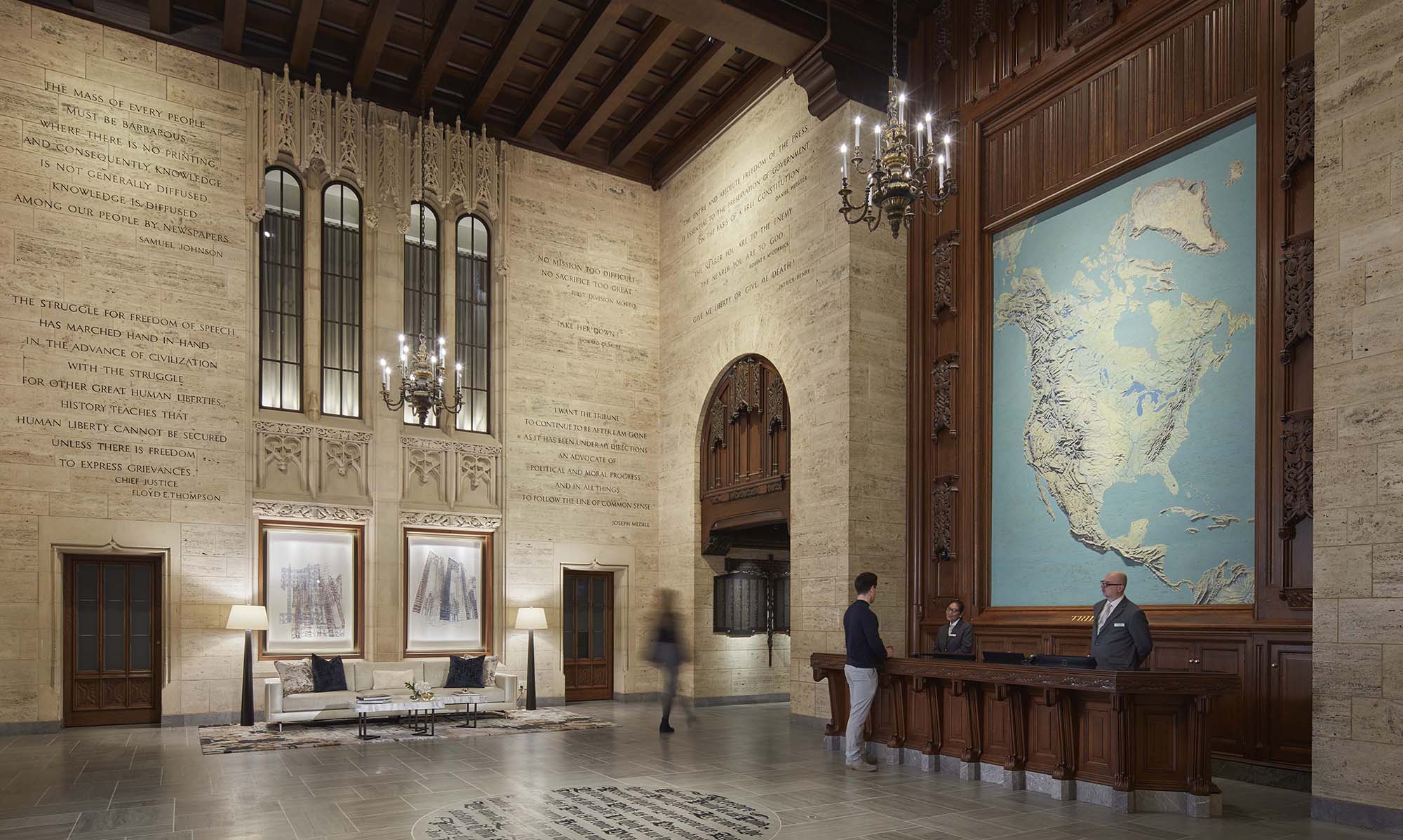
The article presented five case studies of successful residential conversion or repositioning projects (in which the building remained office space) in the American Midwest. These included Chicago’s 34-story landmark Tribune Tower, which together with surrounding structures was converted into 162 luxury condominiums.
Like many office buildings, the Tribune Tower had more elevators than needed for a residential property. But those elevators did not serve every floor, as required for emergency access by the fire department, the authors noted. SCB’s solution involved converting a decommissioned boiler flue shaft into a fire service elevator, adding a new stop at the lobby level, and installing additional stairs in various parts of the structure “to ensure proper exiting and safety,” the authors wrote.
 Dave Burk
The renovation also reduced the Tribune Tower’s energy usage by 50%, thanks in part to an overhaul of the mechanical system design and upgrades to the historic facade, such as new insulation and improved, operable windows.
Another SCB project in Chicago involved the repositioning of the former Illinois Bell headquarters building at 225 West Randolph St., which because of its proximity to commuter rail made it “a desirable office destination, even in the post-pandemic era,” the authors said.
Because the building’s existing mechanical systems were becoming obsolete, the project replaced that equipment, which had been installed in large mechanical rooms at the top of the building, including a mechanical penthouse space on the 32nd floor. The new mechanical systems were installed in localized spaces on each floor, which freed up those upper-level areas to become new amenity spaces.
The interior of level 31 was demolished, and a new curtain wall was installed, the authors explained. In addition, a new partial floor was constructed on level 32, wrapping around the existing penthouse. The changes follow a trend in Chicago that “has embraced the use of rooftops on older buildings for lush gardens and activity spaces,” the authors noted.
An urban village
In Canada, a previously “nondescript low-rise industrial area” has been converted into an “urban village in the heart of downtown Toronto,” featuring density, diversity, and key amenities, according to another of the report’s articles, “Reimagining Mixed-Use: Charting a Well-Integrated Future for Toronto,” by David Pontarini, founding partner of Toronto’s Hariri Pontarini Architects.
The Well, as this new urban village is known, was master-planned by Hariri Pontarini Architects with extensive public input. The project featured a series of high-rise towers – up to 570 feet tall – and shorter buildings with an equal mix of commercial and residential properties. The public input, in particular, persuaded the developers to connect the retail components via a set of outdoor walkways, with some coverings, rather than the enclosed mall originally envisioned, the author noted.
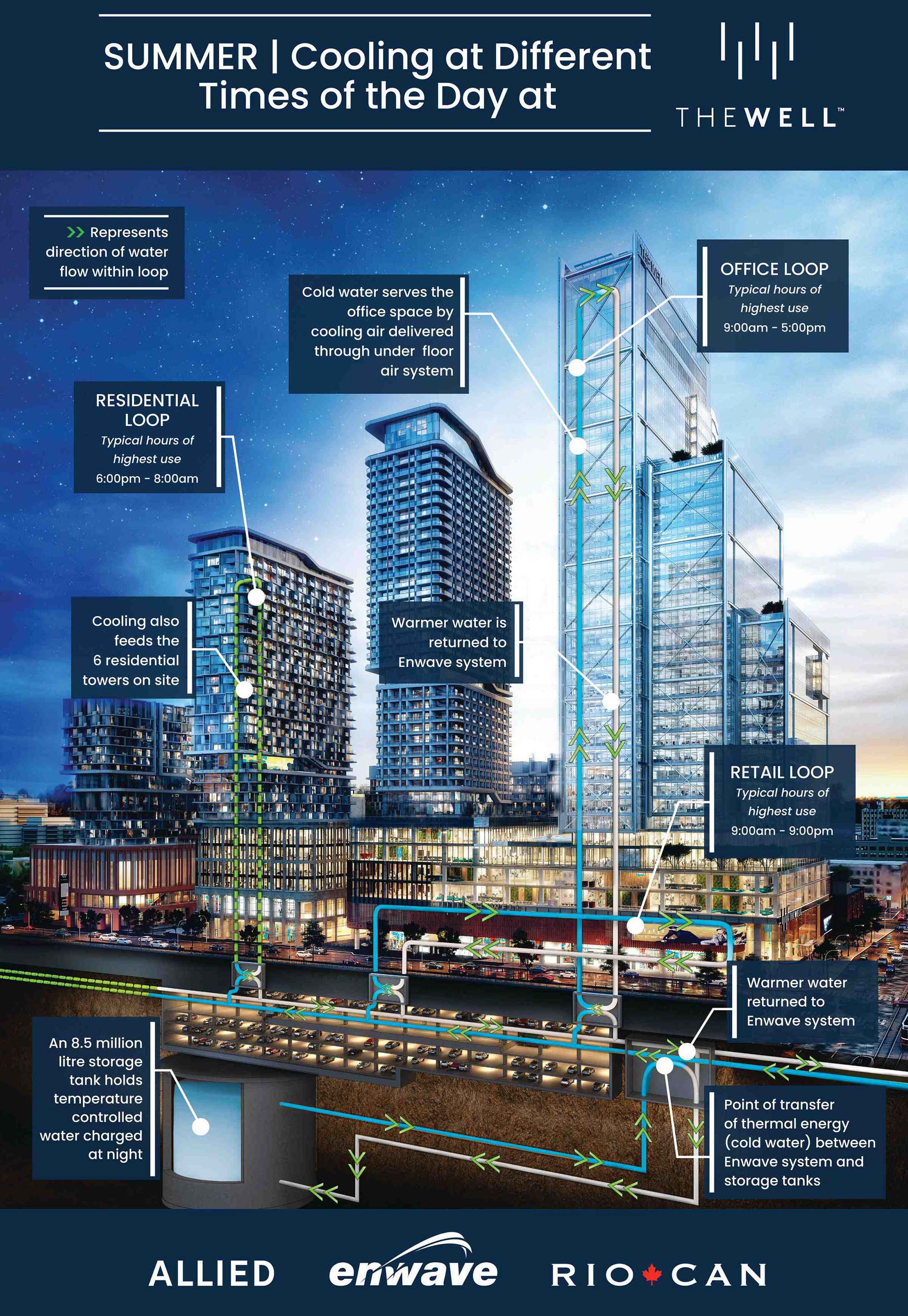
The Well’s “most outstanding sustainability feature,” according to the author, is its use of a deep lake water cooling system.
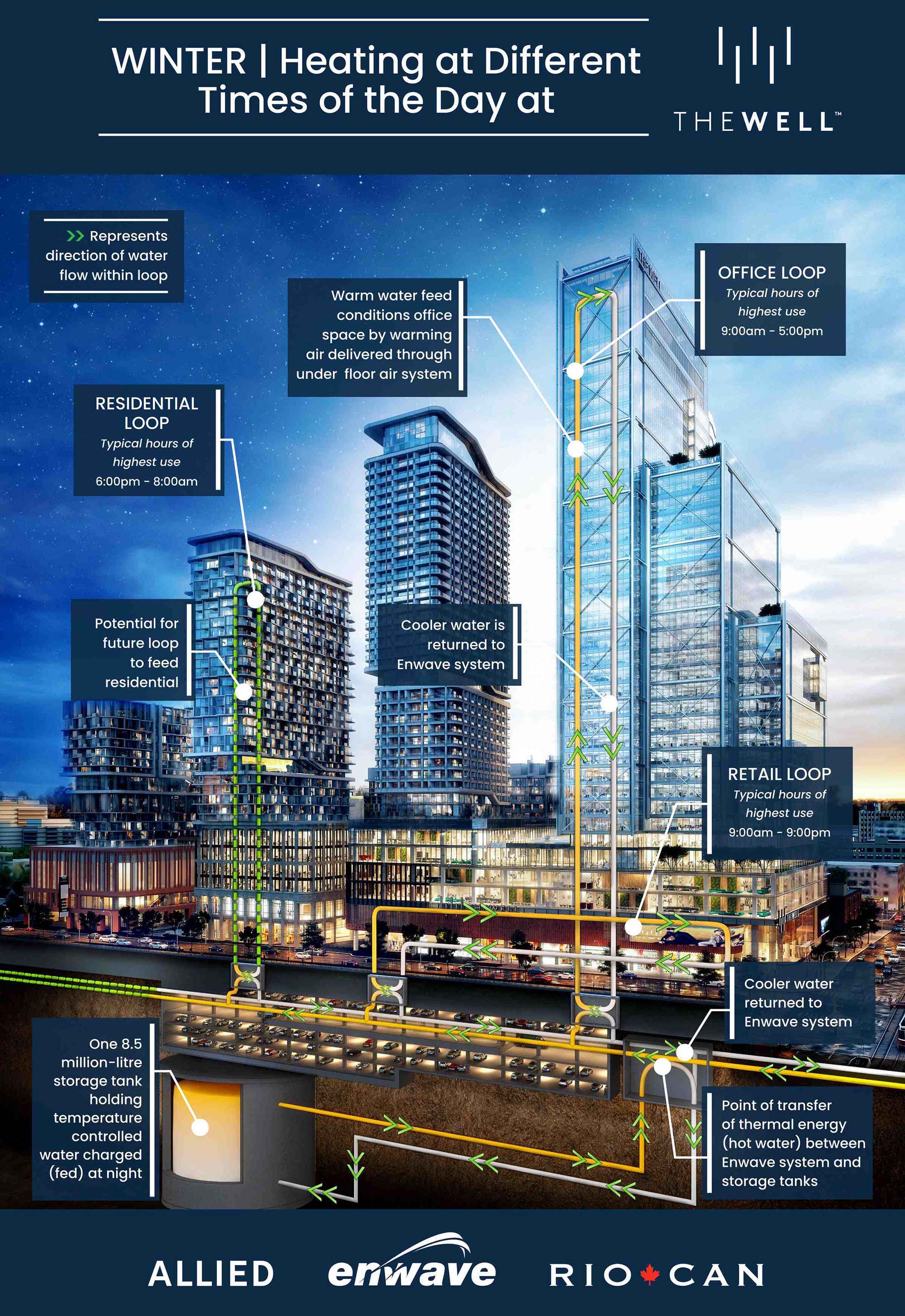
Designed by Toronto’s Enwave Energy Corp., the system features a series of underground pipes that draw water “from the bottom of Lake Ontario where it remains 4 (Celsius) all year,” the author explained. This water is sent to a heat transfer station downtown, from which “it circulates through office towers … hotels and hospitals via (25 miles) of underground piping to provide a low-carbon heating and cooling alternative to fuel-driven energy sources.”
The system’s infrastructure also includes an 8.5 million-liter, temperature-controlled underground water storage tank. The tank “acts as a thermal ‘battery’ that can store energy at night during off-peak times, easing strain on the electricity grid and reducing costs,” the author wrote.
Solar solutions
The report also highlighted “solar neighborhoods,” such as Vauban in Freiburg, Germany, and BedZED in London, that “demonstrate how entire neighborhoods can be powered by solar energy, reducing their carbon footprint and promoting energy efficiency,” according to another article in the report, “‘Solar Neighborhoods’ as a Green Resilience Strategy in Latin America,” by Ricardo Calabrese, a Ph.D. candidate at the University of São Paulo in Brazil, and Marcelo Romero, provost of research at the Belas Artes University Center of São Paulo.
The authors explored Florida’s Babcock Ranch, which was “designed to be the first U.S. city entirely powered by solar energy,” they noted. And they discussed solar case studies in Brazil such as the off-grid, microgrid system in the remote community of Vila Limeira that became the first location in southern Amazonas to operate with 24-hour solar electricity.
The article also stressed the value of solar power in emergency situations, such as floods. The authors discussed such technological innovations as a mobile photovoltaic system known as a “solar container,” which features dimensions similar to a shipping container, that “allows for the rapid installation of solar power plants in virtually any location, providing an emergency solution for areas severely affected by natural disasters,” the authors wrote.
Each solar container unit features 240 solar panels with a capacity of 140 kilowatts and proved quite beneficial to the Brazilian city of Porto Alegre, which was hit hard during floods in 2024, the authors noted. In addition to providing electricity to households, the solar containers can supply reliable energy to field hospitals and rescue centers, especially in “isolated areas without access to the conventional electrical grid,” they stated.
Additional articles in the report explored the biophilic design of the Libertad HO Mons Civitas project in Monterrey, which features multiple vegetated terraces as well as playful slides in a downtown tower; the creation of green spaces and sports areas on former railway grounds in Buenos Aires, along with the use of autonomous electric buses in a new downtown park and green projects along the city’s coastline; and various other topics.
The report was edited by Tarana Haque, technical sales manager at the Canadian steel construction company Cast Connex; Laura Jiménez, senior associate principal at the Chicago-based design firm Krueck Sexton Partners; Victor Montero-Dien, CEO and president of the sustainable design firm REGENBE, in San José, Costa Rica; and the council’s Daniel Safarik, director of research and thought leadership. The report is available from the council’s website.

Get ready for ASCE2027
Maybe you have big ideas about urban density and resilience. Maybe you are looking for the right venue to share those big ideas. Maybe you want to get your big ideas in front of leading big thinkers from across the infrastructure space.
Maybe you should share your big ideas at ASCE2027: The Infrastructure and Engineering Experience – a first-of-its-kind event bringing together big thinkers from all across the infrastructure space, March 1-5, 2027, in Philadelphia.
The call for content is open now through March 4. Don’t wait. Get started today!