 Flickr
 Disparity in access to reliable, high-quality infrastructure is a worldwide issue that generations of civil engineers have sought to solve.
One team is taking a novel approach in sub-Saharan Africa, leveraging a wealth of on-the-ground data and robust high-precision satellite data to better understand access to infrastructure at a block-sized scale.
Further reading:
- Using software to streamline wastewater network design in impoverished areas
- Texas DOT works to leverage artificial intelligence’s power
- Climate tools map hazards into the future
In a new paper in Nature, researchers detail this bottom-up approach. They hope their work will help planners and engineers better create sustainable, local development in a systematic and equitable way.
How this problem of inequality arose is pretty simple.
For centuries, humans have drifted toward urban areas, driven by the promise of greater employment opportunities and a better standard of living. In many areas around the world, this urban influx is growing fast, and it becomes difficult for cities’ infrastructure efforts to keep up.
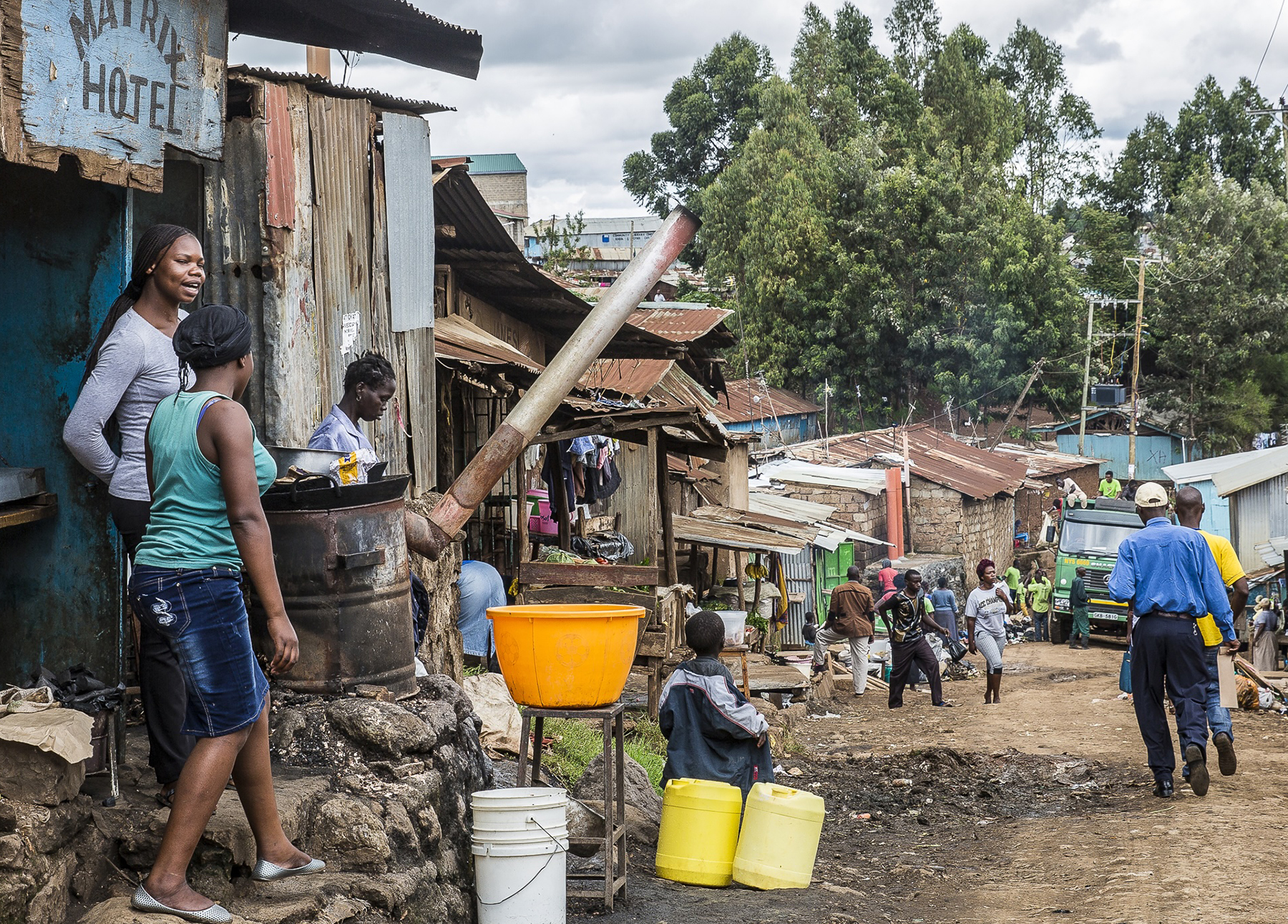
Informal settlements often have limited access to basic services like water and sanitation. This lack of infrastructure increases health concerns while decreasing economic growth for residents in these settlements.
The United Nations estimates that more than 1.1 billion people around the world live in settlements without basic infrastructure services. As part of the U.N.’s Sustainable Development Goals, reducing poverty and eradicating informal settlements and their accompanying poor conditions would help improve health and education while reducing inequality.
Installing water and sanitation infrastructure would greatly improve the lives of residents. However, assessing infrastructure deficits in these densely packed, amorphous settlements has long been a challenge, one that the research team is tackling head-on.
In contrast to the team’s approach, some researchers and development practitioners in past efforts have leaned on top-down efforts for infrastructure plans, including a heavy reliance on socioeconomic measurements or well-known yet ill-fitting engineering solutions that do not work in established neighborhoods.
Better data means better solutions
In sub-Saharan Africa, a geographic swath of land that includes all African countries south of the Sahara Desert, fast urbanization has created scores of informal settlements.
But like any neighborhood, informal settlements can vary widely.
“People think of … informal settlements as very dense places in the middle of cities. Those places are actually quite rare,” said Luis Bettencourt, Ph.D., a professor of ecology and evolution at the University of Chicago and lead author of the paper.
He said most informal settlements without access to infrastructure are peri-urban neighborhoods, located on the edges of established cities. “Part of the problem is that people are settling before these cities are expanding their infrastructure.”
Bettencourt previously worked in these informal settlements, collaborating with residents on various urbanization projects. Traditionally, these projects used top-down infrastructure plans that were not suitable for the unique neighborhoods. He noted that many of these projects were based on the socioeconomic status of residents, discounting their access to established infrastructure systems.
He said that a person in an informal settlement can be both poor and have access to water and sanitation, adding that these communities might not need certain infrastructure interventions.
He and his colleague, Nicholas Marchio, a research data scientist at the University of Chicago’s Mansueto Institute for Urban Innovation, wanted to look at access to infrastructure in a different, quantitative way. They focused on evaluating infrastructure access by using physical, proximity characteristics instead of an economic measure of poverty.
They worked with Slum Dwellers International, an organization that works within neighborhood communities to improve the lives of residents in informal settlements. As part of its work, SDI creates maps of communities to help with infrastructure projects.
The team used SDI maps along with OpenStreetMap data – a geographic dataset of streets around the world. Along with these local datasets, the researchers primarily relied on high-precision satellite-derived data, capturing sub-meter scale resolution. These immense and highly detailed datasets allowed the team to zoom into neighborhoods, breaking them into block-sized chunks.
Seeing the blocks and street access was an a-ha moment for Bettencourt.
“It’s not the geometry of the block that’s important,” he said. “It’s the relationship of the street and the infrastructure networks to the building.”
 Luis Bettencourt
“It's an interesting example of what can be done when you have both citizen science and also very advanced, usually government-funded science like satellites to map where streets and building footprints are,” said Shoshanna Saxe, Ph.D., P.Eng., an associate professor of environmental engineering at the University of Toronto. She was not involved in the study.
“It's an interesting combination to get big mapping data at a fine-grained scale of how the world is built, and especially in places where governments don't necessarily have complete data or the resources to get complete data,” she added.
Good mapping reveals gaps
Urban environments can be very dense, and streets can sometimes be limited. To calculate a number to represent infrastructure access, Bettencourt said the team focused on each building’s proximity to the street, or the topological distance.
Instead of measuring “as the crow flies,” the team looked at how complex it would be to connect each building to the street. For example, if a building’s underground infrastructure might have to connect through multiple other buildings to reach the street, the block was considered complex.
Each block was then assigned a number that represented the worst-case scenario for how hard it would be to connect all buildings to any street-installed infrastructure.
“This gives us an objective way to look at this problem, which is physical, instead of a socio-economic objectification of poverty,” Bettencourt said. He added that the approach in evaluating access and sustainability differs from what is usually done by planners, U.N. agencies, and nonprofits.
“I think it's a really interesting paper. It's an interesting metric,” Saxe said. “The practical question becomes: How do people use it?”
She noted that while this block-scale value can be helpful when thinking about infrastructure access, there are caveats.
“If what we're talking about is development or well-being – sustainability, access to services, education, wealth, maternal survival rates, any of those things – we have to be careful about diverting our attention too much to the proxy measure,” she said. “The road access or street access is a very good proxy for infrastructure delivery because of the way we build modern infrastructure. But there are other ways to build infrastructure, and there are other ways to deliver service.”
Bettencourt agreed, adding that it is important to consider engineering solutions that preserve the history and community of a settlement while allowing it to evolve. “That’s the ultimate objective,” he said.
He also noted that there is an economic incentive for engineers to think about innovative ways to address these infrastructure gaps because there are millions of such neighborhoods experiencing similar problems, which require innovations in engineering design and operations.
Once engineers develop a sustainable infrastructure solution for one of these blocks, the method could be replicated in millions of other blocks around the world, said Bettencourt. “There's a market for innovation.”

Get ready for ASCE2027
Maybe you have big ideas like the ones in this article. Maybe you are looking for the right venue to share those big ideas. Maybe you want to get your big ideas in front of leading big thinkers from across the infrastructure space.
Maybe you should share your big ideas at ASCE2027: The Infrastructure and Engineering Experience – a first-of-its-kind event bringing together big thinkers from all across the infrastructure space, March 1-5, 2027, in Philadelphia.
The call for content is open now through March 4. Don’t wait. Get started today!