 Courtesy of Granite Construction
 The Big Sur region in California has a long history of wildfires and landslides.
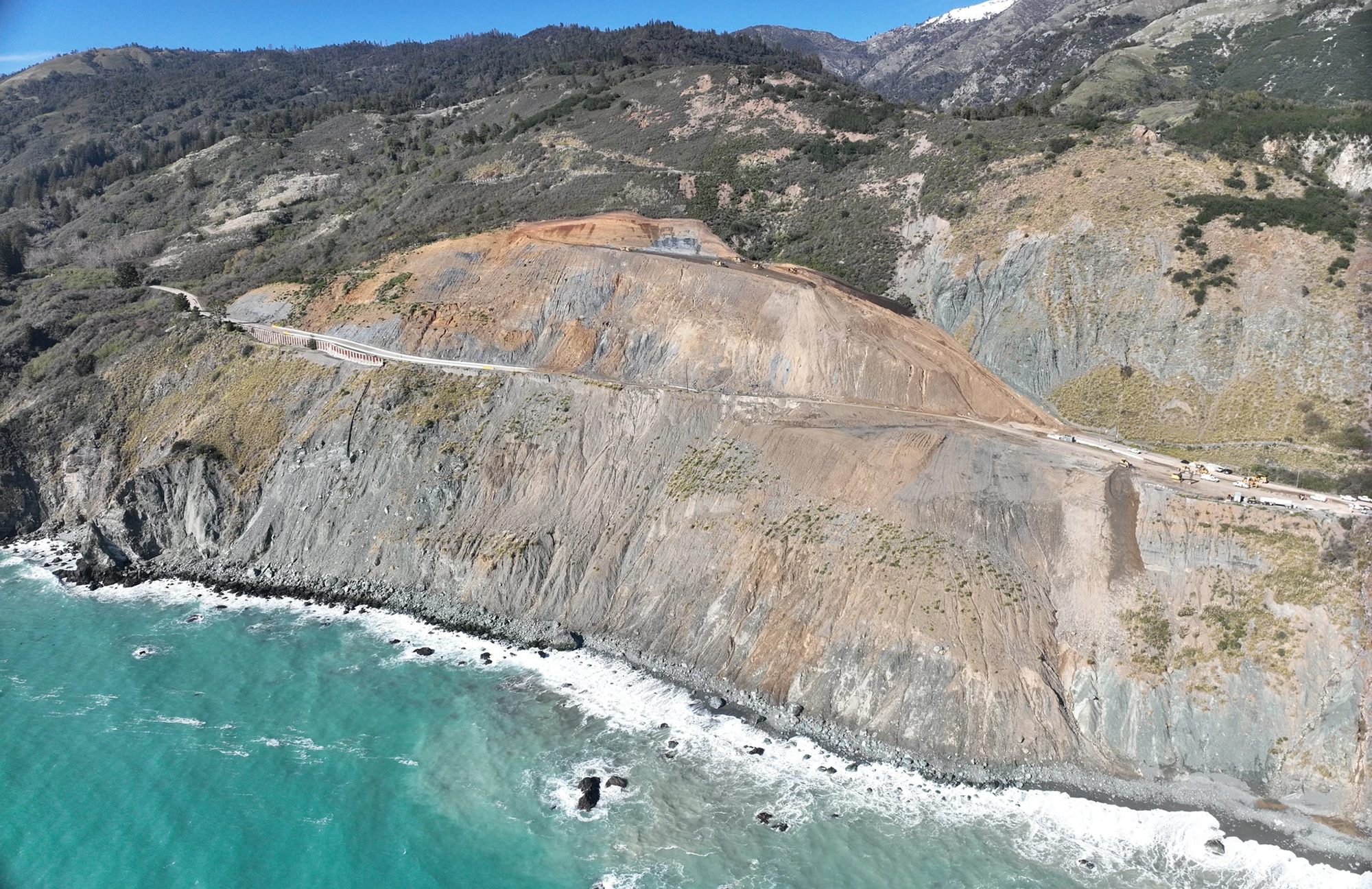
But the past few years have been particularly active, with a series of landslides shutting down the scenic coastal Highway 1 and presenting a major challenge to the California Department of Transportation.
Further reading:
- What did engineers do when a massive landslide blocked a road in Denali National Park?
- 1.1-mile tunnel to make highway safer would be California’s longest
- In landslide-prone areas, earthquake effects can extend for years
Victor Devens, P.E., and his maintenance engineering team at Caltrans are typically charged with restoration after each incident, and Papich Construction, acquired by Granite Construction in 2025, carried out recent landslide mitigation projects that helped lead to a full reopening of the storied highway.
Challenges in landslide mitigation
Keith O’Connor, project manager at Papich, said the nonuniformity of the mitigation projects at each slide across a distance of just 10 or so miles was a significant challenge. Paul’s Slide, for example, was a straightforward mitigation project with a vertical cut and hydroseeding along the way to encourage plant growth. But a similar straightforward path would not work at Regent’s Slide, which proved to be the most challenging, representatives from Caltrans and Papich said.
 Courtesy of Granite Construction
“Regent’s was a completely different animal,” O’Connor said. “It was a lot more steep with a lot more rock.”
The teams agreed on a top-down removal to gradually stabilize the steep slopes of the Santa Lucia Mountains.
“If you start a cut at the bottom of the mountain, it’s going to make that landslide more active and probably going to make it fail,” O’Connor explained. “It's better to start from the top down.”
Caltrans also needed standard road-grade slopes for landslide mitigation. The agency was equipped with information about the geology and different rock formations, which helped. “We relied on Caltrans to tell us how long that rock has been there, what they expect it to do, and that dictated to us how we can cut so we don’t always have to drill and blast,” O’Connor said.
Challenges at Regent’s Slide
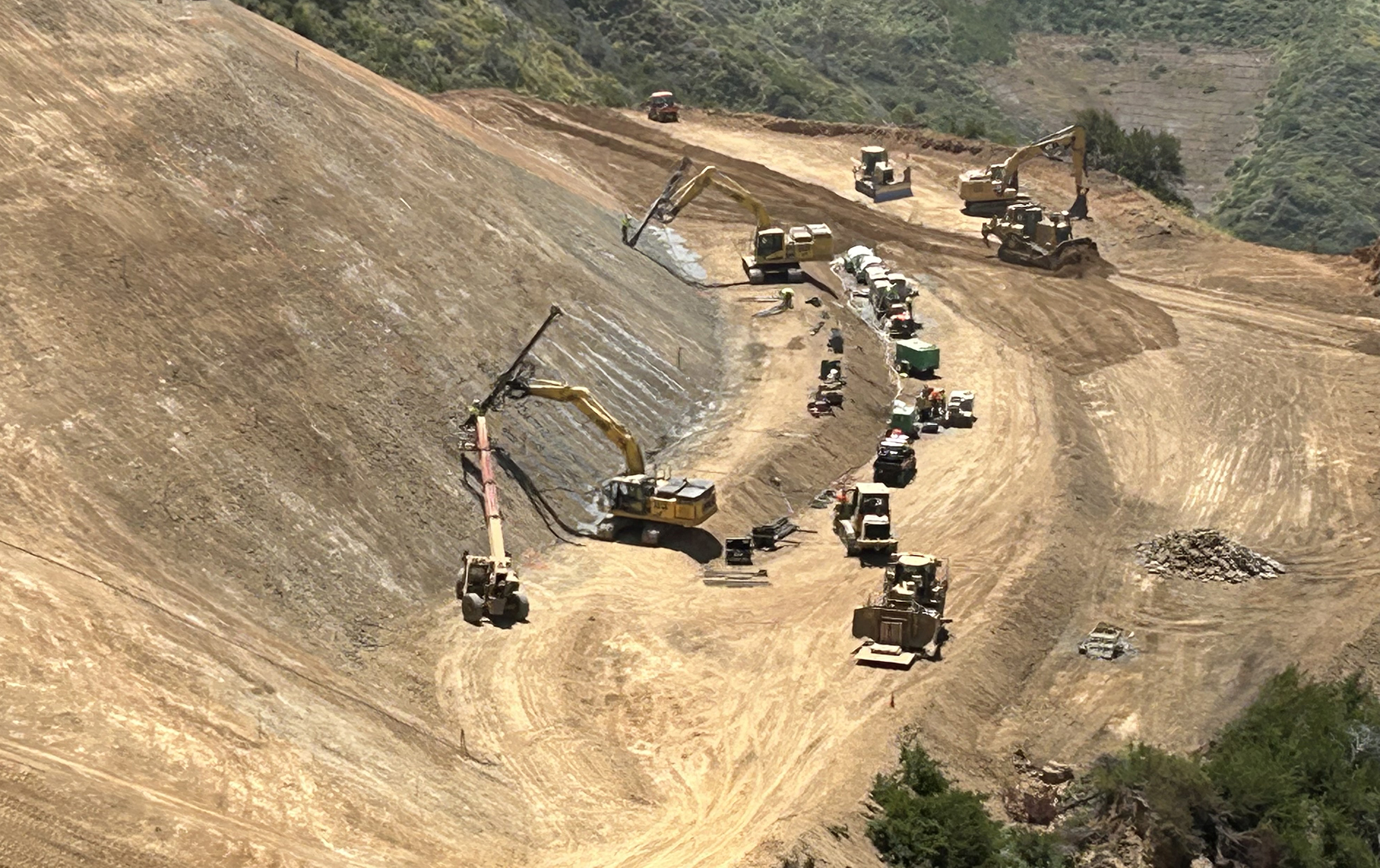
At Regent’s, the idea was to use small bulldozers and spider excavators to clean up the slide and remove the material as they worked down the mountain to reestablish the roadway. The teams hoped for a relatively straightforward process. “All went well until we hit a rocky block layer,” said Devens, the maintenance engineer for the north region of District 5.
Working with the rocky layer was dangerous. “The geotech team called it like playing Jenga,” Devens said. “You stack the blocks, and when you remove them, you introduce some kind of instability.” Sudden, large releases of the rocky block layer would put operators and equipment at risk.
To solve the challenge, the team initially decided to make a larger cut behind the rocky layer, working around the problem. But three subsequent cuts were unsuccessful. In the middle of the fourth one, the cut started to mobilize – material was actively moving.
It was back to the drawing board to strategize about what might work for slope stabilization.
“In the landslide mitigation business there’s not really a fixed set of plans. It’s more of a design-build as you go along,” O’Connor said. Papich and Caltrans worked together to figure out plans, including the slopes for the stabilization of all areas affected by the landslide.
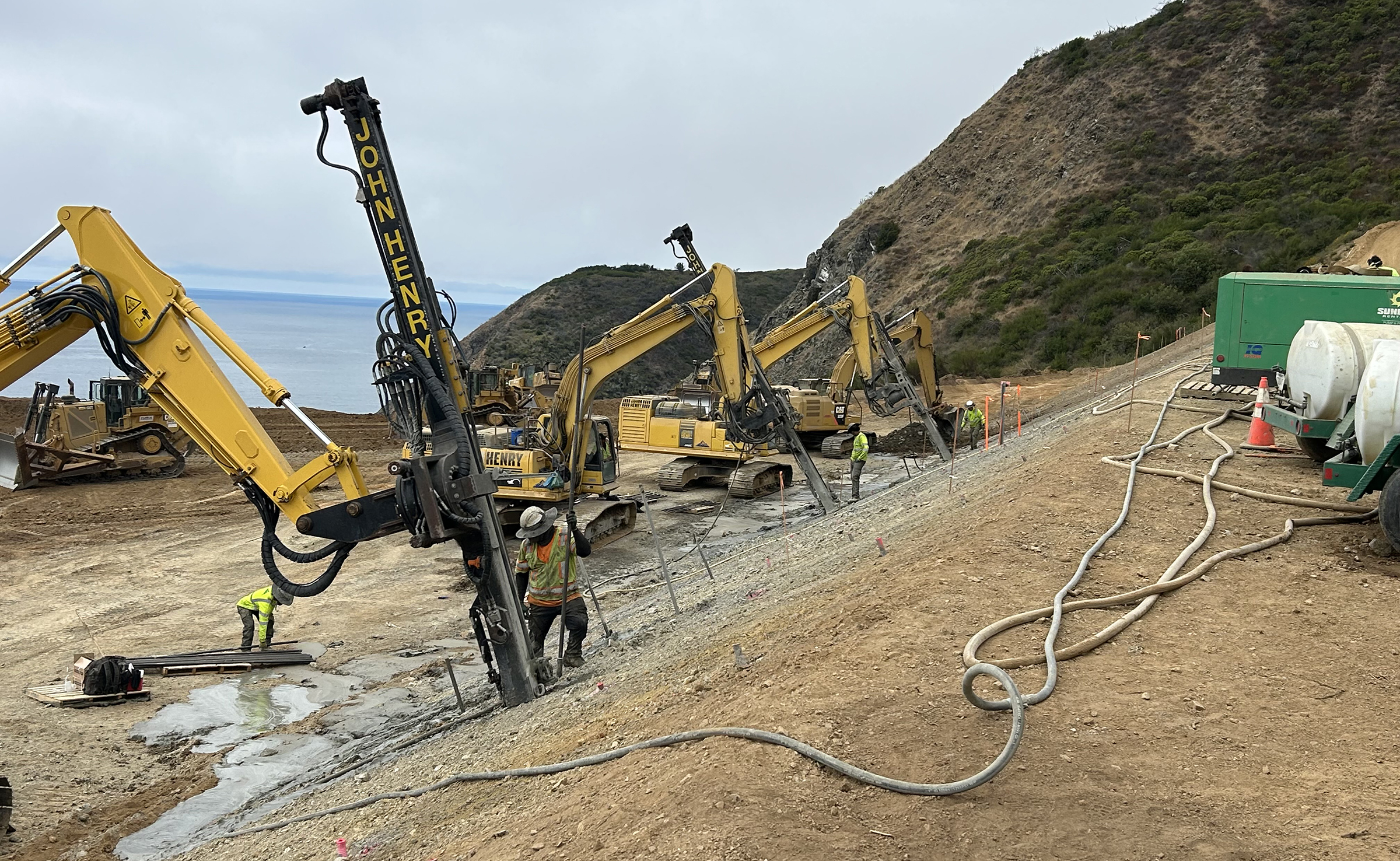
As part of the successful solution, the Papich team drilled and grouted 4,600 shear dowels up to 60 feet long into the slopes. These were in a 10-by-10-foot grid to tie layers of the hillside together and reduce the risk of future slides. The structure pinned the slope in place so the team could cut underneath.
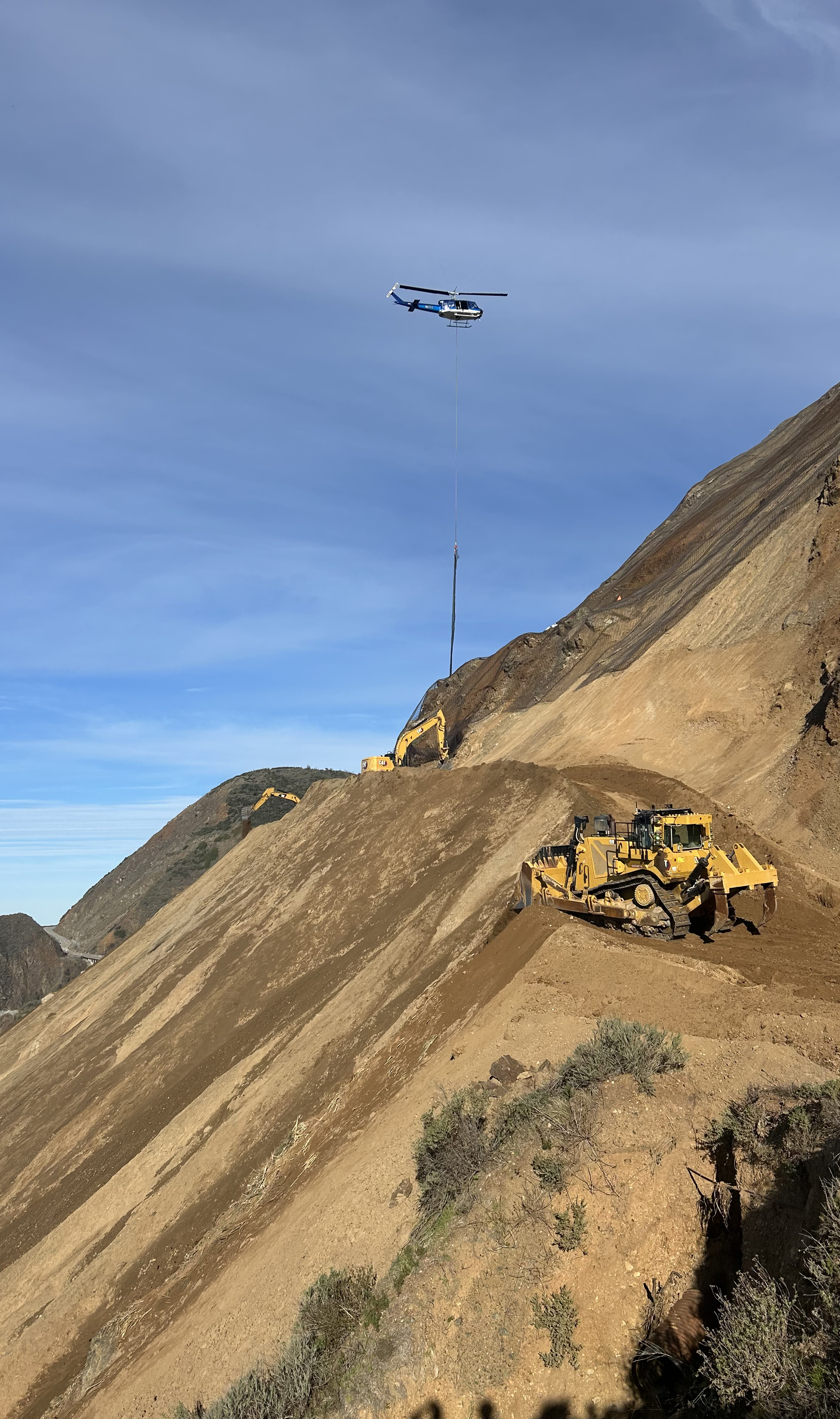
When workers reached the ends of the dowels, instead of cutting through the rocky layer, they installed a cable net drapery system. “We worked around and then in front of the layer and then continued with our original strategy of just cleaning up the slide,” Devens recalled.
Because the drainage culverts that run underneath the mountains in Regent’s Slide had become clogged due to vegetation debris, the restoration project also involved adding more drainage capacity with new larger culverts on the south end of the slide, Devens said. The original 30-inch corrugated steel pipe was upsized to a 39-inch inside diameter high-density polyethylene pipe. In addition, the teams regraded the catchment areas on the north end of the slide to ensure water would flow as it should.
Use of technology to address challenges
“The most significant challenge in the landslide mitigation business is that you never know what the mountain is going to do,” O’Connor said. “We can always predict what might happen, but we really don’t know until it actually happens.”
To enable more accurate predictions, both Caltrans and Papich shot prisms, a surveying method to gauge shifts in the landscape. Caltrans took frequent readings with slope inclinometers and shape arrays, which helped the team understand what was going on underneath the surface in real time.
The team also used drones to conduct frequent aerial surveys and to take additional measurements of ground movements. Frequent fog was a problem when using drones for measurements.
Because the mountain was very active, teams had to frequently pause work if it was deemed unsafe. Moving large volumes of debris from the Regent’s Slide alone was a challenge for worker safety. Papich moved a significant amount of that material using robots, a likely first for the area. Remotely operated bulldozers and excavators, controlled from a safe distance, allowed excavation to continue during periods of heightened geologic risk, Caltrans reported.
 Courtesy of Granite Construction
A helicopter helps maneuver drapery on the steep slopes of Regent’s Slide.
Devens said original modeling estimated the debris to be between 750,000 cubic yards and nearly 1.5 million cubic yards. He estimates the number will be much less than a million cubic yards, given adjustments to the slope geometry.
“We are waiting on a follow-up topographic survey to compare the topography just after the slide occurred to its current state to determine the actual yardage moved,” Devens said.
An eye on the future
While wildfires and landslides have been a regular part of the Big Sur landscape for a long while, when planning for the future, it helps to understand how the newer ones have happened.
Dimitrios Zekkos, Ph.D., P.E., F.ASCE, professor of civil engineering at the University of California, Berkeley, researches climate adaptation techniques to prepare infrastructure for natural disasters.
Along with co-editor Timothy Stark, Ph.D., P.E., BC.GE, Dist.M.ASCE, a professor of geotechnical engineering in the civil and environmental engineering department at the University of Illinois Urbana-Champaign, Zekkos and several co-authors published Highway 1 Rat Creek Embankment Failure: 2021 Reconnaissance and Analysis for ASCE.
Focusing exclusively on the 2021 Rat Creek slide, Zekkos said it was a classic example of a “hazard cascade,” where there’s not one trigger but a series of unfortunate events. First, the Dolan Fire in the summer 2020, started by an arsonist, burned more than 120,000 acres in the area.
The loss of vegetation meant little resistance to water flow, which was a problem during the atmospheric rivers in 2021. In addition, a large natural dam that had been formed by tree trunks had been accumulating sediment and holding water back, and that also broke during the storms.
The resultant debris flow took out the surface water drainage systems, and the continued precipitation resulted in the highway embankment being overtopped and washing out – along with the underlying ground – into the Pacific Ocean.
While this particular series of events was specific to the Rat Creek landslide, it doesn’t take much to see similar patterns playing out up and down Highway 1. Zekkos points out that the highway is a very long infrastructure system and it’s easy to play whack-a-mole addressing every landslide or natural disaster as it comes.
But preparation for climate adaptation has to look at systemwide components instead of adopting a piecemeal approach, he said. Data gathered from technologies such as satellite and uncrewed aerial vehicles can feed advanced artificial intelligence models that are able to pinpoint sediment motion activity, for example, more precisely and with fair warning.
“We can get an assessment of the entire system, as opposed to only focusing on the areas that are clearly problematic and not noticing other changes around that might be similarly problematic,” Zekkos said.
The key is to detect small changes over many miles that add up. Such an approach also recognizes that the drainage basins along Route 1 are different in size, geology, topography, and susceptibility to landslides and debris flows.
“Highway 1 is right on the edge between the mountain and the ocean,” O’Connor pointed out. “As much as those mountains continue to move, it’s a miracle the road is still there.”
Devens said the area is used to the challenges. “Living with geologic instability is something we have learned to do,” he said. “There’s really no economical way to ‘fix it.’ The price tag would be too large.”
To see more photos and videos from Caltrans about the project, click here.
 Courtesy of Granite Construction