 UC Law San Francisco
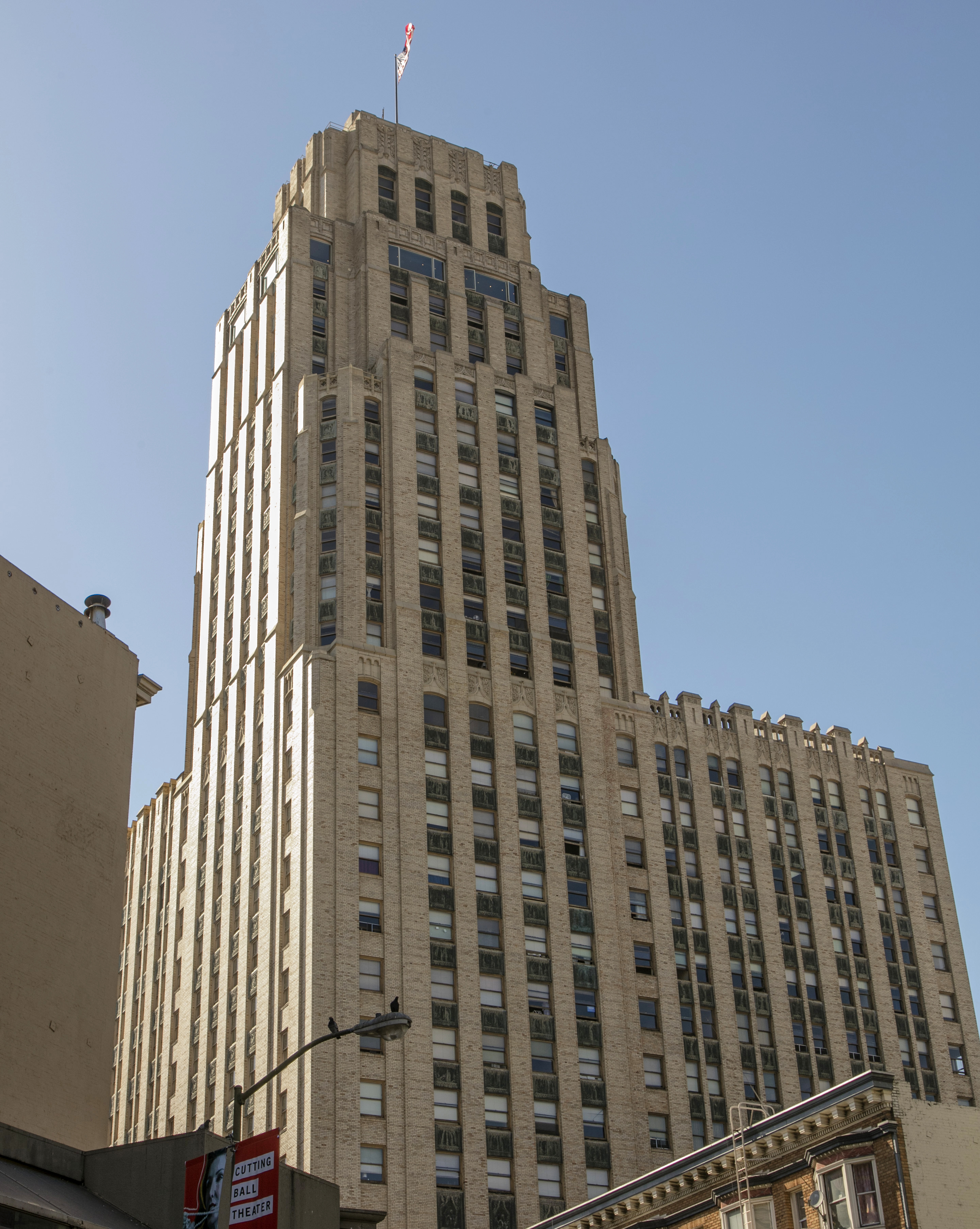
 The seismic retrofit of a 28-story historic tower is advancing the “academic village” plans of the University of California College of the Law, San Francisco.
Together with a new purpose-built building at 198 McAllister Street, the historic tower at 100 McAllister will add housing, academic facilities, and other amenities that will be available not just for students, faculty, and other professionals from UC Law SF. Instead, these academic village buildings will also provide services to students and others from the University of California, San Francisco; San Francisco State University; the University of San Francisco; the University of the Pacific Dugoni School of Dentistry; and other colleges and universities in the Bay Area.
Further reading:
- Strengthening seismic resilience in Haiti after devastating earthquakes
- How to integrate resilience into structural design
- Open-source simulation software boosts earthquake resilience
The idea is that good candidates for students or professionals at these various schools might decide to study or work elsewhere because of the high cost of living in the San Francisco area, said Anders Carpenter, AIA, LEED BD+C, the higher education practice leader for the West Coast at Perkins&Will, the architect for 100 and 198 McAllister.
The multischool approach of an academic village, however, aims to “provide housing that is below market rate and amenity rich so that (students and others) can feel that the value proposition of moving to this region … will be worth their while so the schools can retain top talent,” Carpenter explained.
New and renewed
The 15-story 198 McAllister building, also known as the Academe, was completed in 2023 and provides 656 affordable housing units as well as simulated courtrooms, classrooms, and amenity spaces. San Francisco-based Rutherford + Chekene was the structural engineer for the new construction posttensioned concrete building.
Work on the historic 100 McAllister building is expected to be completed by fall 2027, at which point the new facility will provide 80 residential units, each offering between one and six bedrooms. The lower podium floors will include academic, administrative, and amenity spaces.
The effort to seismically retrofit and strengthen 100 McAllister’s concrete-encased, steel-framed structure has been especially challenging because the building features “the most discontinuous structural system that I’ve ever worked on,” noted Daniel Bech, P.E., S.E., M.ASCE, a principal and technical director at San Francisco-based Holmes, which served as engineer of record on the project.
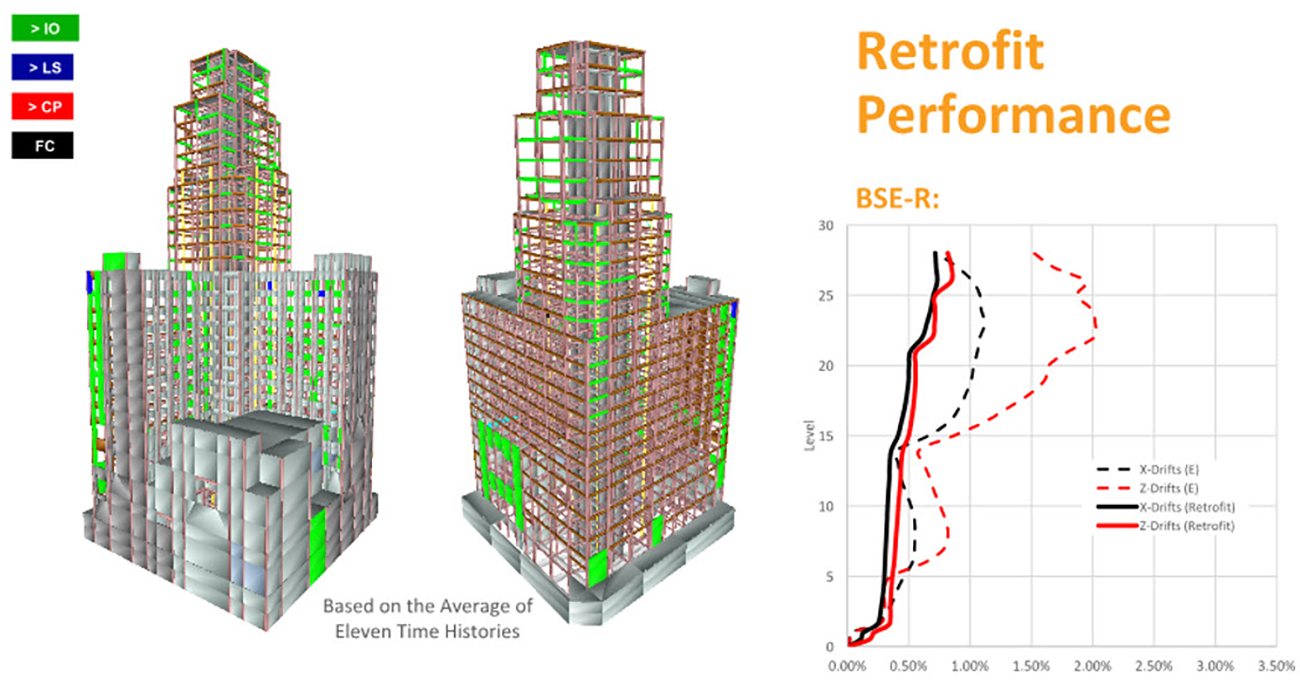
“Fifty percent of the columns don’t continue down to the foundations,” Bech added. “They just sit on transfer beams, and some of those beams sit on other transfer beams.”
In addition, the Art Deco/Gothic Revival building, which is listed on the National Register of Historic Places, has an unreinforced masonry and terra cotta facade that had to be protected and preserved as much as possible – for aesthetic reasons as well as to obtain specific historic tax credits that helped fund the project, Bech said.
Completed in 1930, the original building – which served as both a church space and a hotel – featured a 14-story podium structure, L-shaped in plan, and a 14-story tower that rises from the southwest corner of the podium. The podium includes a five-story open space called the Great Hall, which covers roughly half the podium footprint and served as the sanctuary for the Methodist church – the original owner of 100 McAllister.
The tower steps back as it rises and represented “the weakest portion of the building and the most significant seismic deficiency,” Bech noted. That was because the structural system featured a series of steel gusseted moment-connected perimeter frames called wind braces that extended up from the base but stopped at level 20. Consequently, only the masonry facade itself provided lateral force resistance for the top eight floors of the tower, Bech explained.
Other challenges included a large wall that ran north-south through the first several levels of the podium, essentially bifurcating the building and inhibiting circulation on those levels, plus the large open area of the Great Hall. That space created the need for many of the aforementioned transfer beams, including one massive, 66-inch-deep beam that supported all the podium levels above the fifth floor, Bech said.
Successful strategies
To bring this historic structure up to current seismic codes, the project team – which, in addition to Perkins&Will and Holmes, included general contractor Plant Construction, geotechnical engineer Langan, and historic preservation architect Page & Turnbull – developed a number of strategies.
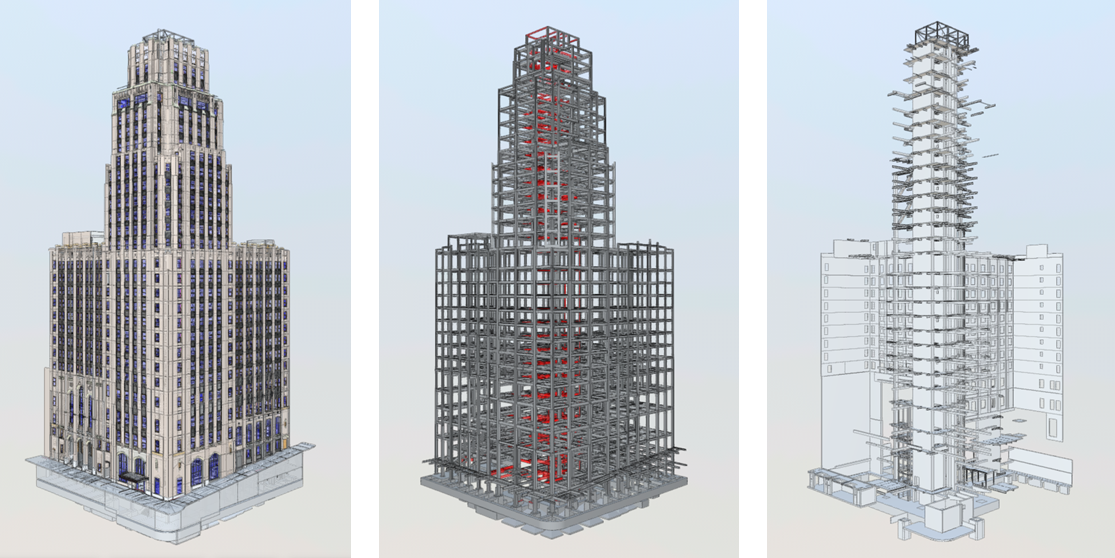
One of those involved the addition of new 24-inch-thick concrete core walls, which replaced the original stair enclosure. The core’s original 6-inch-thick walls were significantly undersized in thickness and length.
The new core extends to the rooftop and is supported by outrigger columns with buckling restrained braces. The outriggers, which feature concrete-encased W14 x 286 elements, extend from the foundations up to level 20. The steel BRBs are found at levels 16 to 20 and work to stabilize and stiffen the new core, which has a relatively narrow aspect ratio even though it is much wider than the historic stair enclosure.
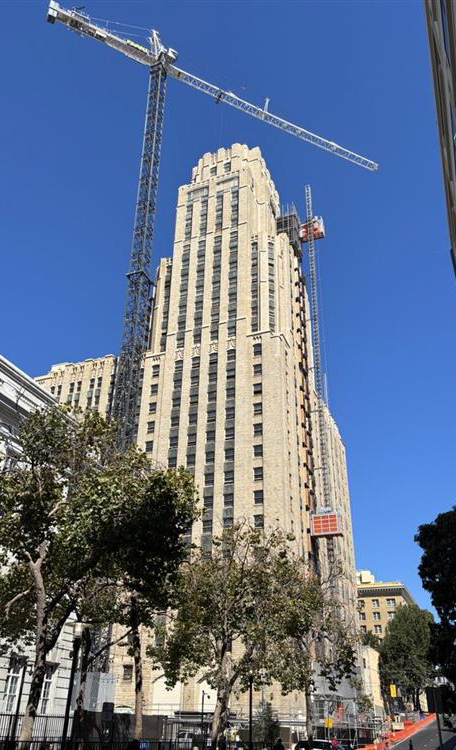
The construction of the new core involved the use of self-climbing formwork within the existing structure, which required that several of the original transfer beams be removed or cut and resupported. To do this work, all the floor plates in the tower had to be cut out, which meant that during the core construction phase the walls of the tower’s top three levels were unbraced for wind and seismic loads and needed to be shored up, Bech said. Also, additional temporary bracing was required at level 19 to support the attachment for a tower crane.
All structural connections during the construction phase were made to the steel or concrete portions of the building, not to the historic brickwork.
Despite the various challenges in using the self-climbing formwork, Plant believes the strategy cut as much as 10 months or more from the construction schedule, Bech noted.
Although the project team initially hoped to avoid installing any new structure within the Great Hall, this proved impossible, Bech noted. So two concrete blade walls, 24 inches thick and five stories tall, were constructed to help support that large open space and its enormous existing transfer beam.
 UC Law San Francisco
In addition, a series of new concrete collector beams and shear elements were installed in exterior walls to work with the new core, and a 6-inch-thick concrete overlay was applied to a nonhistoric masonry wall at the back of the podium section, along with other improvements.
At the base of the building, a new 6-foot-thick mat foundation was installed beneath the new core walls but above the historic foundations, which involved pyramid-style concrete shapes. Because the soil beneath the new mat was considered liquefiable and unable to support the potential seismic loads, permeation grouting was used to strengthen that material and to transfer seismic loads to the more competent Colma Formation soil farther beneath the site, Bech said.
During this foundation work, however, significant groundwater issues were discovered that required extensive dewatering as well as the monitoring of adjacent structures for differential movement, he added.
As the work on 100 McAllister continues, Bech stresses the importance to the project of the close relationship that developed between the engineers, architects, and contractor. This included weekly constructability meetings to help determine “how we would retrofit the tower in the most cost-effective manner,” he explained.
 Holmes