Chris Bird, TYLin
 In 2015, then-President Barack Obama commemorated the 50th anniversary of the civil rights-era marches in Alabama with powerful words.
Recalling the Selma-to-Montgomery marches, he said: “You are America. Unconstrained by habit and convention. Unencumbered by what is, ready to seize what ought to be. For everywhere in this country, there are first steps to be taken, there is new ground to cover, there are more bridges to be crossed.
“America is not the project of any one person. The single most powerful word in our democracy is the word ‘we.’ ‘We the people.’ ‘We shall overcome.’ ‘Yes we can.’ That word is owned by no one. It belongs to everyone. Oh, what a glorious task we are given to continually try to improve this great nation of ours.”
Further reading:
- Frank Lloyd Wright’s small but iconic theater at Taliesin restored
- Efficiency is key to $1.3B expansion of Chicago’s historic O’Hare airport
- How engineers saved Washington, DC’s, iconic Arlington Memorial Bridge
Now those words have become the architectural centerpiece of the new Barack Obama Presidential Center, an $850 million campus opening in Chicago this month after nearly five years of construction. The presidential center, which will consist of a museum, a forum, a public library branch, a plaza, gardens, and even a basketball court, is on the city’s South Side along a newly landscaped edge of Jackson Park, the site of the 1893 World’s Columbian Exposition (also known as the Chicago World’s Fair).
“I hope those words will now serve as a beacon – of courage and hope – not just for this community, but for the next generation of Americans looking to chart their own course,” Obama said on the center’s website.
A team of designers and engineers faced the challenging task of making the beacon a literal reality.
 Chris Bird, TYLin
 Designers at Tod Williams Billie Tsien Architects sought ways to carve into and articulate the solid mass of the center’s main tower and were inspired in part by early Chicago skyscrapers that featured carved ornamentation at the top.
“We also wanted something that would embed meaning into the material of the building, something that spoke to what this building was about, what the center was about,” TWBTA’s Brian Abell said. “Words and speeches and writing have always been a critical part of President Obama’s career.”
The speech screen also faces south and west and provides solar shading for the president’s study and seminar room on the seventh floor and for the eighth-floor public Sky Room.
Making the letters structural
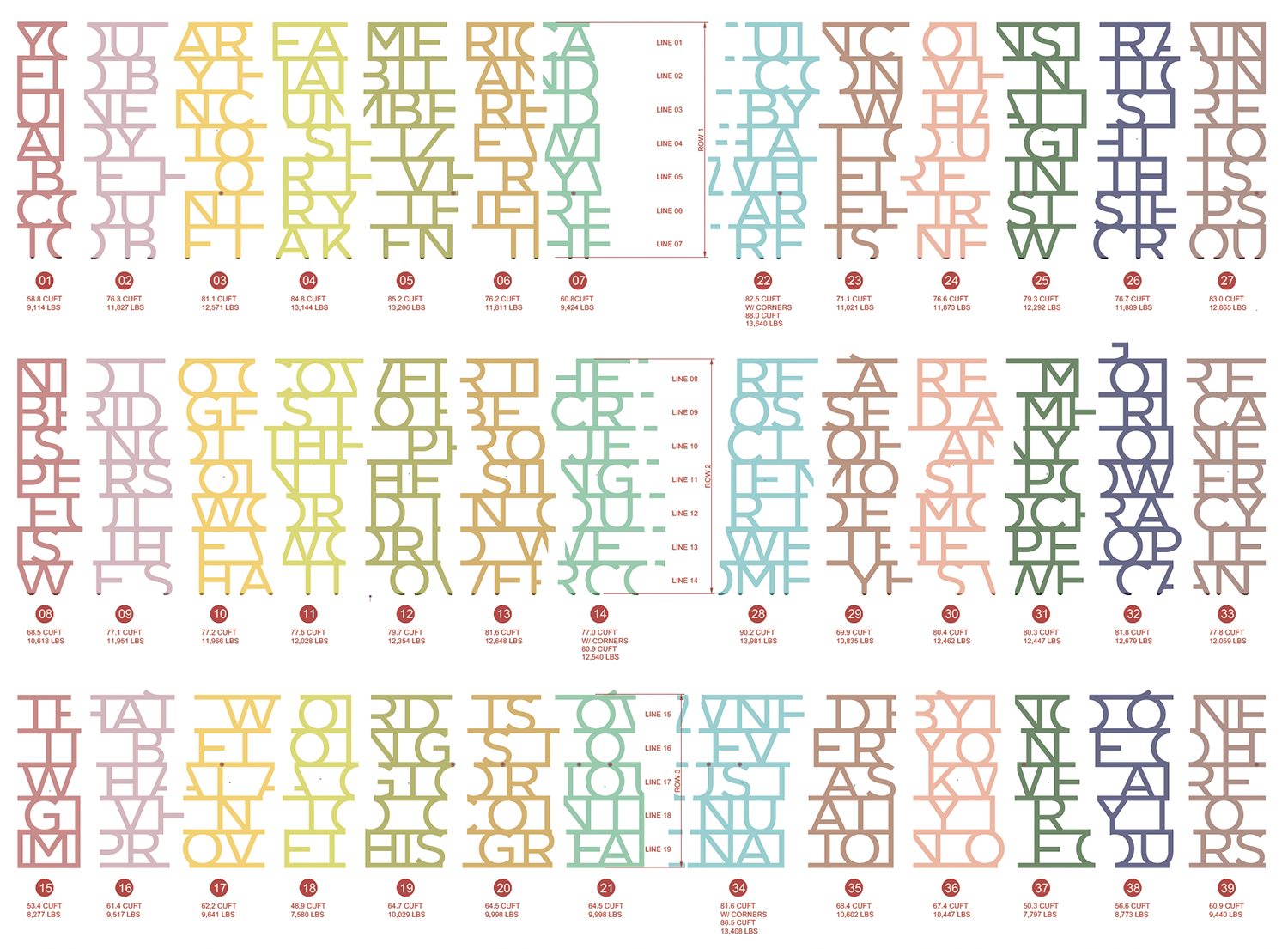
The letters of Obama’s speech have been mounted on a series of 39 panels, measuring 20 to 30 feet tall and 9 to 13 feet wide, weighing 11,000 to 20,000 pounds, and about 1 foot deep. They crown the presidential center’s 225-foot main tower, joining at the building’s southwest corner.
The two elevations of the speech are approximately 84 feet tall and 67 feet wide, said Alexander Kitchin, founding partner and director of design for Virginia-based Fine Concrete, a custom concrete fabricator. The letters are cast in Obama’s Gotham typeface, a signature of his 2008 campaign.
They appear just 2 inches thick from inside the Sky Room – but widen to 7 inches when viewed from outside the building.
To cast the forms in an environmentally efficient manner, Fine Concrete developed a special tool.
“So, what we decided to do was, in essence, build what I think is the world’s largest letterpress, just like you’d use for printing,” Kitchin said. Fine Concrete used a six-axis robot to rout out 24 letters in the positive – omitting only X and Q, which do not appear in the speech. From there, several negative copies could be made.
“And so you line up all the letters, put blockouts in as required, and then cast that panel, pull the concrete out, take off the letters, rearrange, put new letters on, cast another one,” Kitchin said.
The result was 52 molds made from 24 letters with minimal waste.
Engineering structures out of letters
Working with facade consultant Heintges, TWBTA wanted the letter screens to function as architectural elements that spanned with minimal, unobtrusive brackets. When viewing the city from the seventh or eighth floors, “we didn't want you looking out and seeing a bunch of steel,” Abell said. But this created structural challenges.
Within each panel, Fine Concrete and its engineering partners had to figure out how to take two lines of structure that Kitchin said were “in essence, two beams that were built in the shape of letters” and then “turn these letters into structural elements.” This was difficult because the letters making up each panel didn’t line up in neat vertical or trusslike forms. The presence of curving letters made the load path tricky to resolve.
The original plan called for the letter panels to be stacked on top of one another. “But what happened is that the bottom panel would receive the load from the two panels above, and those S’s and G’s that they were talking about – they would be squished by all of the load from above,” said Vassil Draganov, P.E., a principal based in Washington, D.C., for TYLin’s buildings sector, the structural engineer of record for the panels.
Chris Bird, EIT, M.ASCE, a senior engineer for TYLin’s buildings sector, said what followed were “months where we were in an intellectual struggle with this beast of a project, and we had to come to a solution with pretty rigid parameters, right?”
The letter cross section and font were defined. But the team could change how the panels were supported off the building.
The facade is composed of three rows of panels. Each panel is “supported by two load-bearing connections back to the main structure and two lateral braces,” Kitchin said. “None of the braces are visible from the interior, with clear spans of nearly 39 feet.”
Bird said that from a lateral perspective, “it’s really like a static scheme of a bridge turned on its side. It’s like a cantilever bridge system. If you draw it flat horizontally, you would think it’s a bridge, and then we rotated it up at a 5-degree angle onto the tower. That was the way we were able to mitigate that issue of the ‘squishy’ letters, as I called it.”
TYLin also developed new computational design tools, using Rhino and Grasshopper to aid the analysis. The firm ran preliminary linear studies to better understand how load forces would flow through the panels and where the right connection points needed to be on the ledger lines.

That helped the team home in on a handful of potential solutions that it could then model precisely with a full nonlinear analysis that could run all design load combinations.
“We had to really push this material into its nonlinear, post-cracking ductility behavior in order for the spans to work,” Bird said.
The firm also brought in two additional engineering firms, C&E of France and Maffeis Engineering of Italy, to conduct an independent peer review of the structural analysis. Discrepancies could be addressed and resolved among the firms.
“This project was too important not to do that level of rigor in the analysis and the quality control,” Draganov said.
Working with UHPC
Bird described the project as likely the largest scale use of architectural ultra-high-performance concrete in North America, and he said the material was essential to making the project work.
The UHPC used on the project features small-diameter, stainless steel fibers – about a half-inch long – to give the concrete significantly higher tensile strength. It was, Bird said, “the perfect mixture between stone and steel. You get the durability of stone and the tension and flexural capacity of steel.”
But its fabrication posed a challenge, said Craig Heaney, president and owner of Envel Facade, which installed the panels, because “the stainless steel specific gravity is heavier than concrete. So normally, where you would vibrate concrete a little bit, to get it to flow and give a good finish, we couldn’t do that in this case because if you did it, the stainless steel fiber would precipitate out of the mix and fall to the bottom of the form.”
Envel experimented with different formulations and admixtures in the concrete mix. Superplasticizers helped keep the mix flowable, and retardants were added to keep the concrete from setting too quickly during the complex pour. The installation lasted from late December to the end of February.
Rebar was added to support letterforms at places where loads were strongest. On difficult junctions and curves, Envel used a combination of standard half-inch rebar along with seven-strand posttensioned wire.
Each panel was attached to a lifting frame, which took the flexural load of the panels as they moved from horizontal to vertical. The frames had modular clips to accommodate different panel shapes.
A granite facade
The Obama Center’s tower is clad in thousands of pieces of Tapestry and Kitledge granites quarried by A. Lacroix Granit in Canada. The granite was installed by Akron, Ohio-based S.M. Haw Associates Inc., a multiservice structural firm that specializes in foundation designs, industrial renovations, and veneer cladding anchorage design.
Most of the granite pieces are about 9 feet, 4 inches tall and 3 inches thick. Further, the pieces have three widths, ranging from 2 feet to 4 feet, 6 inches. There were 1,390 unique configurations for the stone, accounting for different sizes and different conditions across the building’s complex, angled geometry. There were at least 923 unique stainless steel elements that had to be fabricated to build out the anchoring system.
Dave Cremers, P.E., M.ASCE, president of S.M. Haw, said architects had established roughly nine pattern rules about how the stone could be joined in an acceptable pattern; the firm even hired a computer scientist to write an algorithm to create a pattern that would meet all the design guidelines.
The anchors holding the stone to the concrete building had to be adaptable enough to handle shifting dimensions and tolerances – including granite panels at the corners of the building, which had to be cut an inch thicker than other panels to better resist wind pressure. But the tolerances for the exterior face of the stone panels had to be within 1/16 inch.
“The way I describe what we have to do is we have to wrap a pineapple with aluminum foil, but the aluminum foil has to be smooth,” Cremers said.
For Bird, the project is a full-circle moment – he served as an intern in the Obama White House in 2016, an experience that solidified his desire to pursue a career in engineering rather than law.
The panels are likely to be one of the signature elements of the campus.
“If you think about it in a different way,” Draganov said, “physically, these could be the longest-surviving pieces of that building because this is the most durable element of that building. Steel will rust. Concrete will degrade. Glass will break. But in 200, 300 years, these panels will still be in the same condition.”