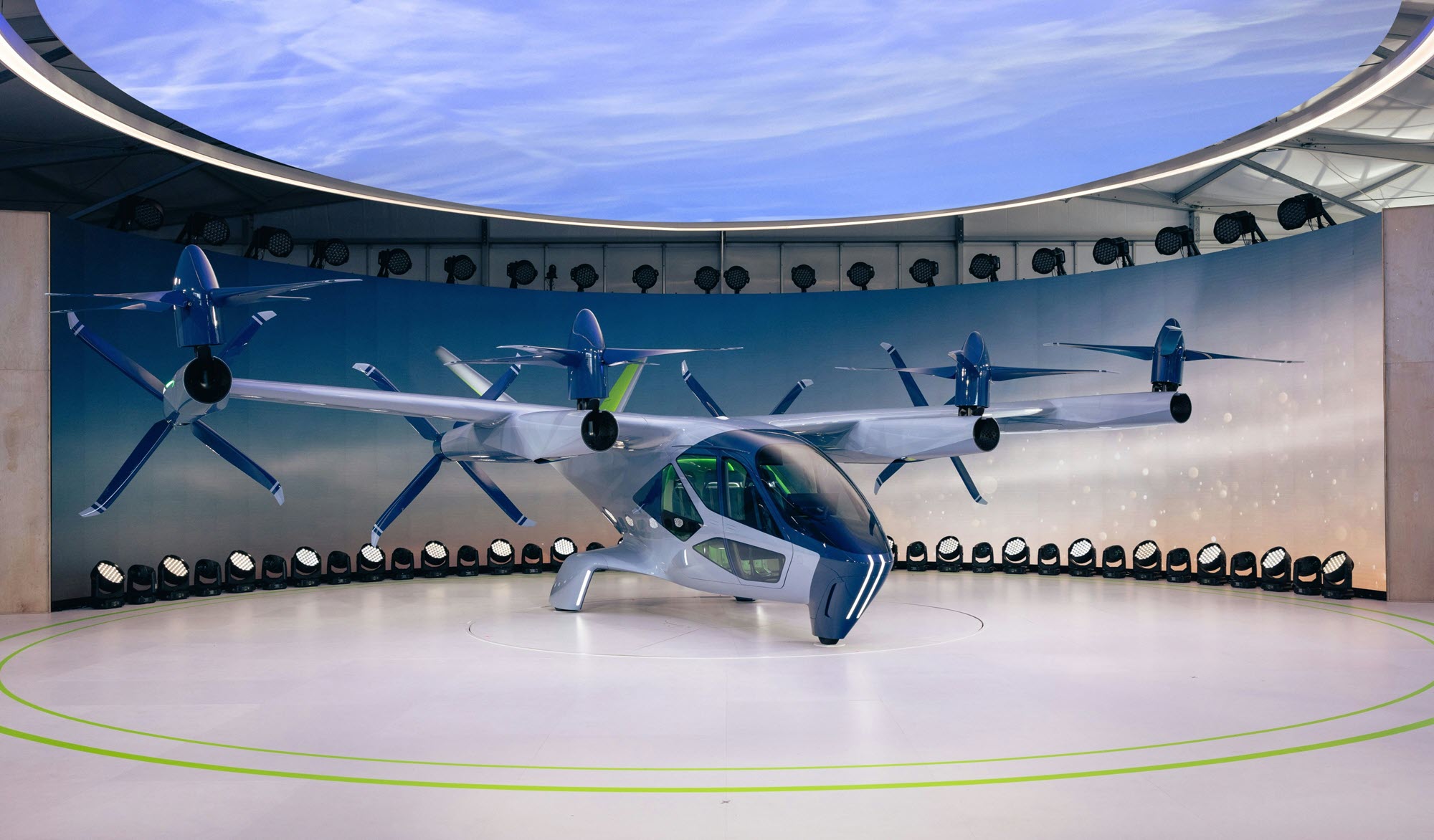
Millions of Americans find themselves trapped in gridlock every day.
Once contained by rush hour, the flexible commute times offered by remote and hybrid work have made traffic an all-day affair.
But that doesn’t mean we can’t adapt. There is a new way around – or over – the roads: electric vertical takeoff and landing aircraft.
Known as eVTOLs, these aircraft offer an environmentally friendly option for air travel with significantly less noise pollution than traditional aircraft. And their potential as future air taxis has received plenty of attention. The vehicles are prominently featured in Cities of the Future, ASCE’s 2024 IMAX movie.
“Our commuting traffic is getting more and more congested on the ground,” said Tor Anderzen, P.E., F.ASCE, a civilian community planner for the U.S. Air Force in Anchorage, Alaska, and ASCE Region 8 director. “I think there’s definitely – at least looking from the sidelines – a ready and waiting market for short- to midrange transportation.”
Because eVTOLs are relatively new technology and their place in the air travel market is evolving, there is a long road ahead before air taxis become reality.
But that doesn’t negate their potential.
Exploring new opportunities
Although much of the eVTOL buzz has surrounded air taxis, these aircraft have plenty of other uses.
“What I am most excited about is regional air mobility and how both eVTOLs and electric conventional aircraft will expand the capability, while reducing costs and emissions, to reach into suburbia and rural America to connect people and services,” said Leah Whitfield, C.M., ACE, president of The Aviation Planning Group in Littleton, Colorado. “Cargo is likely the most near-term use case for eVTOLs.”
That use, along with air taxis and others, is being explored by the U.S. government.
In June 2025, the Federal Aviation Administration launched the eVTOL Integration Pilot Program, or eIPP, supporting the development and deployment of Advanced Air Mobility vehicles in the National Airspace System. There are eight pilot programs under the eIPP testing various uses for eVTOLs, including emergency medical response operations, autonomous flight technologies, and more.
“For a long time, the focus for eVTOL aircraft was on short urban trips,” said Amiy Varma, chair of the ASCE Transportation & Development Institute’s Aviation Council and president of AAAJ in Fargo, North Dakota. “But now their use is being explored for regional passenger transport, cargo logistics, medical and emergency services, and also as airport shuttles.
“Regional routes often offer better economics and fewer infrastructure constraints than dense city-center operations,” he said. “However, the demand and technological feasibility will restrict predominant use to short urban trips for some time.”
Because eVTOLs are quieter than traditional aircraft, integrating them into air traffic could make them less intrusive in areas that already experience noise pollution from aircraft. Vertical takeoff also lowers spatial requirements for these aircraft.
Varma noted that although eVTOLs are quieter than helicopters, they are not silent, meaning public perception will largely depend on acceptance of externalities weighed against environmental benefits.
Details of these externalities and the required infrastructure aren’t quite ironed out.
And achieving that hinges on technology, infrastructure, and policy.
Is our infrastructure ready?
Gaël Le Bris, CM, ENV SP, P.E., vice president and technical fellow at WSP in the U.S., noted three major factors to consider with eVTOL infrastructure: energy systems, ground facilities, and airspace.
All three of these come with their own challenges.
Many of today’s airports and helipads aren’t currently equipped to handle eVTOLs, making it difficult to scale the technology. A big part of that is power.
“Some metropolitan areas are already well provided in heliports,” said Brendan Smith, P.E., ENV SP, M.ASCE, lead consultant and aviation engineer in New York City for WSP in the U.S. “Even so, part of these aviation assets are not adapted to serve high-intensity operations with eVTOL aircraft.”
Whitfield said the industry has been focused on the idea of building new vertiports, facilities specifically designed to support eVTOL aircraft. And although many facilities are unprepared for eVTOLs, there are over 5,000 airports in the U.S., only 500 of which are primary airports.
“Most [airports] are underutilized assets that exist today and can broadly support eVTOL operations,” she said.
She recommends shifting the near-term focus to electrical capacity and infrastructure before building new facilities.
“For eVTOLs to serve airports and even cities across the country, we must evaluate the existing electrical capacity and capability and quickly move to improve this infrastructure for charging,” Whitfield said. “While electric vehicles have been adopted fairly broadly across the country and significant federal grant programs have helped communities create EV charging stations, we have not on a large scale focused on the electrical infrastructure needed at airports.”
Many airports are beginning to integrate electric ground support equipment, which already means evaluating available power and building charging stations. Adding eVTOLs into the mix would require more power, more infrastructure, and more planning.
“We have fuel available at many airports, but charging stations for eVTOLs are not yet built out, and I know some of the designs and concept development that I've seen requires (building) charging facilities for eVTOLs as well,” Anderzen said.
EVTOLs are only part of the world’s shift to electrification. With EVs becoming more popular and data centers being built across the country, civil engineers are already concerned with strain on power grids.
“Two key considerations must be addressed when planning (electric airport) infrastructure: whether it can be effectively accommodated within the constraints of the airport environment and whether the existing electrical grid has sufficient capacity to support the additional load associated with eVTOL operations,” Smith said.
Even with careful planning, technology develops fast. As eVTOL technology evolves, the process of updating existing and building new infrastructure will have to keep pace.
Anderzen pointed to EVs as an example of infrastructure lagging behind technology.
“We’ve seen generations in new charging types or charger types,” he said. “And sometimes, the change in charging capabilities needed is so fast that by the time we’re done building charging stations, they’re already outdated. They weren’t planned for the right electrical loads.”
Le Bris emphasized that preparing for eVTOLs isn’t just “installing an electric charger near a helipad.”
There are many other factors involved.
“While early deployment of eVTOL aircraft could bloom from existing aviation procedures and infrastructure assets – including those developed for helicopters – enabling more advanced concepts of operations at scale will require developing further and adapting the urban aviation infrastructure, integrating it with ground mobility, and also introducing new flight procedures and air traffic management,” he said.
Smith expects the process of building and updating eVTOL infrastructure to be area dependent.
“In cities like New York and Boston, where both the airports and surrounding urban environment are already heavily developed, integrating eVTOL infrastructure requires thoughtful planning,” he said. “In some cases, this may involve adapting existing structures, such as parking facilities or other buildings, for different uses to support both current uses and the introduction of eVTOL operations.”
New technology, new policy
Like any new technology, getting eVTOLs off the ground is a matter of policy.
“EVTOL aircraft are expected to become part of broader multimodal transportation systems, where passengers can seamlessly combine air taxis, public transit, ride-hailing, rail, micromobility, and walking within a single journey,” Varma said.
It’s an exciting idea. But integrating an emerging technology so deeply into society isn’t a small effort.
According to Varma, the primary risks associated with eVTOL integration are collision hazards, system failures, cybersecurity threats, weather sensitivity, and urban ground risk. There are also capacity challenges: low-altitude congestion, vertiport limitations, and air traffic management.
So, their successful integration depends heavily on how they are managed as part of the broader air transportation landscape.
And with current technology and infrastructure, eVTOLs are confined to shorter trips in areas that can provide spaces for them.
“But that’s also where the greatest challenges are from an airspace perspective because that’s where the airspace is more congested,” Anderzen said.
According to Varma, the biggest policy hurdle is aviation certification.
“Traditional aircraft certification frameworks are not fully suited to eVTOL designs, which often combine characteristics of helicopters, airplanes, drones, and electric vehicles,” he said.
Although eVTOL policy is still in the making, the federal government is investing in projects that could give new insights into these aircraft and how they should be managed.
“The good news here is that the eIPP, established under President Donald Trump’s Executive Order 14307, is directly intended to accelerate safe eVTOL deployment, generate real operational data, and shape the national regulations that have been missing,” said Le Bris.
What’s next for eVTOLs?
Although eVTOLs are still emerging, things are picking up.
“We have seen reduction in the number of original equipment manufacturers,” Whitfield said. “As with any new technology, not all survive, but we are seeing those that have begun to move more rapidly.”
Now, the eVTOL industry is moving toward the early commercialization phase, Varma said.
“Regulators are exploring pathways for limited commercial passenger and cargo operations before full-scale deployment,” he said. “Industry sentiment has shifted from ‘if’ eVTOLs will enter service to ‘when’ and ‘where first.’
“There is a promising outlook that by 2030, the industry will move from prototype demonstrations to successful certification to viable (but limited) commercial service to appropriately scaled operations,” he continued.
Le Bris noted that it is important to remember that eVTOLs aren’t intended to replace mass transit or other aircraft; they have different flight performance, capabilities, use cases, pricing, and capacity.
“It will be a ‘crawl, walk, run’ journey,” he said. “Then, recognize the challenges ahead and maintain a holistic vision of what needs to be done.”

Feed Your Brain
Interested in eVTOL or other advanced technologies? ASCE2027: The Infrastructure and Engineering Experience is a first-of-its-kind event bringing together subject-matter experts from all across the infrastructure space, March 1-5, 2027, in Philadelphia. So, yes, we know you’re excited about the Philly cheesesteaks, but ASCE2027 also is the perfect place to satisfy your appetite for learning.
Technical deep dives. Infrastructure expertise. Come feast!
Learn more about ASCE2027: The Infrastructure and Engineering Experience.