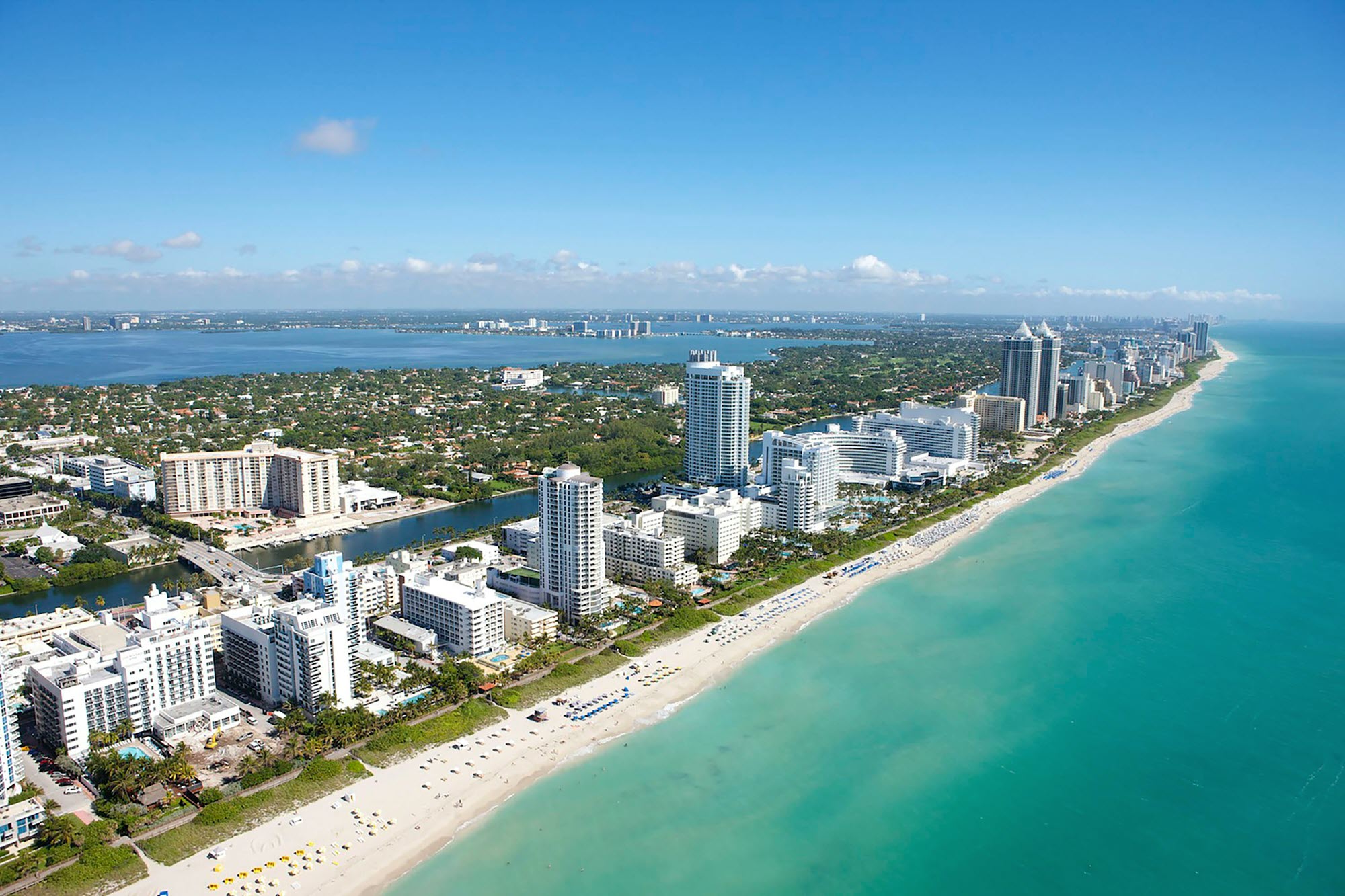
Coasts are sinking around the globe.
That means loss of land, threats to infrastructure, and more frequent, extreme flooding in coastal communities, affecting some of the places many U.S. residents will flock to over the Fourth of July holiday.
Sea-level rise is one of two major factors causing cities to go under water. Since 1880, the global mean sea level has risen approximately 8-9 inches. And sea-level rise isn’t going away.
Along U.S. coasts, many areas are dealing with the impacts of rising waters. The East Coast and Gulf Coast face the highest projected sea-level increases in the nation, with the former estimated to rise 10-14 inches and the latter 14-18 inches by 2050. The West Coast, the Hawaiian coast, and the north coast of Alaska are also at risk, making it a nationwide problem.
In many locations, the effects of sea-level rise are exacerbated by land subsidence: the sinking of land.
Some areas along the coast are still experiencing minor land uplift, like Maine, where the earth’s crust and mantle are adjusting to the melting of continental ice sheets, Walker noted.
“Cities appear to be ‘sinking’ with respect to the sea, but what is going on is, in fact, a complex interplay of geologic, climatic, oceanic, and human-driven processes,” said Dan Walker, Ph.D., P.G., M.ASCE, a professional geologist with EA Engineering, Science, and Technology Inc. and co-chair of the ASCE-NOAA Task Force on Climate Resilience.
Other areas – on top of sea-level rise – are feeling the effects of sinking land.
“So, land goes down and sea level goes up – that increases the problem for coastal communities,” said Thomas Wahl, Ph.D., an associate professor in the University of Central Florida’s department of civil, environmental, and construction engineering. “It means more likely flooding, more frequent flooding, or more extreme flooding, depending on whether we are talking about minor high-tide flooding or hurricane-surge-related flooding. Both of them will be impacted with higher sea levels.”
Subsidence isn’t perfectly even, either, Wahl noted. And that can have additional impacts on infrastructure.
“Land goes through phases of very rapid subsidence, and then you have phases of slower subsidence,” he said. “That has to do with seismic activity and how we extract ground fluids, for example. And the spatial aspect is important because buildings do not like spatially variable settlements.
“Infrastructure is not often built to experience subsidence in one corner and none in the other corner, so that is where we will see additional impacts of the spatially variable subsidence that can lead to cracks in roads and runways of airports, buildings being damaged, and, in the worst case, collapsing because the foundation fails because of the uneven settlement of the ground,” said Wahl.
Land subsidence isn’t limited to coastal cities, but when sinking intersects with sea-level rise, its impacts can be felt more intensely.
Exploring solutions
One area facing a high rate of relative sea-level rise is the Virginia Coastal Plain. In Hampton Roads, Virginia, one of the most vulnerable regions in the country, relative sea level is expected to rise over 4 feet from 2000 to 2100 – an “intermediate” projection. Other projections for that time period range from 2.6 feet to 6.97 feet.
And that increase could put up to 176,000 Hampton Roads residents at risk of displacement.
The impacts of relative sea-level rise are already visible. In Virginia Beach, an independent city within the Hampton Roads area, floods have become a common event – even without the presence of a storm.
“We’ll get dry day or sunny day flooding,” said McKenzie White, P.E., M.ASCE, an associate environmental engineer at Brown and Caldwell who works in Virginia Beach. “So, it’s a gorgeous day out, but because tides are rising and things are just hitting the way they are, we’ll have roads that are completely flooded on a normal day.”
Land subsidence is a very significant factor in Hampton Roads’ rate of relative sea-level rise. Subsidence has a variety of causes, but in this case, much of it comes from human activities, specifically the extraction of groundwater from the Potomac Aquifer.
Fortunately, the Hampton Roads Sanitation District is taking steps to address the human-caused part of the problem. The area’s Sustainable Water Initiative for Tomorrow aims to replace the groundwater that has been removed from the Potomac Aquifer by pumping water treated to meet drinking water standards back into the ground.
“One of the things that causes the land subsidence is that we lose the pressure from the overdrawn aquifers,” said White, a 2026 New Face of Civil Engineering. “By repumping that back in, it allows the pressure to be maintained, and it keeps our land from going down quite as fast.”
The causes of relative sea-level rise vary from region to region. For Hampton Roads, subsidence is the more immediate challenge. In coastal Florida, it’s rising waters.
So, solutions are focused primarily on keeping the ocean at bay.
In one part of Florida, water pumps are helping cope with the problem.
“The land is, for the most part, staying in place,” said Tzufit Boyle, P.E., F.ASCE, a senior discipline engineer at H2M architects + engineers in South Florida. “It is subsiding a little bit. But we have to deal with sea-level rise more urgently – it’s already here, and we need to push the water away.”
The region is also utilizing nature-based solutions.
“One thing we’re looking at doing is more of the living shorelines, where we’re putting a breakwater further out or putting in plants, like seagrass and mangroves, that will hold the structure of the land a little bit more and also hold back any waves that are coming because what we do experience is a lot of shoreline erosion,” said Boyle.
Wahl sees solutions combining nature-based solutions and traditional infrastructure as an option with much potential.
“Infrastructure needs to be upgraded,” he said. “That includes drainage systems, existing levee structures, and natural features such as wetlands, mangroves, oyster reefs, coral reefs. We want those to be healthy and in good shape because they are our first line of defense.”
Another strategy is building infrastructure above the reach of floods.
“If we have electrical components, we’re going to put those up above the ground because we’re counting on flooding,” said Boyle. “If we have roadways that we’re designing, we’re not designing them for current levels, we’re designing them for an elevation that’s a little bit higher.
“That’s something that should affect every coastal environment,” she continued. “And you do have to think forward to the fact that you’re designing that roadway crest maybe a little bit higher than what you currently see. So, predictive analysis needs to be done rather than just on what you’re building for today.”
In New York City, flood resilience is a top priority. Although the city’s rate of subsidence is lower than some other coastal cities, increased flooding due to sea-level rise has brought flood prevention into the spotlight, particularly the devastation caused by Hurricane Sandy in 2012.
A study by the Regional Plan Association found that by 2040, up to 82,000 New York homes could be lost due to flooding, which would exacerbate the housing shortage in the region.
To address the flooding problem, the city is working on multiple coastal resilience projects – including Manhattan’s “Big U” – across the different boroughs, which focus on adding raised parkland, floodwalls, and floodgates around the city.
“There are some pieces of construction (of the Big U) that have been started that are going to be consistent with building essentially a moat around New York City and then dealing with the management of stormwater from inside it,” said Craig Musselman, P.E., Dist.M.ASCE, principal engineer at CMA Engineers.
Are tourist economies safe?
Failing to adapt to the challenges of relative sea-level rise not only threatens residents of coastal communities, but the economies of these regions as well.
Many coastal areas rely on tourism as part of their economic models. In 2024, over 14 million people visited Virginia Beach, spending $2.6 billion, which provided $3.9 billion in total economic impact. The economic boost sustained 19% of all jobs in the city.
Miami drew over 28 million visitors in 2024 and received $22 billion in visitor spending. New York City saw nearly 65 million visitors that year, which brought $79 billion. And many other coastal areas see great benefits from tourism.
But after a certain point, increased hazards and the loss of natural attractions like beaches could deter visitors. Issues like uneven subsidence make it difficult for cities to plan for the tourist season.
“In Virginia Beach, we’re starting to get in the hot season, and our boardwalk is incredibly busy,” White said. “If one part of the boardwalk is starting to collapse because the land under it is starting to go, that’s a problem. And if you have trouble accessing areas – because we’re seeing more sunny day and tidal flooding – people can’t get to their vacation homes. …
“When we have that kind of uncertainty and are losing land to the water, we’re just losing (economic) opportunity that we don’t need to,” White said.
Along coastal Florida, a large portion of tourism is driven by beachgoers. And losing beaches means losing visitors.
“If the beaches start to disappear, it’s less appealing for the tourists to come,” said Wahl. “And I think that is a similar problem for most other states in the U.S. and many countries across the globe that rely on beach tourism.”
Daily flooding could also tarnish tourists’ experiences outside of the beach.
Cities flood “based on how the water is moving that day or what the tides are doing or if you have a king tide that comes in where you have assets that are getting flooded seemingly without any cause,” Boyle said. “If you’re a tourist and you’re coming in and you’re walking around in water that looks questionable because it’s washed around a city street, you’re going to be turned off by that, and you’re not going to want to return.”
One cause of this flooding is under-equipped stormwater systems.
“In a rainstorm during a high tide, one of the things that happens with (coastal) stormwater systems now is that as the tide rises, outfalls can become submerged, flow capacity is reduced, and what is available for storage within their system is taken up by the incoming tide rather than by stormwater, backing up drainage flow in the city,” said Musselman.
To deal with the combined effects of subsidence and sea-level rise, Musselman suggests the future use of smart drainage systems and automated tide gates.
“It’s probably a long-term issue, but some coastal cities are going to need smart drainage systems with automatic tide gates that are controlled by level sensors beneath the city throughout their stormwater system that operate the tide gates,” he said.
Musselman noted that solutions are area-dependent and that some places may also need to pump water out.
Beaches aren’t the only natural attractions at risk. Sea-level rise has an impact on many types of landforms.
Sea-level rise “is going to change some areas that are currently dry land with shallow groundwater into freshwater wetlands,” said Musselman. “It’s going to have a very significant impact on existing salt marshes, and there will be salt marshes migrating inland.”
Everglades National Park in Florida is facing these challenges. Its marshes, mangrove and buttonwood forests, and accompanying wildlife are all vulnerable as saltwater moves farther inland. The Everglades ecosystem contributes over $30 billion to the South Florida economy annually.
Successful infrastructure projects could prevent the effects of sea-level rise from worsening and possibly bring more revenue to tourist areas in the future.
Musselman said that in New York, the addition of parks from projects like the Big U could make the city an even more desirable place to visit.
What’s next for coastal infrastructure?
Land subsidence and sea-level rise have become larger priorities for civil engineers. Many projects are underway across the U.S., and civil engineers are exploring new techniques to increase infrastructure resilience in areas experiencing land loss.
Wahl cited deep foundations as one strategy: “If you use piles and you drill deeper, then you would probably also mitigate some of that effect.”
“We can also make sure that certain parts of our infrastructure, such as utility connections, including water, sewer, gas, and electrical, have flexible connections so that if there is this uneven settlement, it won’t necessarily break,” he said. “It’s the same for bridges, roads, or pipelines.”
And coastal cities are getting more creative – Virginia Beach even purchased a private golf course to transform into a stormwater park so excess water has a place to go.
“If you put your fingers that far apart, a millimeter or 3 millimeters a year is not very much,” said Musselman. “But over 75 years, it’s not insignificant.”
He emphasized that cities aren’t the only places affected by sea-level rise and land loss; it’s something that impacts every coastal community.