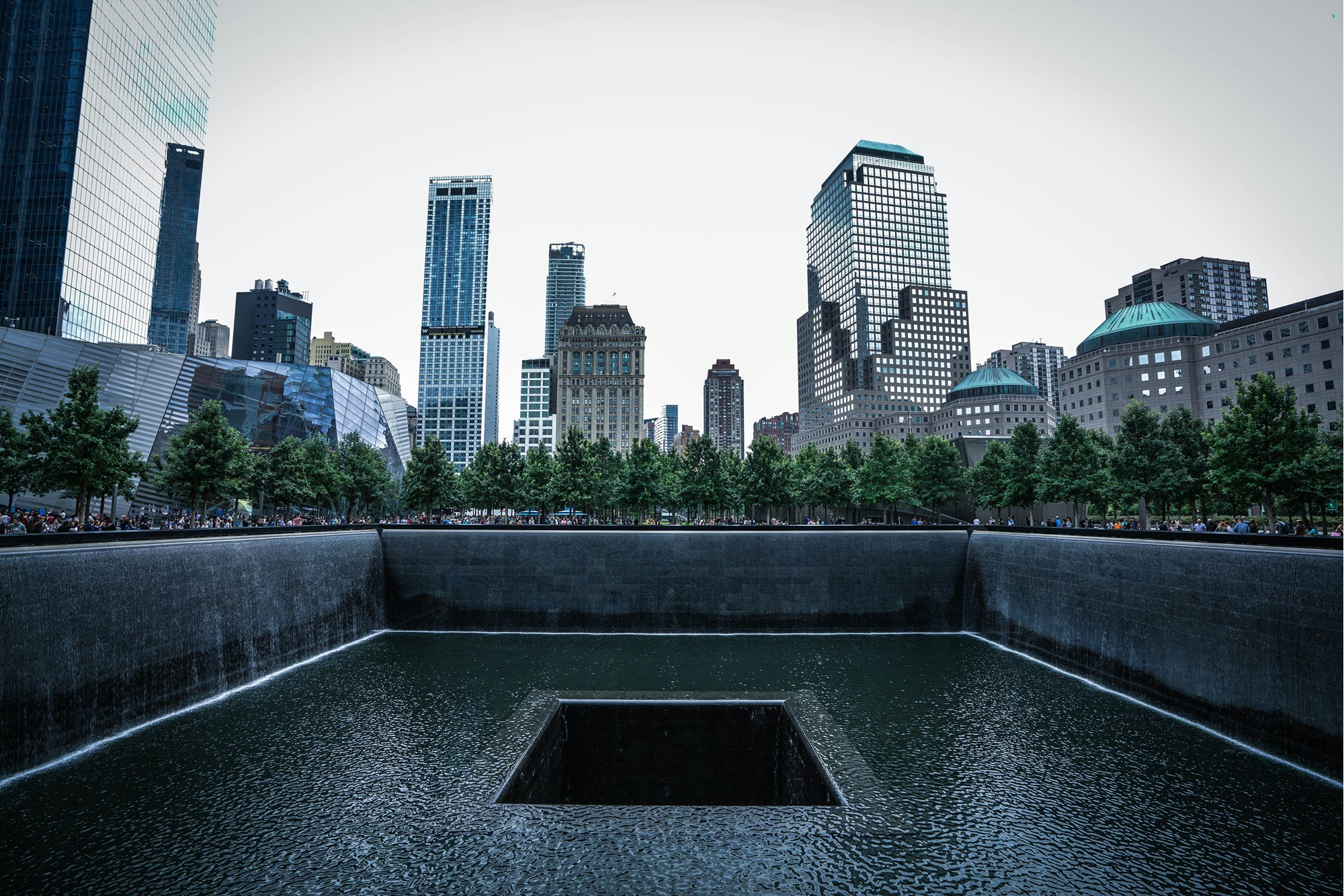
Today’s young professionals may have no memory of the Sept. 11, 2001, terrorist attacks. But that doesn’t mean they lack connections to the tragedy.
Bennard Amponsah, M.ASCE, a structural engineer at Simpson Gumpertz & Heger, was born that day.
It’s a bittersweet feeling for Amponsah. As a child, he was aware that something significant happened that day, but he didn’t know exactly what.

“As I grew up, I was kind of scared to know what happened because I didn’t want it to spoil my birthday, in a way,” he said.
But over time, learning about the attacks added a deeper layer to his perspective on that day.
“There was so much loss of life, but that was still the start of my life,” he said. “So, it’s more of a day for reflection to me than necessarily celebration.”
Built into civil engineering
In civil engineering, the legacy of 9/11 is evident in the codes, standards, and design practices that young civil engineers routinely encounter.
“It’s just the unfortunate reality of our industry that building codes and standards are often updated or forged in the wake of tragedies,” said Alex Guzowski, a blast engineer at Arup.
After the attacks, investigations required civil engineers to assess structural damage from a technical angle. The “why” behind the World Trade Center towers’ collapse was heavily probed.
An investigation published by the National Institute of Standards and Technology in 2005 found that dislodged insulation and the ensuing fires played a critical role in the collapse by heating the structural steel to critical levels. Findings from this and other investigations shaped the development of new codes and standards that civil engineers use today.
Further reading:
- Veteran structural engineers reflect on 9/11 and lessons that changed the profession
- The evolution of tall building design after 9/11
- Reflections on the 25th anniversary of 9/11: Share your thoughts

One standard born from 9/11 is Blast Protection of Buildings, ASCE 59-22. The standard “provides minimum requirements for planning, design, construction, and assessment of new and existing buildings subject to the effects of accidental or malicious explosions.” The first edition was published in 2011 after an extensive development process, and it was updated in 2022.
“9/11 brought this blast design much further into the civilian context,” Guzowski said. “Before then, this type of work was more commonly associated with the military, government facilities, and the explosive safety industry. But ASCE 59 really helped bring those protective design principles into a standard that could be used more broadly for civilian infrastructure.”
As a blast engineer working in New York City, Guzowski frequently encounters mentions of 9/11 in his work. Accidental or intentional threats and credible worst-case scenarios are something he and other blast engineers think about often.
“Blast and the larger security field have broad roots, but I would say 9/11 is a defining moment that led to this paradigm shift within the U.S. where, even though I entered the profession more than two decades afterwards, the tragedy still lingers over the work that we do daily,” he said. “Now, security considerations can directly drive the design in the same way that structural calculations or other technical requirements would, whereas before 9/11, this was less common, save for embassies or other high-security areas.
“There is definitely an underlying awareness of the tragedy, and everything that resulted from that is present in our day-to-day conversations,” Guzowski added.
ANSI/ASCE/EWRI 56-10, 57-10, Guidelines for Physical Security of Water and Wastewater/Stormwater Facilities, also grew from security lessons learned from 9/11. The standard has since been revised as ASCE/EWRI 78-24, which considers modern security issues, such as cyber threats that could harm physical systems.
The 9/11 attacks led to updates of the International Building Code. These changes include additional fire safety and evacuation requirements and new structural support requirements for buildings with heights of 420 feet or more.
Additional changes regarding structural elements were included in other standards, such as ASCE/SEI 7-16, Minimum Design Loads and Associated Criteria for Buildings and Other Structures, which has since been updated.
In high-rise buildings, evacuation routes, such as elevators and stairs, can double as cores for the building.
“(The changes can) affect the cores, your lateral system, and how you resist wind loads or earthquake loads,” said Amponsah. “So, if those locations change, well now that has an effect on how your entire building is responding to different types of loads.”
Amponsah doesn’t encounter many direct references to 9/11 in his work, but he views these changes as a “baseline” for standards as time passes.
Changes in codes come from new events or perspectives. And having taken place 25 years ago, 9/11 is now more of a foundation that influences the way civil engineers look at new safety challenges than something evolving, he said.
“It’s something that we have now incorporated into our design codes and in our profession, and because we’ve incorporated it, it’s already integrated,” said Amponsah.
A changing memory
The 9/11 terrorist attacks shocked the world. Although lessons learned are embedded into certain aspects of civil engineering, new members of the workforce don’t necessarily remember that shock.
Like any tragedy, Guzowski expects the memory of 9/11 to evolve and eventually fade. But he doesn’t see its impact on civil engineering going away.
“Speaking specifically to the civil engineering aspect, I think the echoes of 9/11 will absolutely continue to be reflected in our processes, our codes, and best practices,” he said. “But on more of a personal level, I think it’s inevitable that future generations of professionals are not going to have a lived memory or personal connection to the event.
“While they may not recognize where something came from, they’ll still be applying it in the future,” he added.
Guzowski sees Gen Z, whose members are currently taking on early-career roles, as a dividing line between the lived memory of 9/11 and its transition into a tragedy of the past. However, he expects the emphasis on resilience and redundancy in security brought about by 9/11 to persist.
And there is another lesson that particularly stands out.
“In college, we learn a lot about different failures of structures because those are lessons,” said Amponsah. “You look at the Hyatt Regency collapse or the Tacoma Narrows Bridge, things of that nature that were design flaws.
“But I think one of the things that 9/11 can teach us is that you can do everything right, and yet there’s still a chance something might happen to your structure.”