The 1.5 million-acre Barataria Basin estuary – 120 miles long and between 24 and 35 miles wide – unfurls south of New Orleans and is a major commercial fishing hub, producing tens of millions of pounds of fish and shellfish annually.
But the basin, notable for its oysters and shrimp, has been eroding steadily for decades, losing roughly 432 square miles of land since 1932, according to the Barataria-Terrebonne National Estuary Program, making it the second-greatest land loss among coastal Louisiana basins.
Further reading:
- US coastal cities are sinking. What can civil engineers do?
- Effects of rising groundwater levels due to sea-level rise will be many
- Aging US dams pose rising safety risks – how can civil engineers help?
The state planned an ambitious solution as the losses – driven by a variety of issues, including subsidence, oil and gas infrastructure, and extensive levees and dams across the lower Mississippi River – mounted. But then the $2.9 billion Mid-Barataria Sediment Diversion project, which aimed to reverse decades of erosion by channeling sediment from the Mississippi River into the basin, was canceled in July 2025.
Under consideration since the 1980s and in active planning for more than a decade, the MBSD project would have taken advantage of billions in funds from the settlement of the Deepwater Horizon oil spill. That event sent more than 3 million barrels of oil into the Gulf of Mexico in April 2010 and affected more than 1,300 miles of shoreline across five states, according to the National Marine Fisheries Service.
Despite widespread agreement about the severity of the erosion problem, concerns about the impact of the diversion on marine life in the basin – and on the commercial fishing industry that’s part of the lifeblood of the region – led to the project’s demise.
In total, more than $600 million was spent on a project that was never completed. And more than a year later, stakeholders are still debating the best way forward.
The cost of taming the mighty Mississippi
“Louisiana’s coastal wetlands have been disappearing, turning into open water for at least about a century,” said James Karst, director of communications for the Coalition to Restore Coastal Louisiana, a New Orleans-based, statewide nonprofit.
According to the 2023 Coastal Master Plan produced by the state’s Coastal Protection and Restoration Authority, 1,110 to 3,000 additional square miles of land could be lost over the next 50 years, with potential economic damages between $15 billion and $24 billion.
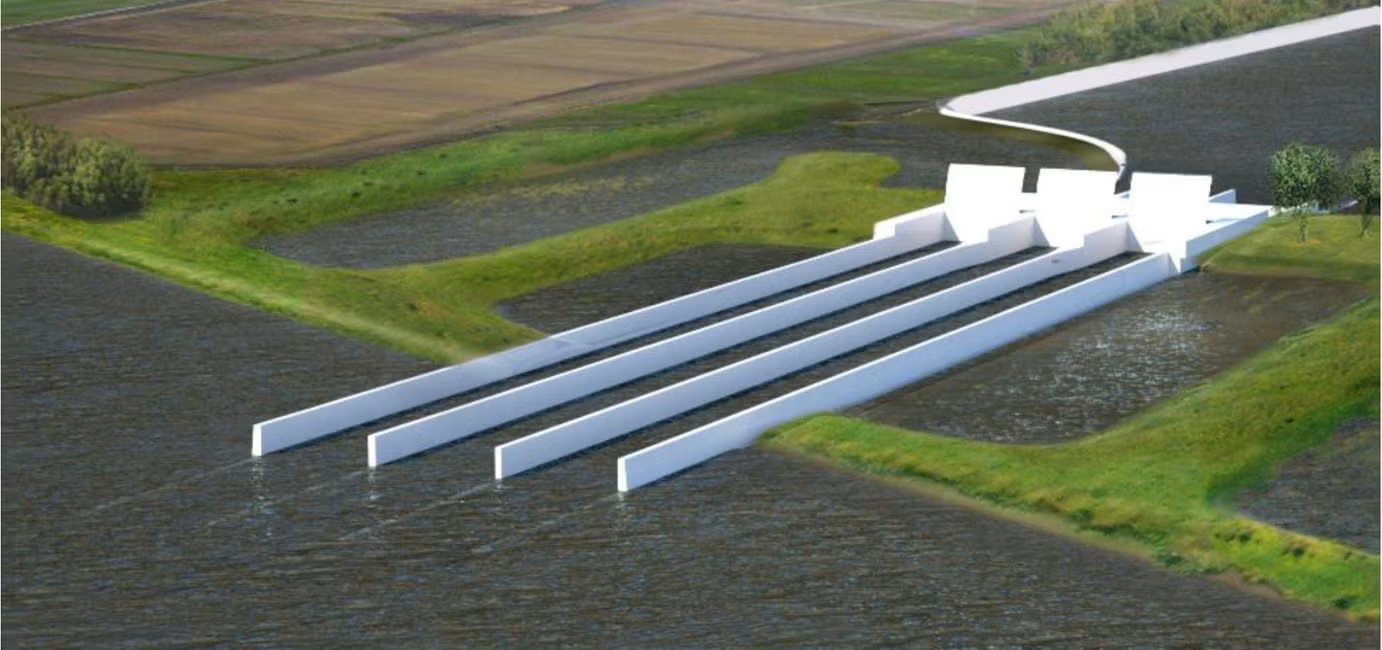
A mockup of the 800-foot-long intake structure that would have diverted water and sediment from the Mississippi River to the Barataria Basin. (Courtesy of Restore the Mississippi River Delta)
The Mississippi River is a highly engineered landscape – a triumph of the skills of generations of engineers. But there has been a price to pay.
“We’ve chosen a path for it,” Karst said. “We wanted to stick along that path. So that has prevented this periodic introduction of freshwater and sediment into these wetlands on one side or the other. And because it’s not getting that periodic introduction, it’s not getting what the land is made out of – the sediment – and it’s also not getting this regular flushing out of saltier water from the Gulf.”
Planners in the region considered a diversion project at Mid-Barataria as early as 1984. Over the years, plans came and went, including one in the early 2000s that would have moved between 2,500 and 15,000 cubic feet of sediment-laden water per second.
Ultimately, a bigger plan emerged: the MBSD. The project, approved by Louisiana’s legislature in 2017, would have channeled up to 75,000 cubic feet per second to the basin. The intake structure, designed by WSP, was planned to be 300 feet wide, 50 feet high, and 800 feet long and was to feature gates that would allow water engineers to control flows from the river to the basin.
The promise of the sediment diversion project, as laid out in the 2022 U.S. Army Corps of Engineers environmental impact statement, would have been “5 to 7 million tons of sediment transported through the diversion and deposited in the Barataria Basin annually, which would have permanent, major, beneficial impacts on land building. The diversion is projected to create 6,260 acres of land in the Mid-Barataria Basin in its first 10 years, with a maximum of about 17,300 acres (27.0 square miles) of land built in the Mid-Barataria Basin by 2050.”
Still, the project would have had adverse impacts on the basin’s population of eastern oysters, brown shrimp, and numerous other marine species. Further, bottlenose dolphins, which thrive in the Barataria estuary system, would be significantly harmed, due to “prolonged exposure to low salinities,” which could, according to some studies, lead to “the functional extinction of dolphins in portions of the (Barataria Bay Estuarine System) stock over time, with only a remnant population … near the barrier islands by the end of the 50-year assessment period,” the EIS noted.
Construction on the MBSD began in August 2023. But a year later, a self-described “coalition of conservationists, commercial and recreational fishermen, and local residents” filed suit in a U.S. District Court, claiming that the Corps, the U.S. National Marine Fisheries Service, and the U.S. Fish and Wildlife Service were in violation of the National Environmental Policy Act and the Endangered Species Act.
According to the complaint, “Alterations in salinity, temperature, and nutrient concentrations are also expected to seriously disrupt (or even destroy) commercially important fisheries in the Barataria Basin, threatening many local residents’ livelihoods and jeopardizing economic stability in these communities for decades into the future.”
As public opposition mounted, Louisiana Gov. Jeff Landry ordered a 90-day pause in early April 2025. A few weeks later, the Corps suspended the project’s permit. Finally, on July 17, the project was officially scrapped.
The decision, as the Louisiana Trustee Implementation Group announced, “follows CPRA’s determination, as the lead implementing trustee for the construction of the sediment diversion, that the project is no longer viable due to multiple factors, including costs, permitting concerns, and ongoing litigation.”
Mid-Breton – a companion project first authorized in December 2010, whose own price tag had risen to an estimated $1.8 billion – was canceled a few months after Mid-Barataria.
Making sense of the aftermath
“The ‘what went wrong’ is purely politics,” said Kristi Trail, P.E., M.ASCE, executive director of the Pontchartrain Conservancy, which does scientific research on anything related to water in southeast Louisiana. “Zero flaws in the science and engineering. And I say that confidently because it was decades of research. This is not a flash-in-the-pan idea that somebody pulled out of the skies.
“This is decades of research, research not only by Louisiana engineers … but it was cross-checked with engineers and researchers from other coastal cities, not only in the U.S. but from all over the globe.” (Trail’s organization is part of a larger collective of environmental nonprofits called Restore the Mississippi River Delta.)
In an email to Civil Engineering Source, David Muth, former director of the National Wildlife Federation, another member of Restore the Mississippi River Delta, argued that the science on the project was solid. “Arguably, no major ecosystem restoration project in history was better vetted with the public (more than 80% consistent support statewide, including in the affected parishes). It underwent decades of planning and environmental analysis.”
Indeed, multiple organizations did physical and computational modeling work on the MBSD, including project engineer AECOM and the Corps. But some found the modeling results questionable.
In a letter to the Corps in 2021, R. Eugene Turner, professor emeritus in Louisiana State University’s department of oceanography and coastal sciences, argued that the EIS modeling was “incomplete and not trustworthy” and that “the anticipated benefits are contradicted by empirical data from three large diversions operating for decades.” He was referring to three river diversions – Caernarvon, St. Phillips, and Davis Pond – that he contended all resulted in land lost, not gained.
In an interview with the Source, Turner said, “Engineers more and more in a lot of places use models, and they end up having more authority than we should give them at the first glance, I think. They are trying to summarize and collect information in an understandable way, but then they’re relied upon without being checked as thoroughly as they could be. So that’s what’s happened to this project.”
The plan had set aside millions of dollars for mitigation efforts and to monitor dolphin health. And proponents point out that without any plan, the basin will continue to erode.
“All of these things that they have termed and tagged and branded for this job – all of them have merit,” said Dennis Lambert, M.Eng, P.E., BC.NE, BC.PE, BC.WRE, F.ASCE, Gulf Coast waterways practice lead for Bowman Consulting. “But when you start looking at the flaws, you can’t ignore that. You can look at something as a concept and say, ‘That has merit,’ but that doesn’t mean that it’s going to happen. You have to go through this process and come out on the other end ironclad, and it wasn’t. There were too many red flags.”
The way forward
The CPRA, which declined to comment about the cancellation of Mid-Barataria, issued a press release in July 2025 saying it was pivoting back to the more modest Medium Diversion at Myrtle Grove with Dedicated Dredging project, which “offers similar restoration benefits.”
According to an analysis on Substack by the ByWater Institute at Tulane University, a smaller diversion, though it wouldn’t have as drastic an impact as the MBSD, could create significant new land and be “less disruptive. It would introduce less freshwater, minimizing impacts on oysters and bottlenose dolphins. This could allow the state to move forward without the costly lawsuits and political opposition that haunted MBSD for years.”
Others are skeptical of dredging.
Karst said southern Louisianans are really good at dredging, but there’s not enough raw material to do it and maintain it. “And that would’ve been the beauty of the sediment diversion,” he said. “Once they built it, it would’ve run not in perpetuity, but it would be running nonstop or it could be running nonstop. Whereas when you dredge and build land, you do it at great expense, and then in 20 years it’s underwater because of subsidence, and you’ve got to redo it.”
Trail echoed the point about dredging, citing a lack of mechanical capability to create a sufficient amount of land in a reasonable time frame. The sediment diversion plan, by comparison, was economically feasible.
“You’re getting that freshwater and sediment by just opening the gates,” Trail said. “So long-term sustainability is really the key win of that project. And it was at no cost to the taxpayers to construct.”
Ehab Meselhe, Ph.D., P.E., M.ASCE, chair of the river-coastal science and engineering department in Tulane’s college of science and engineering, and his research team are developing an alternative diversion proposal called a sand engine, a way of pumping sand from sandbars on the riverbed and mixing it with enough water to create a slurry that can be pushed into the basin.
It’s a way of adding sufficient sediment to the basin while using far less water. The proposal, he said, is a lot cheaper than sediment diversion, but the trade-off is that the sand would have to be continuously pumped.
“But you will put a lot less freshwater into the basin,” Meselhe said. “So you are not going to bother the fishing industry at all. You are not going to interfere with flooding any community. You’re also not going to impact the river itself at all because you’re not taking a substantial amount of water from it. So you address a lot of the issues.”
In an unpublished paper, Lambert notes that on large projects such as the MBSD, governance itself is an engineering problem.
“Engineers cannot redesign the political economy,” he wrote. “But we can advocate for governance structures that protect independent technical judgment regardless of the funding environment.” He recommends that future projects “adopt publishable governance norms: a governance map, disclosure of funding relationships, structural insulation of independent reviewers, and a single source of truth document index.”
Everyone – even critics of the Mid-Barataria project – seems to agree that some solution needs to be found.
“But it is the difference between known and unknown,” Karst said. “And we’ve known that coastal wetlands are vanishing. We’ve known it for a very long time, and we have adapted to that. And I guess people made the choice that it was better to have that known catastrophe.”
In a 2022 article in Marine Technology Society Journal, “Creating a Diversion: Why the Mid-Barataria Sediment Diversion (MBSD) Project Is Unpopular Among Coastal Communities in Southeast Louisiana,” authors Grant S. McCall and Russell D. Greaves of the Center for Human-Environmental Research noted “the importance of fishing, and especially small-scale commercial shrimping and oyster operations, as the basis for local social systems and as key features of social identity and place attachment.”
Future solutions should leverage that knowledge. The authors argue that “a diversified program of ecological, economic, and social interventions applied to system leverage points, which could be identified using local traditional knowledge, might offer a less risky and potentially more effective strategy for dealing with coastal erosion and storm surge threats.”
“Even the people that oppose the projects, it’s not like they are in denial about the land loss,” Lambert said. “Those fishermen know better than anybody that we’re losing enormous amounts of land. They need to get together to come up with the right solution. I think right now the dust is still settling.”
Meselhe noted there are other land creation strategies in the coastal master plan besides sediment diversion like Mid-Barataria, including marsh creation, ridge restoration, shoreline protection, and hydrologic restoration, as well as elevating homes and building new levees to protect communities from flooding.
He said restoring the basin is still possible.
“I hope people don’t give up. … It’s not a lost cause,” he said. “There’s still other ideas out there. The master plan has a lot of good components in it. We have to keep up our optimism to keep pushing to restore and protect this very valuable wetland system.”