 Softwood Lumber Board
Wood is gaining traction as a viable material in North American commercial construction, but college engineering programs still devote far more time and resources to steel and concrete.
It’s a gap that institutions are looking to address. ASCE's Structural Engineering Institute has a Wood Education Committee, which works on expanding wood education in the U.S.
Further reading:
- Mass timber helps create fossil-fuel-free home for fossils in New Jersey
- Paris Olympics swim venue’s timber elements put sustainability on display
- Modular timber designs could extend building life
Since 2022, the Softwood Lumber Board, a nonprofit industry-funded organization, has partnered with universities to offer faculty development workshops, including six focused on engineering faculty. The workshops help educators integrate wood design and construction into postsecondary curricula. Participation is fully funded for selected educators.
Clemson University’s Wood Utilization + Design Institute hosts an annual edition of the Timber Design Faculty Development Workshop under the guidance of Weichiang Pang, Ph.D., M.ASCE, the college’s Wilbur O. “Billy” and Ann W. Powers Distinguished Professor of Civil Engineering. When Pang first started as an assistant professor at Clemson, there was a need to help the department cover reinforced-concrete design, so he was sent to a faculty training workshop in Skokie, Illinois, to learn the ropes and institute a course at Clemson.
The success of that model, combined with an increased demand from students and industry, prompted Pang and a few faculty members at Clemson to contact the Softwood Lumber Board and initiate the timber workshop. This summer’s edition, held June 9-11, attracted 30 faculty members from across the U.S.
The need for expanded wood education
In 2019, the National Council of Structural Engineers Associations surveyed higher education institutions that offer accredited civil engineering and architectural engineering programs. Of the two-thirds that participated, nearly all reported offering steel and concrete design courses, but only a little more than half (52%) offered a wood design course to undergraduates.
Also challenging: The courses are often only available once every two or three years, making them less accessible in a four-year education format where mandatory foundational courses leave little room for optional ones.
 Softwood Lumber Board
“Even when courses are offered, they usually include instruction about timber design in combination with masonry, although the design methodologies for the two are different,” Pang said.
The dearth of systematic education about wood construction is especially striking because the sustainable material is gaining ground as a possibility for commercial buildings. Cross-laminated timber was introduced into the 2015 International Building Code. The International Code Council’s Tall Wood Building Ad Hoc Committee codified changes to the 2021 IBC to include heights of up to 18 floors for mass timber use, depending on assembly fire ratings, occupancy, and other safety requirements.
The Softwood Lumber Board hears from engineering firms seeking graduates with stronger foundations in wood design. At the same time, new generations of students are gravitating toward wood, interested in the sustainable and biophilic nature of the material.
“Wood’s expanding use in larger and taller buildings creates new opportunities for engineers,” said Reed Kelterborn, P.Eng., director of education at the Softwood Lumber Board. “Students need to understand these systems and the design principles behind them.”
Through its Think Wood program, the organization has supported 17 educational workshops, including the Clemson versions.
“Engineers should be fluent in all the major structural materials,” Kelterborn said. “When graduates can evaluate wood alongside steel and concrete and choose what’s right for each project, the whole profession benefits—and so do the people who live and work in those buildings.”
Why faculty workshops
The workshops provide technical instruction, teaching resources, and curriculum guidance while connecting faculty with a network of peers. Educators can exchange knowledge and ideas, collaborate, and support one another as they incorporate wood design into existing courses or develop new ones.
“Faculty capacity is a key barrier to expanding wood education,” Kelterborn said. “We’re helping educators build the knowledge and confidence to bring the subject into their classrooms.”
Added Pang: “Many faculty told us they don’t feel like they have enough background or teaching resources to offer the wood design courses by themselves from scratch. They’re hearing from the students in addition to industry demand, and they need some help and educational resources to meet this demand.”
The Softwood Lumber Board sees the faculty workshop model as an efficient way to expand wood education, helping educators integrate wood design into their teaching and reach successive cohorts of students across multiple institutions. “If a participant goes back to their home institution and teaches 20 students, with 30 faculty members, that can become a force multiplier,” Pang said.
In addition to the workshop, the board has supported Clemson’s development of a free course related to wood engineering, which consists of a syllabus, lecture slides, solved design examples, and a question bank, including assessment tools like quizzes and assignments.
Workshop sessions
Wood is an interesting biological material that behaves in unique ways that engineers need to learn about, Pang said, especially because its resistance to moisture, fire, and vibration, as well as its durability characteristics, are vastly different from steel and concrete.
“Wood is considered an anisotropic or orthotropic material, meaning it has very different strength properties parallel and perpendicular to the grain,” Pang said. “Understanding the fiber orientation and load transfer properties is also important.”
Part of educating future engineers about working with wood is understanding its utility and limitations.
“I often remind students that there isn’t one material that’s best for every application; good structural engineering is about choosing the right material for the right application,” Pang said, adding that the construction sector is seeing hybrid structures with wood, steel, and concrete.
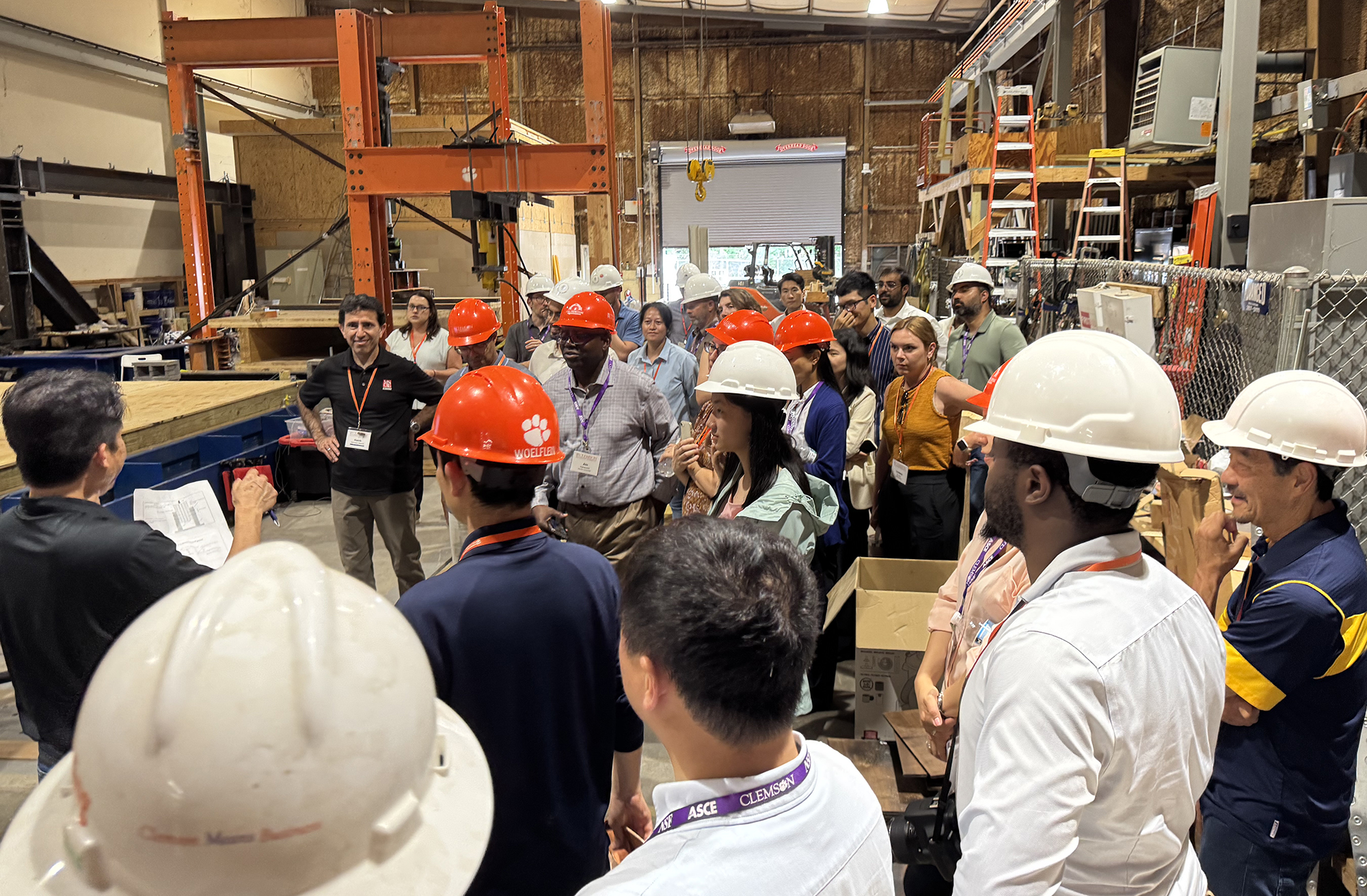
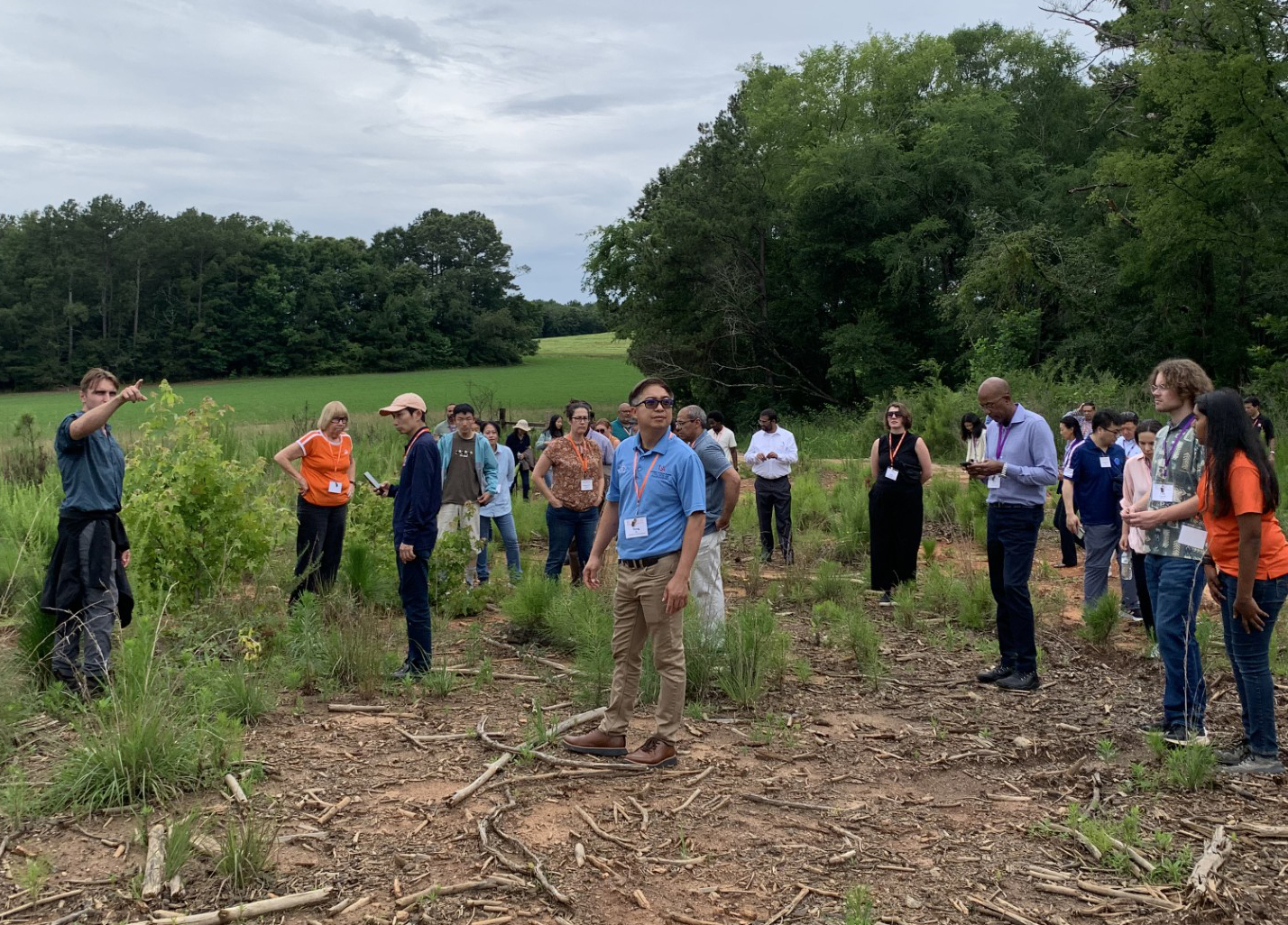
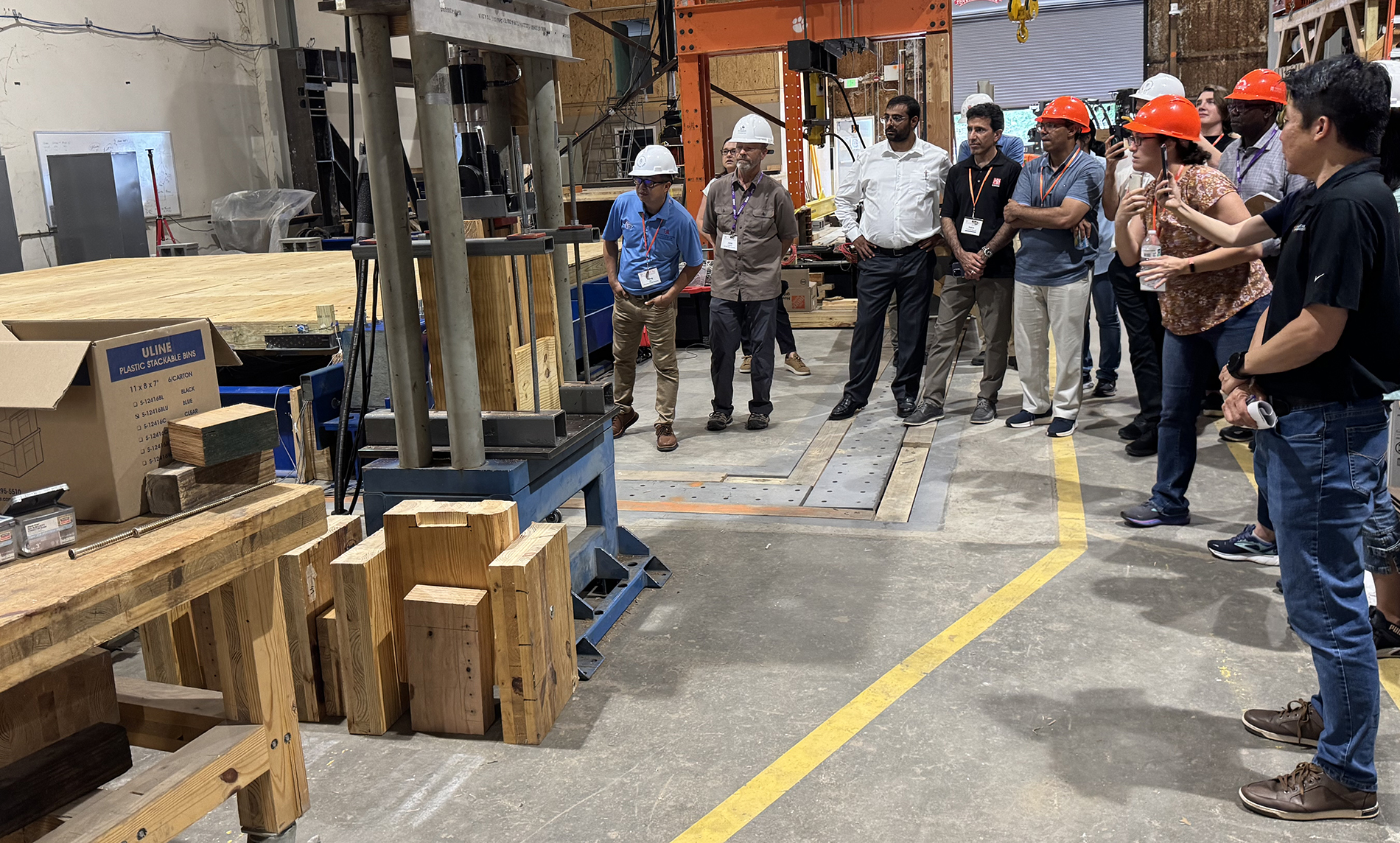
The summer Clemson workshop covered wood engineering and design, an overview of relevant design standards and codes, and strategies for incorporating the subject matter into teaching, research, and outreach. It included presentations from guest speakers and covered both light-frame and mass-timber construction.
More than 80% of participants in this year’s workshop said they would be including more wood design content in their coursework, and over 60% of faculty from earlier workshops have done so already.
“Wood is a material where the connection between the design, fabrication, and construction stages is especially important,” Pang said.
With that in mind, participants received seminar-style instruction in the classroom; visited Timberlab, a mass-timber fabrication facility in Greenville, South Carolina; and toured constructed wood buildings on campus.
“Once the participants saw all these elements, they were able to recognize how the materials and connections being fabricated using (computer numerical control) machines were used in the completed buildings,” Pang said.
 Softwood Lumber Board