
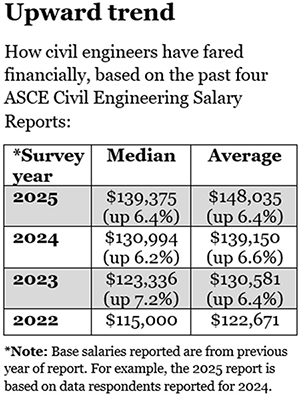
The numbers spoke loudly and clearly when the ASCE 2025 Civil Engineering Salary Report was released in October: It’s a good time to be a civil engineer.
Yes, the $9,000 average boost in pay for 2024, as noted in the report, is great news for those in the profession, but there is much more to glean from the survey of ASCE members.
Further reading:
- New ASCE report shows civil engineering salaries up an average $9,000
- Women are more visible in civil engineering, but gender-based challenges persist
- ASCE’s Top 10 Best Places to Be a Civil Engineer in 2025
A career is not all about the money, and civil engineers clearly have a high level of happiness and job satisfaction, as only 6.9% of salary survey respondents reported voluntarily leaving their jobs in 2024. In fact, 50.3% of respondents reported having one employer over the past 10 years, and 27.8% reported only two.

In addition to the average reported base salary of $148,035, civil engineers enjoy strong benefit packages, according to the survey, which saw 2,415 ASCE members responding, of which 2,061 were counted in the data after excluding students, part-time employees, retired or unemployed engineers, and others in special circumstances.
More than 95% of respondents say their employers offer health insurance, and more than 78% are vested in retirement plans via their employers.
In terms of where civil engineers are physically plying their trade, 47.6% say they are fully in-person, 42.3% are hybrid, and 10.2% are fully remote. Hybrid workers average 3.9 days per week in the office.
The median number of days offered for paid time off per year is 20.
Of course, money is a significant factor in happiness and job satisfaction. The small number of respondents who changed jobs in 2024 most often cited increased pay as a main reason, with job switchers enjoying an average base salary increase of 22%.
Gender, race, location are factors
There is disparity in the numbers. Female civil engineers trailed their male counterparts. Median pay for men was $144,002 but $119,975 for women, though the gap narrows when considering experience. And when it comes to race, white engineers had the highest median income ($137,450), while Native American or Alaskan Natives reported the lowest ($111,000).
Location also plays a significant factor in pay. Respondents in the Pacific region (California, Oregon, Washington, Alaska, and Hawaii) had the highest median income at $155,000. Respondents in the West North Central region (North Dakota, South Dakota, Nebraska, Kansas, Minnesota, Iowa, and Missouri) were lowest at $124,900.
Licensing also makes a big difference. Those with Professional Engineer licenses (80% of respondents) earned a median primary income of nearly $40,000 more than those with no licenses or certifications.
Also noteworthy:
- Employees at nonprofit institutions (excluding education) received the most pay: a median salary of $180,000.
- Working for an employer with more than 10,000 workers means the highest median pay ($149,100).
- The best-paid civil engineers among lines of business were those listing aeronautical/aerospace/astronautical, whose median income was $195,977.
No matter their locations, specialties, or credentials, civil engineers can enjoy life in a profession that is pointing upward in so many ways.
For a deeper dive into the survey, including a salary calculator, a searchable data tool, and an e-book fully breaking down salaries by race, gender, experience, location, credentials, specialties, and more, click here.