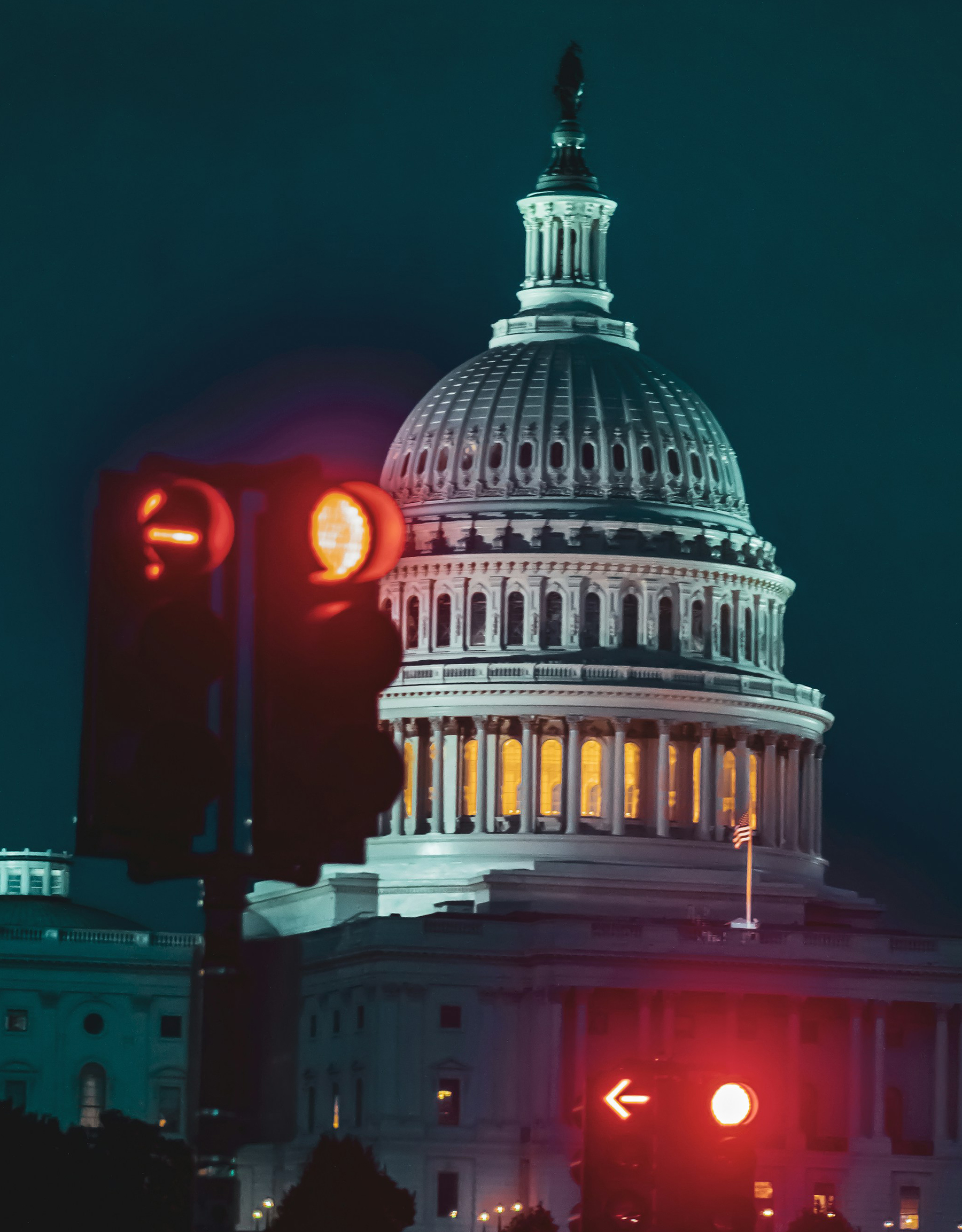
 Jingxi Lau via Unsplash
Civil engineers’ relationship with congressional earmarks keeps twisting and turning, and their potential return in fiscal year 2026 – after a one-year hiatus – is yet another shift. And, as always, it’s complicated.
Earmarks – funds appropriated by Congress for specific projects – are secured by legislators for the district in which those projects are happening. They became very common in the last two decades of the 20th century.
Further reading:
- How can we deliver projects faster? Civil engineers weigh in on NEPA and more
- 5 key takeaways from the ‘2025 Report Card for America’s Infrastructure’
- New ASCE report shows civil engineering salaries up an average $9,000
Eventually, they fell out of favor, at least in part because of perceived wasteful spending, such as so-called bridge-to-nowhere projects. Congress temporarily banned earmarks in 2011 before reinstating them in 2021. But, with the federal government operating under continuing resolutions, they went unfunded in FY 2025.
Officially called congressionally directed spending or community project funding on Capitol Hill, earmarks have made a strong comeback. Most of these projects are worthy and beneficial, and they often involve infrastructure and, therefore, civil engineers.
A large percentage of the new earmarks are going toward water- and environmental-related projects, so civil engineers will be beneficiaries. But one concern is that the funds often are diverted from the Clean Water State Revolving Fund or the Drinking Water SRF, which civil engineers rely on to help support projects.
Greg DiLoreto, P.E., P.L.S (Ret.), BC.WRE (Ret.), Pres.13.ASCE, says earmarks can lead to questions about objectivity. Funding through the SRF process includes a list of priority projects put together by state agencies with established criteria to determine rank. But taking money from the SRFs, which have already been scaled back in the federal budget, and using it in the form of earmarks introduces subjectivity, allowing stakeholders to persuade elected officials that their project is important enough for this form of funding.
A mixed bag
DiLoreto sees earmarks as necessary to civil engineers but is sympathetic to those relying on SRFs.
“Some might say, ‘Hey, that’s not a great thing. I’ve been waiting for a long time to get my project funded. I played by the rules, and now I’m getting bumped because the money that used to go into that account is now going to fund these accounts,’” he said. “It can be questionable about whether a criteria system was used to get those projects.”
Rebecca Shelton, P.E., F.ASCE, a utility director in the metro Atlanta area, says that receiving money via an earmark vs. through an SRF is much different, as earmarks don’t have to be repaid. Conversely, money from an SRF is a loan.
Earmarks help pay for “things you may not have gotten funded at the local level and have the potential to maybe not have quite as many strings as the SRF,” she said. “I think the negative certainly is the perception of, ‘It’s just not fair.’ Certain elected officials have more pull to get earmarks than others. Whereas the SRF is distributed based on a formula, the earmarks are not.”
But from a practical standpoint, civil engineers have an obligation to pursue earmarks when they are available.
“Without earmarks, you can’t do some of these really large projects,” said DiLoreto, the former CEO of the Tualatin Valley Water District, which serves more than 222,000 residents in Beaverton, Oregon, and other surrounding communities. “You go to your elected officials to help get those projects done. Agencies, cities, counties all have a real need for large federal projects that have some federal component to them.”
Shelton, whose agency regularly seeks earmarks, says engineers sometimes have to be creative in funding crucial projects.
She has seen an ebb and flow in funding throughout her multidecade career, which has spanned recessions, crunches in infrastructure funding, earmark hiatuses, increased funding from the Infrastructure Investment and Jobs Act of 2021, and the current situation.
“As a local government, you’re always just looking at every option you can to figure out how to fund the infrastructure that your community needs,” Shelton said. “That could be a local sales tax, water and sewer bills, or property taxes. And then, of course, if you can get help from the federal government, great.”
Responsibility to society
Even though earmarks have a negative connotation for many, largely because of past bridge-to-nowhere fiascoes, DiLoreto says they ultimately benefit society. First and foremost, civil engineers have a responsibility to do what’s in the best interest of the public. So executing a project that benefits from an earmark just makes sense.
“The fact is that we’re still civil engineers, hired to build and design the project,” DiLoreto said. “From a purely selfish engineering point of view, we got a project out of it. Now the question, the part that became questionable was, ‘Was the amount of money spent for the project worth it?’”
Shelton says the answer to that question overwhelmingly is yes.
“Occasionally you hear of the bridge to nowhere, but I think the vast majority of earmarks are projects that are actually needed in their community,” Shelton said. “It’s important to remember that nothing’s free. So, as local governments, we’re trying to create a place where people want to live and have a good quality of life.”
But she emphasized that infrastructure funding comes from a wide variety of sources.
“There are many different ways to fund infrastructure,” Shelton said. “And this is just one of them if it’s available. So if it’s available and you’re trying to do what’s in the best interest of your community, it doesn’t make sense to not participate. If it’s not available, then you’ve got to look at your other options because at the end of the day, the money doesn’t appear out of nowhere.”
Regardless of the source of funding, our infrastructure desperately needs every dollar it can get.
ASCE’s 2025 Report Card for America’s Infrastructure, released in March, issued an overall grade of C. While that was the best score in the history of the report card, nine of the 18 graded categories received a D or D+, meaning there is lots of work to be done.
“The best way is to put more money into it,” DiLoreto said. “Quit robbing from one spot to put it in a different spot. … Leave the state revolving funds where they were. Because our infrastructure needs far exceed the amount of money that’s being funded today.
“The best thing (engineers) can do is design the best, most efficient, cost-effective projects possible. Use that money to serve the most and do the greatest good.”
Also of note
- ASCE’s infrastructure grades are in for two of the largest states in the U.S. California, the highest-populated state, received a C- in the 2025 Report Card for California’s Infrastructure, the same grade it received in 2019. Florida, with the third-most people among states, got a C+ on the 2025 Report Card for Florida’s Infrastructure, beating the national average.
- The Federal Railroad Administration extended the deadline to submit applications for Federal-State Partnership for Intercity Passenger Rail Program funding to Feb. 6.
- Karen Evans, formerly a top official at the Energy Department for cybersecurity and emergency response, has taken the role of acting administrator of the Federal Emergency Management Agency.
- The Department of Transportation recently awarded $2 billion to support bus-related projects in 45 states and Washington, D.C., aimed at modernizing bus infrastructure, reducing congestion, creating jobs, and enabling people to travel more affordably.
- As Congress continues work on surface transportation reauthorization legislation, the DOT sent two internal proposals aiming to pare back funding. The first would eliminate the Mass Transit Account of the Highway Trust Fund, diverting the money to the HTF’s Highway Account. The second would remove the Federal Highway Administration’s eligibility to fund transit projects and prohibit states from using highway formula dollars for transit purposes.
Get ready for ASCE2027
Maybe you have big ideas regarding infrastructure. Maybe you are looking for the right venue to share those big ideas. Maybe you want to get your big ideas in front of leading big thinkers from across the infrastructure space.
Maybe you should share your big ideas at ASCE2027: The Infrastructure and Engineering Experience – a first-of-its-kind event bringing together big thinkers from all across the infrastructure space, March 1-5, 2027, in Philadelphia.
The call for content is open now through March 4. Don’t wait. Get started today!