
Recent advances in artificial intelligence, educational technology, and workforce demands are rapidly reshaping how we approach civil engineering education.
During the annual conference of the American Society for Engineering Education, held in June in Montreal, AI-related themes were at the forefront, ranging from integration in curricula and learning systems to applications in grading, advising, and project-based instruction. AI is no longer a novelty; it is deeply embedded in how students engage with knowledge.
Further reading:
- AI pioneer, expert announced as an ASCE2027 keynote
- The top 5 technical skills civil engineers need
- Texas DOT works to leverage artificial intelligence’s power
As a civil engineering faculty member at Manhattan University, I believe that undergraduate education in our field must undergo a fundamental shift to meet the realities of AI-enhanced learning and the urgent challenges of the 21st century. To accomplish this, we need to provoke dialogue among educators, practitioners, and accrediting bodies on the necessary evolution of civil engineering education.
Declining enrollment
Universities across the U.S. are experiencing significant enrollment declines. To remain competitive, institutions are resorting to discounted tuition, aggressive scholarship offers, and restructured programs. Families are increasingly questioning the return on investment of a traditional college/university degree, especially when AI-powered tutors, open-source resources, and so-called educational boot camps offer flexible, cost-effective alternatives.
While civil engineering job prospects remain strong in the near term, automation is gradually reshaping the early career landscape. Repetitive tasks once assigned to junior engineers can now increasingly be supported or replaced by AI systems.
Tech companies have begun phasing out junior coding positions, citing efficiency gains through AI platforms like generative pretrained transformers.
 Via Wikimedia
 Today’s elementary school children already interact daily with Google Docs, Google Slides, and AI tools like ChatGPT. Their generation will likely expect more efficient, personalized, and technology-integrated pathways to learning and careers. As they grow up in an AI-enhanced world, will these students still think that traditional four-year engineering programs make professional or economic sense?
Rethinking curriculum
Engineering educators need to ask themselves several key questions, including: What do students and industry really need? Can we deliver it more affordably and in a flexible manner? And can we maintain quality without relying exclusively on accredited degrees?
Basic civil engineering curricula, originally shaped by industrial needs following World War II, emphasize two years of foundational math and science, followed by discipline-specific courses, and culminating with senior design experiences. This model presumes a linear, cumulative learning structure.
But modern tools like GPT and other AI-based platforms – if used critically and under supervision – can help students understand and simulate civil infrastructure systems such as water distribution systems or guide them through complex problem-solving. These tools are not a substitute for engineering fundamentals but can accelerate conceptual comprehension.
But will attempts to compress the traditional engineering curriculum weaken the current emphasis on fundamental principles and analytical rigor? Although this concern is valid, I believe that rigorous learning can be preserved – even enhanced – through intensive, immersive formats such as project-based learning, guided design studios, AI-supported modeling environments, and integrated apprenticeships or co-ops.
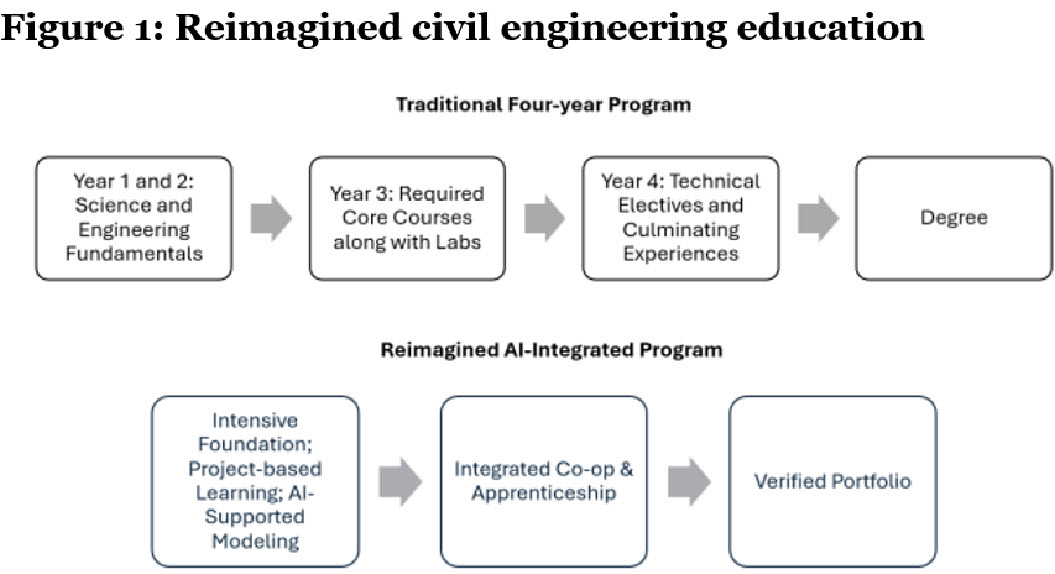
The current emphasis in undergraduate engineering education can shift away from a focus on lectures, credit hours, and classroom seat time and toward demonstrable learning outcomes and engineering judgment. Figure 1 compares the current four-year degree program to one that features a flexible, outcome-driven system emphasizing immersive learning, mentorship, and AI integration.
Cultivating judgment
Current AI tools can generate technical reports, solve equations, and write code, and while there are known errors/hallucinations that need to be resolved, the capacities of AI systems are increasing significantly every day, it seems.
These systems enable adaptive learning, personalized tutoring, classroom analytics, and content generation. They cannot, however, interpret ambiguous context, make ethical decisions, or weigh trade-offs in real-world systems under uncertainty. Those tasks remain the domain of human engineers and educators – for the time being.
To prepare future engineers for this changing world, civil engineering education needs to prioritize judgment over memorization. Students need to develop skills such as cultivating engineering judgment in complex systems; using real-world data to design by considering uncertainty; critically assessing/interrogating the validity of AI outputs; and considering trade-offs in the context of multiple objectives with conflicting constraints.
They should also consider ethics and the long-term impacts of the decisions they make. To accomplish these goals, future civil engineers must evolve from being the solvers of predefined problems to becoming systems thinkers, ethical decision-makers, and integrative strategists.
Consider this example: AI-driven digital twins are being used in utility-level water distribution systems to simulate hydraulic behavior, leak detection, and pump scheduling. If students can work with such models in real time – supported by AI tutors and guided by expert mentors – they can gain practical exposure to uncertainty, risk trade-offs, and model validation procedures and capacities.
These processes and tools will not only reinforce hydraulics/water quality principles, they will also cultivate critical engineering judgment under real-world constraints, which is an essential competency in civil systems operations, management, and planning.
Augmenting with AI
At the education-focused nonprofit Khan Academy, recent innovations have demonstrated how AI tutors can support personalized learning while human educators focus on facilitation and mentorship. This blended model has powerful lessons for civil engineering education and curriculum design.
If AI can handle much of the routine academic workload, the faculty role must evolve into that of mentors who guide students in system framing, ethical reflection, and critical thinking.
A major challenge to this transition, however, is figuring out how the faculty can be equipped to teach and mentor in AI-integrated environments.
This will require dedicated faculty development programs, interdisciplinary co-teaching models, and institutional support for upskilling, not only in tool usage but also in AI ethics and pedagogical integration. In this sense, colleges/universities should also explore hybrid models that include:
- Flexible/shorter, more intensive academic programs
- Real-world project studios with AI tools
- Portfolio-based credentialing
- Embedded internships and industry mentorships
Diploma vs. skills?
Traditionally, a degree from a reputable institution served as a proxy for competence. But more recently, employers seem open to candidates who can demonstrate appropriate skills without a college degree.
For example, as of early 2024, fewer than one in five job postings in the U.S. required a four-year degree, and a majority did not mention any formal education requirement.
Instead, employers increasingly seem to want job candidates who can demonstrate tangible competencies, such as problem-solving, collaboration, communication, and AI proficiency. It’s reasonable to expect that the civil engineering community will act likewise.
If this happens, ASCE and ABET (formerly known as the Accreditation Board for Engineering and Technology Inc.) should consider new measures such as developing competency-based certifications, approving AI-assisted evaluation methods, and endorsing stackable micro-credentials that provide civil engineering students with short, skills-focused certifications.
These certifications offer flexibility, aligned with industry needs while keeping education quality by responding to new emerging or critical technologies.
Of course, any such changes must still align with ABET’s core student outcomes, particularly those addressing ethics, communication, teamwork, and lifelong learning. Rather than dismantling the accreditation framework, this new vision would aim to modernize how learning is delivered and how competence is assessed.
By embracing this shift, our field can preserve public trust in the value of universities’ civil engineering education while adapting to new realities.
This is not about lowering the bar. Rather, it is a call to redefine and modernize our educational frameworks with the demands of an AI-driven, rapidly evolving world. It is crucial for ASCE, ABET, faculty, national licensing bodies, and industry leaders to continue to reassess the core competencies for civil engineers and explore credential systems that validate engineering judgment not just knowledge.
We need to design more flexible, adaptive, and affordable pathways that support lifelong learning, career transitions, and diverse learner modes while also equipping faculty with the tools, mindsets, and support needed for AI-integrated instruction, mentorship, and curriculum development.
Today’s students already rely on AI for research, writing, and design exploration. If we fail to evolve now, we risk irrelevance. The question is no longer whether we should adapt, but how effectively and responsibly we can do so, while preserving the integrity and purpose of our engineering profession.
Get ready for ASCE2027
Maybe you have big ideas about civil engineering education. Maybe you are looking for the right venue to share those big ideas. Maybe you want to get your big ideas in front of leading big thinkers from across the infrastructure space.
Maybe you should share your big ideas at ASCE2027: The Infrastructure and Engineering Experience – a first-of-its-kind event bringing together big thinkers from all across the infrastructure space, March 1-5, 2027, in Philadelphia.
The call for content is open now through March 4. Don’t wait. Get started today!
