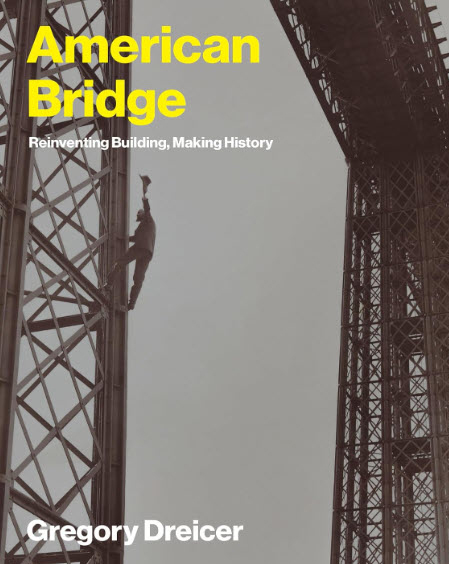
American Bridge: Reinventing Building, Making History, by Gregory Dreicer. Cambridge, Massachusetts: The MIT Press, 2026; 420 pages, $75.
This is a book about bridges. In particular, it’s about the revolutionization of bridge building in the U.S. from the early 19th through the early 20th century, when the invention of the lattice bridge and an associated new bridge construction process enabled faster construction.
But it is also about more than bridges. Because American Bridge author and historian Gregory Dreicer has a larger purpose as well: to help readers “understand transformations in building, one of the world’s oldest professions.”
Further reading:
- ‘Disruptive innovation’ is a narrower term than you might think, author argues
- ‘Undammed’ makes a strong case for dam removal
- Mega-project success: Author offers advice to land and deliver the big jobs
“Why focus on a bridge?” he asks rhetorically in the introduction. Because “ideas about infrastructure and landscape, and nation and community, are inextricably bound to bridges. People, goods, and information all flow across them.”
So, like the inventor of the lattice bridge – American civil engineer and architect Ithiel Town – Dreicer has ambitions. And his book fulfills them, telling the meticulously detailed story, heavily informed by fresh investigation of primary sources, in a way that, by design, should be understandable to readers without deep technical expertise.
The central narrative tracks how the new lattice design – whose central innovation was replacing heavy timber beams with smaller, crisscrossing planks – enabled mass construction of bridges in a way that hadn’t been possible before, much as the Ford Model T later did for automobiles. “Almost a century before Ford’s car,” Dreicer says, “this iconic structure was a buildable articulation of an aspiration that innovators had long been working toward: the making of long, level structures out of small, uniform parts, on a mass scale, and fast.”
The author is a public historian (i.e., while holding a Ph.D. in science and technology studies, he is not a university professor). Dreicer describes himself on his website as “a curatorial strategist, partnership builder, experience designer, and historian who collaboratively creates multidisciplinary offerings that engage people in discovery and conversation.” In addition to his positions at museums and other organizations during his career, his wide-ranging projects and exhibitions have been featured at many museums.
As he unspools the story of how the technology of bridge building changed, he keeps his historian hat firmly on, waxing poetically about what it meant in a larger sense for community and place, the development and connection of the nation itself, the transformation of landscapes, capitalism, and so much more. And the tale is always buttressed by research, rethinking, and refusing to accept, in his words, “nineteenth-century technologists’ narrative framings” of what happened, why, and who was responsible, without solid sourcing.
Just how deeply researched is American Bridge?
The book contains more than 100 pages of detailed footnotes and additional commentary. It is appropriate that the very first note that appears in the book is attached to a mention that “most of the research behind this book was done via ‘immersive research methodologies,’ otherwise known as spending a lot of time with paper documents.” (The footnote is to credit Thomas Smits, Ph.D., a fellow historian who coined that phrase.)
Dreicer also takes pains to point out that the notes are not necessary for many readers and are so extensive because much in his book challenges previous accounts – and therefore thinking – on the subject.
Lofty in tone while remaining dense with facts and filled with 170 period photos, drawings, and other artwork, American Bridge is a carefully constructed work about one technology that effectively bridges the gap to a broader discussion about the very history of technology.