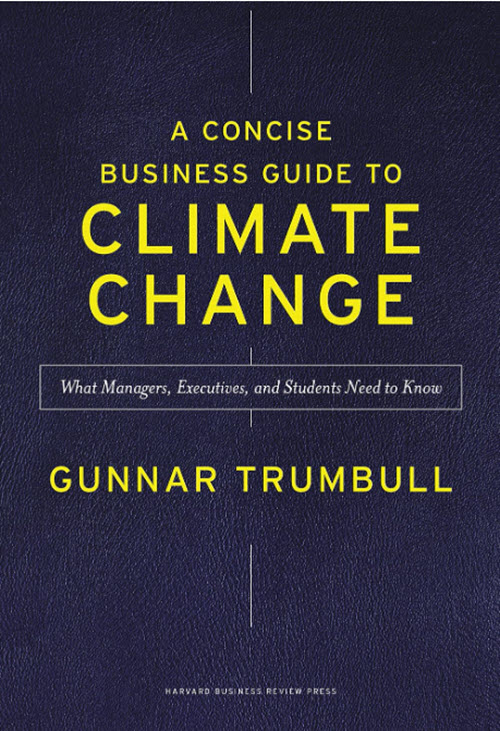
A Concise Business Guide to Climate Change: What Managers, Executives, and Students Need to Know, by Gunnar Trumbull. Boston: Harvard Business Review Press, 2025; 176 pages, $35.
Lake Mead, the nation’s largest reservoir, recently dropped to its lowest level ever – its surface approaching 200 feet below its highest level. This leaves it at just 27% of its total water capacity after more than 25 years of almost uninterrupted decline due to a combination of overconsumption and drought.
At the same time, projections for the current El Nino have been revised upward, with ocean temperatures predicted to reach record levels of more than 4 degrees Celsius above normal. This will likely drive extreme drought in some areas, extreme precipitation in others, and the strong possibility of historically high temperatures for billions of people.
Further reading:
- ‘Inevitable’ makes strong case that EVs will dominate global auto market
- Ithiel Town’s lattice bridge transformed American construction, book argues
- ‘Disruptive innovation’ is a narrower term than you might think, author argues
For civil engineers, the effects of climate change are ever more visible and the need for action ever more obvious. But for business leaders who are willing to do their part – regardless of their mix of strategic, reputational, or operational motives for doing so – it can be difficult to cut through the noise and understand what to do. A Concise Business Guide to Climate Change aims to be a high-minded but clear-eyed primer to help chart the right course.
Clocking in at a crisp 150 pages of content, this is not a book focused on exhaustive argument or scientific explanation. Instead, it is an expert distillation of the most important general points for executives to consider when determining how to define or refine their plans of action related to climate change.
It is similar to books written years ago, at a time when there were skeptics about whether “this internet thing” would be consequential. Those authors assumed readers bothering to pick up their books knew things were changing and wanted to know how to react.
The guide’s key chapters cover firms’ emission-reduction strategies, a crash course in the current climate science consensus, market-based approaches to carbon reduction such as cap-and-trade and carbon taxes, the transition to green energy, and government-led climate change responses.
The focus remains squarely on how to take what is known on the topic and incorporate it to make better strategic and managerial decisions. Each chapter is clear, succinct, deliberately plainspoken, and studiously neutral in tone. Businesslike, you might say.
Author Gunnar Trumbull is a professor of business administration at Harvard Business School whose research focuses on business and climate regulation. Trumbull is also co-director of the Green Industrial Strategy Project – run jointly by HBS and the University of California, Berkeley – and a co-founder of the nonprofit Geohazards International, an organization dedicated to helping countries and cities manage environmental risk.
At the end of each chapter, Trumbull includes a “Concluding Thoughts” section, which runs roughly a page. He then wraps up the book with a four-page chapter titled “Final Thoughts.”
Trumbull muses on the evolution of mechanistic corporate carbon abatement approaches to decarbonization, the restructuring “of the competitive logic of many sectors of the economy,” and the belief that “firms that successfully navigate this moment of industrial reframing” stand to reap rewards that are “potentially enormous and enduring.”
The author then presents one final message to readers. “Ultimately the largest share of responsibility and rewards will rest on our managerial class,” he writes. “MBA programs globally train a quarter of a million managers each year. This is the moment when we get to see whether this massive investment in business leadership will pay off. … My guess is that it will prove to have been one of the most important investments in climate mitigation that we as a society have made.”
Lean and taut, A Concise Business Guide to Climate Change serves as an excellent jumping-off point for anyone ready to immerse themselves in learning to think responsibly about climate change from a thoroughly grounded, business-minded perspective.