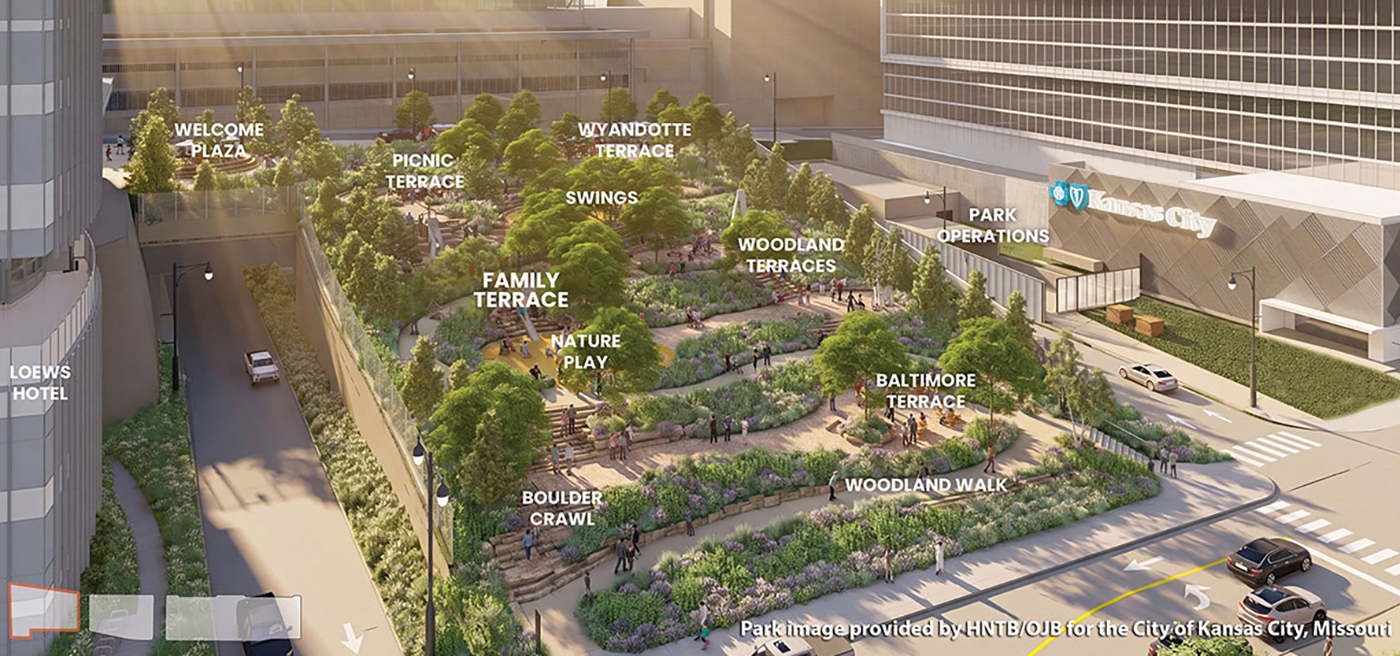
 HNTB/OJB for the city of Kansas City, Missouri
Rendering of an inclusive playground planned above Interstate 670 in Greater Kansas City, which aims to serve visitors of all abilities.
In April 2026, Variety KC, a nonprofit organization with a mission to support children of all abilities to “be active, be social, and belong,” announced its innovative Ten Parks Project, an initiative to create 10 inclusive play spaces across the Greater Kansas City metropolitan area.
Thanks to a generous $5.1 million donation from the Mallouk Family Foundation, the children’s charity has been able to start design on its first accessible playground at the Roy Blunt Luminary Park, located on a structural deck over Interstate 670. Civil engineers, architects, and designers are hard at work developing this novel and complex public space – and, as they do so, they are recognizing the importance of lived experience as they design the right engineering solutions to meet the park’s ambitious requirements.
Further reading:
- Seattle Aquarium Ocean Pavilion wins OCEA Award
- Tree canopy can help cities mitigate air pollution and heat, but space is limited
- Boat-shaped aquarium opens in Florida after years of design, engineering
“Our goal is to create a welcoming, inclusive, and accessible park for everyone,” said Ann Holliday, vice president of strategic initiatives at the Downtown Council of Kansas City. “And as we started, the question quickly became, ‘How (do) you take that kind of big goal and make it real?’”
Starting from the ground up
Kevin Wallace, P.E., vice president and Kansas City office location leader at HNTB Corp., a civil engineering, architecture, and infrastructure design firm, said this is a project that contains “many layers.” The first layer, he said, is to manage the existing infrastructure to build a tunnel and deck for I-670 so the park can extend across the entire highway.
“If we came in and tried to push I-670 lower to try to accomplish our goals, it would have cost us millions of dollars of city infrastructure and utility redesign work that no one has the budget to do,” he said. “We had to hold to the current level and find ways to build the structural supports for the park – the girders and beams you need there – and then start to push on the city street grid to make it work.”
That introduced the second big challenge.
Once adequate structural support was accounted for, it was critical for the designers to allow easy sidewalk accessibility in and out of the park. Wallace said the team had to find ways to expand the space for the four-block park while still ensuring people of all abilities and ages would be able to freely move in, out, and across the space.
“It doesn’t matter how accessible the park is if it’s hard for people to get in and out of,” he said.
All means all
The new park will feature an accessible play tower with a winding ramp, adaptive swings, a variety of sensory and play elements, and wide, interconnected ramps as well as smooth ground surfacing that supports wheelchairs, walkers, and strollers. Holliday said the design was made possible by involving people with lived experience from the earliest days of the project.
That allowed the design team to create something that didn’t just meet the basic Americans with Disabilities Act accessibility requirements, but a park that can be truly inclusive.
“It was important for us to make sure this would be a space that would be fun, but also a place where everyone would be comfortable – no matter the color of your skin, the language you speak, the way you move, or your intellectual capabilities,” Holliday said.
For example, Wallace said, in dealing with another engineering challenge, a 30- to 40-foot grade change on the west side of the park, Variety KC and its members helped the design team design an accessible pathway with flat areas for people to pause, rest, and play rather than just a straightforward switchback path. He said having the people who will use the park offer their feedback early helped them think through the many ways people would move through, experience, and use the different park features.
“Talking with them changed some of the material types we decided to use on the play surfaces, helped us improve wheelchair access, and think about what someone who wanted to play on a slide might need to get up to the slide, get situated, slide down, and then potentially move back to a wheelchair or other assistive device,” he said. “There are a lot of little details that folks with practical experience can offer to make sure you are thinking things through. It’s invaluable.”
Putting the pieces together
Construction for the first phase of the park, which includes the first of four blocks and the tunnel and infrastructure work, is scheduled for late 2026 – with an expected completion date of 2029. When asked what they hope other civil engineers and urban planners take away from this project, Wallace reemphasized the importance of involving people with lived experience as early as possible.
“What works for someone who is visually impaired might not work for someone in a wheelchair,” he said. “If your goal is for a space to be accessible and inclusive for everyone, you need to speak to as many people as possible with different needs. Then you have to figure out how to balance all those needs as you design.”
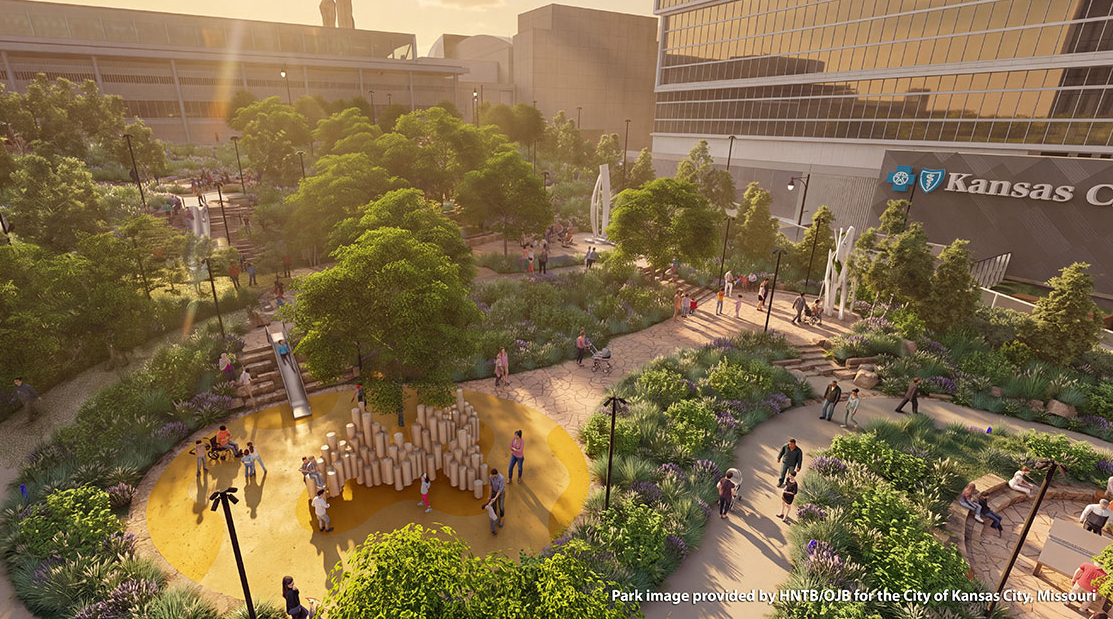 HNTB/OJB for the city of Kansas City, Missouri
Input from people with disabilities helped shape accessibility plans.
That often means expanding your definition of who, exactly, the park is being designed to support, Holliday added. She recalled speaking with a physically disabled mother who wanted to be able to take her children, who did not have physical disabilities, to play at the park once it opens.
“She wanted to have room to be with them and play with them,” she said. “That wasn’t something we had thought about. That’s why you need to talk to a lot of people. Because making something accessible for everyone isn’t always what you think – and having this kind of input can make you expand your definitions so you can make something that will really be inclusive.”
What’s Your Big Idea?
Did you enjoy this article about thoughfully planned infrastructure. Big challenges require big solutions, and ASCE2027 is your place for those big ideas.
Registration is open for ASCE2027: The Infrastructure and Engineering Experience, a first-of-its-kind event, bringing together big thinkers from all across the infrastructure space, March 1-5, 2027, in Philadelphia. Pack your big ideas and join the discussion.
Learn more about ASCE2027: The Infrastructure and Engineering Experience.