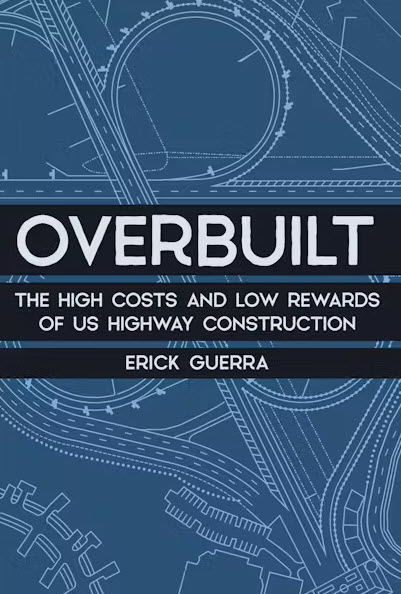
Overbuilt: The High Costs and Low Rewards of US Highway Construction, by Erick Guerra. Washington, D.C.: Island Press, 2025; 256 pages, $35.
At this moment in our history, a relatively new form of infrastructure is being feverishly built all across the U.S.
It is costly and often environmentally unsound – if not outright destructive. And in many places it is disrupting or dividing communities and making long-established towns or neighborhoods louder, uglier, dirtier, and generally less desirable places to live. However, we are told – and many earnestly believe – that despite the negatives, this new infrastructure is necessary for national defense, innovation, economic growth, and our ability to compete globally.
Further reading:
- ‘Arctic Passages’ explores climate change’s role in race to control Arctic trade routes
- History of engineering traces profession’s global evolution
- What business leaders need to know when it comes to climate change
You’ve no doubt guessed that the above reference is to data center construction in the mid-2020s. What is interesting is that many of the same negatives, as well as the promised positives, were shared by a very famous and much older infrastructure push in the U.S.: the Interstate Highway System and its associated road systems.
In Overbuilt, Erick Guerra, a University of Pennsylvania professor of city and regional planning and associate dean for research, vividly demonstrates how one of the most lauded public works achievements of 20th-century America was accomplished at great costs that were largely overlooked at the time. And, just as importantly, that 70 years later many of the same thinking, decision-making processes, and funding mechanisms continue to drive planning today.
This results, Guerra says, in building and rebuilding more and more roadway with little consideration of current needs – the significant body of newer research suggesting more roads often create greater congestion – or even just a willingness to evaluate whether previous investments have delivered the promised value and results.
For all of Guerra’s criticism of the approach to and the volume of roadway continuing to be built, he is not a public-transportation-biking-walking absolutist. He is pragmatic.
“Cars will continue to play the primary role in getting people to and from work, school, church, ball fields, (and) restaurants,” he writes. But, he notes, “the goal of federal transportation policy should be to help make these trips safer, shorter, and less economically and environmentally damaging.”
Guerra returns several times to an idea expressed by then-President George H.W. Bush, in the leadup to passing a major transportation bill in 1991 meant to be a major shift in highway policy, that the country should be focused on ways to “meet our present and future needs, not our past problems.” Unfortunately, after its passage not enough actually changed in terms of priorities, funding mechanisms, and assumptions about how much roadway is needed and where.
And as Guerra puts it, too few people “realize just how unsuccessful highway builders have been at reducing congestion or improving traffic safety, the two primary stated goals of nearly every large federal or state funding package since the National Interstate and Defense Highways Act” of 1956.
After an introductory chapter laying out the thesis, Overbuilt’s 10 chapters are roughly divided into three sections. The first chapters draw on original planning documents and other research to explore the creation of not just our Interstate Highway System (comprising about 40,000 miles) but the much larger 160,000 miles of the National Highway System and the 4 million miles of the Federal-Aid Highway System, including arterials and local roads.
In the book’s middle chapters, Guerra looks at recent studies focused on analyses of roadbuilding’s costs and benefits, with an emphasis on the often-ignored costs of overbuilding, not just in dollars but in traffic deaths and in creating a society that imposes enormous costs on those who can’t afford cars. He pithily summarizes the thrust of these studies: “Somewhere between a city with no roads and a city composed entirely of roadway lies a theoretically optimal amount of roadway for a given city.”
In the final chapters, Overbuilt sets about discussing what can be done, from new approaches to evaluating the financial and transportation dimensions of roadbuilding to federal land use policy alternatives to the gas tax, congestion pricing, automated vehicles, and more.
But a system 70 years in the making won’t be right-sized in a flash, and Guerra asserts that it will take decades, particularly because for now we have “an overbuilt transportation system whose expansion state and federal policy continues to subsidize and encourage.”
Overbuilt is insistent, well argued, and written elegantly in language that does not require advanced knowledge of transportation policy to understand. It should be required reading for policymakers, transportation officials, and others in positions to understand the ways in which the current system is broken and advocate for a new direction.