

By Lacey S. Duckworth, Ph.D., Christine M. Lozano, EIT, M.ASCE, Ashly Horner, Thomas J. Sigler,Patrick R. Ables, Ph.D., and Ashley N. Abraham, Ph.D.
The increasing volume and complexity of information that engineers must review for projects led the U.S. Army Corps of Engineers to develop a new digital process.
Engineering design review has always depended on experienced engineers to bring together information from multiple sources to determine whether a design is complete, coordinated, constructible, and compliant. What has changed is the volume and complexity of the information that engineers must review.
A single U.S. Army Corps of Engineers construction project can involve thousands of pages of specifications, drawings, calculations, schedules, standards, reports, and other supporting documentation that spans multiple disciplines and formats. For engineers and construction managers, the challenge is not simply finding information, it is determining how information relates across all those sources and whether there are issues or inconsistencies. A drawing note may conflict with a specification, a construction element may be missing corresponding requirements, or a standard may affect the information presented in the specifications or drawings.
As infrastructure grows in complexity, engineers and construction managers face increasing demands on their time and technical expertise. The question is no longer whether project reviews should become digital, because many of them already are. The question is how digital technologies and systems can be incorporated into the review workflow while maintaining the engineer’s and construction manager’s expertise.
In 2024, the Corps’ Construction Management Innovation Office asked the U.S. Army’s Engineer Research and Development Center to investigate whether emerging artificial intelligence capabilities could improve the efficiency and consistency of Corps constructability reviews.
ERDC began by examining two questions:
- Were there any commercially available technologies capable of assisting with constructability reviews?
- Could those technologies satisfy the Corps’ cybersecurity and deployment requirements?
The review identified several promising capabilities, but no available solution fully met the Corps’ operational and security needs. So ERDC proposed developing a Corps-specific approach based on the requirements given by the Construction Management Innovation Office.
In July 2025, the team conducted an initial demonstration of a minimum viable product, which established the proof of concept for ingestion of project documents (specifications and drawings). The product applied AI-assisted analysis and presented findings through a web-based user interface.
Ultimately, ERDC developed a system called the Engineering Review Decomposition Framework. The framework translates broad constructability and engineering questions into explicit criteria, required evidence, analytical tasks, and structured findings. This methodology is implemented using subfields of AI such as document intelligence, information retrieval, and computer vision, as well as a multi-agent AI system.
Together, these components are intended to reduce the repetitive work of locating, organizing, and comparing information across multiple documents. The objective is not to replace human reviewers but to flag the relevant evidence and potential inconsistencies so that engineers and construction managers can focus on interpretation, risk, constructability, and final decision-making.
From digital documents to engineering knowledge
Digital engineering has made project information easier to store, transmit, and reproduce, but digital documents do not automatically create digital engineering workflows.
Traditional reviews remain largely document-centric. Engineers locate specifications, search drawings, compare information across files, consult standards, and document findings. Much of the effort involved in a review can therefore be spent locating and organizing information before the engineer can evaluate its significance.
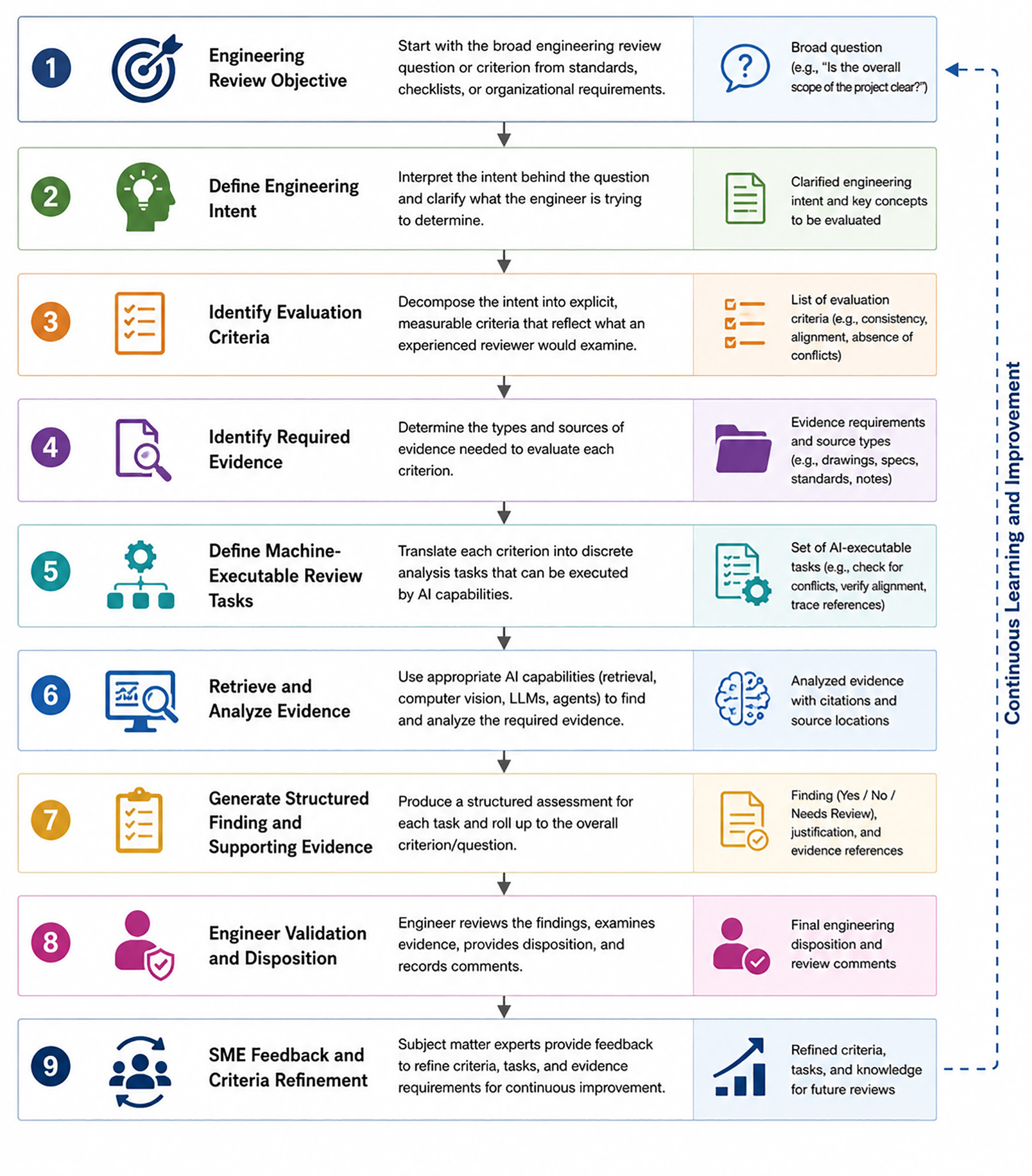
A digital transformation changes this relationship by treating drawings, specifications, calculations, and standards as connected sources of information rather than isolated documents. A faster search tool is a worthy aim, but creating an information environment in which relevant evidence can be assembled around an engineering question is even better.
For example, consider the seemingly straightforward question: Is the overall scope of the project clear? An experienced engineer can interpret that question using knowledge of project requirements, drawings, specifications, and typical construction practices. An AI system, however, needs considerably more structure to perform the same evaluation consistently. Therefore, the question may need to be translated into specific checks:
- Are scope descriptions consistent throughout the specifications and across drawings?
- Do the drawings and specifications describe the same work?
- Are expected specification sections present?
- Are there conflicting descriptions or omissions?
Breaking the question into these observable conditions creates a bridge between engineering judgment and AI-assisted analysis. This decomposition is central to the framework, which makes portions of the review process explicit enough to automate with AI to assist with information-intensive tasks while leaving the final assessment and determination to the reviewer.
The framework uses four interconnected layers:
- Engineering data layer — organizes project information.
- AI processing layer — converts textual and graphical information into analyzable data.
- Engineering reasoning layer — applies structured review criteria.
- Human decision layer — keeps professional judgment and accountability at the center of the process.
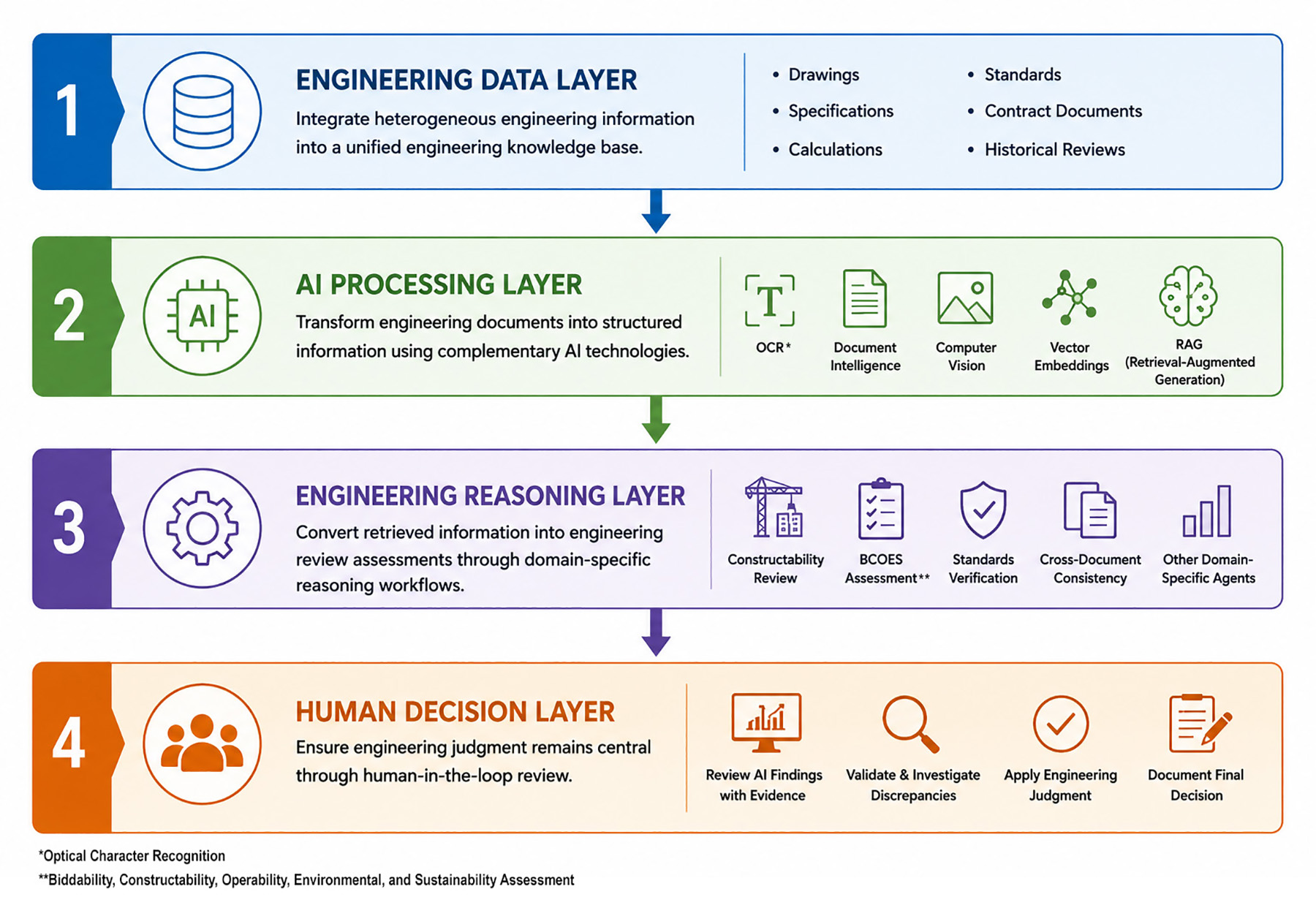
These layers provide a pathway for applying AI to engineering problems without treating AI as a standalone technology. More capable models may expand what AI can do, but model capability alone does not determine whether an AI system is appropriate for constructability reviews. Engineering and construction applications require trustworthy information, domain-specific criteria, traceable evidence, appropriate security controls, and clear accountability.
AI as a collection of capabilities
The ERDC’s evaluation phase demonstrated that construction project review is not a single AI task. Each part of the project package contains several forms of information that must be interpreted differently. Specifications and reports come in a narrative format; drawings communicate through lines, symbols, annotations, dimensions, and spatial relationships; calculations contain mathematical and structured information; and standards establish criteria that must be applied to project-specific conditions. No single AI technique can reliably interpret and connect all these information types.
The framework coordinates several complementary capabilities that perform three main functions: extracting and interpreting information, retrieving and connecting relevant evidence, and organizing that evidence into a structured review workflow.
Document intelligence and optical character recognition extract text — and other structured information, such as tables — from specifications, reports, and drawings. Computer vision interprets graphical content that is difficult to represent through text alone. Lastly, custom object-detection models can be trained to identify specialized engineering features such as soil borings, cone penetration tests, and keynote symbols.

The development of the custom object-detection models presented a distinct challenge. Architecture, engineering, and construction symbols and drawing elements are not always standardized, and human reviewers can infer meaning from context that an automated system would not recognize. Specialized AEC and elements are underrepresented in conventional machine learning datasets.
To address this limitation, the ERDC team used synthetic data generation in which engineering symbols were extracted from existing drawings and converted into reusable image assets.
These assets were then placed algorithmically onto representative drawing sheets reflecting hand-drafted and digitally produced drawings in varying formats. This created labeled examples for a specific model development. This approach provides a practical way to develop specialized computer-vision capabilities without requiring engineers to manually label every example.
Once the information has been extracted from the project documents, the second set of capabilities connects evidence from the project documents to the relevant review question. The process known as retrieval-augmented generation fetches relevant portions of the project document text and supplies them to the large language model as context for analysis.
This reduces the LLM’s reliance on generalized knowledge and grounds the resulting finding in project-specific evidence. This is particularly important for use in reviewing because findings that sound reasonable but cannot be supported by the project documents are not adequate for a quality review.
The framework presents findings with references to the supporting documents and locations within the documents, allowing the reviewer to examine evidence associated with each result.
The third capability is organizing the review workflow. Many of the review questions require evidence across different sources and a sequence of related analyses. This is where the agentic AI approach can help by having multiple specialized agents (workers) execute defined tasks such as retrieving information, consulting project documents, and organizing the results into a structured finding for review.
For example, a drawing-to-specification consistency review may require identifying relevant drawing elements, locating corresponding specification sections, comparing the information, consulting applicable reference material, and determining whether the differences present a potential discrepancy. Once the system has gone through this workflow, it can present the findings and sources to the reviewer.
The decomposition framework does not ask AI to make one overall decision. It breaks down the review into smaller and traceable information-processing activities that support the Corps’ constructability review checklist.
Keeping engineers in the loop
The most important design principle may be the simplest: The engineer remains responsible for the engineering decision.
AI-generated findings are presented with supporting evidence, source references, and context. Engineers can investigate the underlying documents, determine whether a potential discrepancy is meaningful, identify false positives, provide additional engineering context, and document the final disposition. This human-in-the-loop approach recognizes a fundamental characteristic of engineering review: Not every question has an objectively correct answer that can be determined from documents alone. Professional judgment remains necessary to interpret ambiguity, assess risk, understand design intent, and determine whether a finding has practical significance.
This is also why explainability matters. In an engineering application, an AI response should not simply state that something is wrong. The reviewer needs to understand what the system identified, why it was identified, and where the supporting information came from.
The framework therefore emphasizes structured findings rather than unrestricted conversational responses. The structured findings are provided as status outputs such as “Yes,” “No,” or “Needs Review,” accompanied by a justification and references to the relevant project information. The engineer or construction manager can then make the final determination.
From prototype to enterprise capability
Because the framework’s capabilities are still under development, testing has been limited to documents from previously completed projects rather than active ones. The documents used for testing have ranged from buildings to flood risk management infrastructure.
The framework is under review by a pilot group of construction manager reviewers from several Corps districts. Their feedback is being used to assess accuracy, refine review workflows, evaluate consistency across project types, and incorporate additional subject matter expertise into the instructions, review strategies, and reference materials used by the multi-agent AI system.
Subsequent development has expanded the original proof of concept through parallel document processing, specialized object detection, synthetic training data, integration between computer vision and language models, and agentic AI capable of multistep retrieval and analysis.
This progression illustrates an important lesson for organizations considering AI adoption: Developing a model is only one part of deploying an engineering AI capability. Deployment requires attention to infrastructure, security, permission, scalability, maintainability, user interaction, governance, and project isolation (which involves grounding each analysis in the appropriate project data while keeping information from different projects separate).
For federal engineering organizations, these considerations are especially important because project information may be sensitive and access must be controlled; therefore, the framework incorporates project identifiers and user permissions into AI-agent execution so that retrieval can be restricted to authorized project information.
The development effort showed that new technology must fit established review workflows. The framework does this by organizing findings around the Corps’ constructability checklist, presenting evidence in a format reviewers can verify, and allowing reviewers to accept, deny, or do further investigation with each finding. In this way, new capabilities can be introduced without requiring reviewers to relinquish familiar processes, which would reduce the acceptance and learning rate.
Broader deployment of the framework depends on the results of continuing user evaluation, performance validation, cybersecurity authorization, and infrastructure readiness. Presently, the ERDC team is in the process of identifying technical and operational limitations before the framework is considered ready for use on active projects.
Measuring opportunity
The development effort mentioned above also provided an early indication of where digital transformation can produce practical benefits.
During an early capability test of the document-ingestion pipeline, the initial implementation required approximately 45 minutes to process a 900-page specification. The ERDC team subsequently redesigned the pipeline so that multiple portions of the document could be processed simultaneously rather than sequentially. This redesign involved dividing the specification into smaller, logically organized sections, a process known as document chunking. Those sections were then converted into numerical representations that support meaning-based information retrieval, a process known as vectorization. By performing these and related ingestion activities in parallel, the system processed the same specification in approximately three minutes.
The significance of this improvement extends beyond the processing time itself. Faster processing makes it more practical to analyze large document packages and execute multiple review tasks without requiring engineers to perform the underlying information-management activities manually.
The system also expanded the types of project information that could be analyzed. Initially, only digitally generated PDFs containing machine-readable text and scanned image-based documents could be processed. Adding computer vision to the framework process provided a way of analyzing graphical engineering information, such as bore logs. The framework’s workflow is set up so that multiple specialized detection models can operate concurrently, and their results can be incorporated into downstream analysis.
Agentic workflows further expanded the review capability by moving beyond simple search toward multistep analysis of drawings, specifications, and other project information.
These results should be viewed as demonstrations of technical feasibility rather than validation of autonomous engineering review. Because the framework remains in pilot testing, its findings depend on the quality of the source documents, the completeness of the retrieved evidence, and the accuracy of the extraction and detection methods. Continued testing is necessary to characterize performance across disciplines, document formats, and document types.
The engineer of the future
The most useful way to understand the potential of AI in engineering may be to consider how it changes the way AEC personnel steward their time.
Reviewers should not have to spend most of a review searching thousands of pages for information, manually comparing repetitive content, or assembling evidence that a machine can organize. Those activities are great candidates for intelligent automation. The engineer and construction manager’s time is more valuable when applied to questions that require experience: Does this discrepancy matter? Is the design constructible? What is the associated risk, and is there an acceptable alternative? Does the proposed solution satisfy the intent of the requirement?
AI can help bring the relevant information to the engineer at the right time and in a format that can be evaluated. That is the central idea behind the digital transformation of construction project reviews at the Corps: The goal is not to have an autonomous engineer, nor a chatbot that simply answers questions, but a review workflow in which AI processes information, retrieves evidence, executes structured analyses, and identifies potential issues, while reviewers retain responsibility for interpretations and decisions.
As infrastructure organizations confront increasingly complicated projects, growing information volumes, and constrained technical resources, this model offers a practical path toward more efficient review.
The future of engineering AI may not be defined by whether machines can replace engineers. It may be defined by whether engineers can use AI to spend less time finding and organizing information and more time applying the judgment, experience, and responsibility that make engineering decisions valuable.
Lacey S. Duckworth, Ph.D., is the associate technical director for information science and data transformation at the U.S. Army Engineer Research and Development Center.
Christine M. Lozano, EIT, M.ASCE, is a research civil engineer, principal investigator, and program manager at the U.S. Army Engineer Research and Development Center.
Ashly Horner is a computer scientist at the U.S. Army Engineer Research and Development Center.
Thomas J. Sigler is a computer scientist at the U.S. Army Engineer Research and Development Center.
Patrick R. Ables, Ph.D., is a computational scientist at the U.S. Army Engineer Research and Development Center.
Ashley N. Abraham, Ph.D., is a computer scientist at the U.S. Army Engineer Research and Development Center.
This article first appeared in the November/December 2026 issue of Civil Engineering as “Using AI to Transform Engineering Review.”
The authors will be presenting this topic at ASCE2027: The Infrastructure and Engineering Experience, March 1-5, 2027, in Philadelphia. Find out more at experience.asce.org.


