
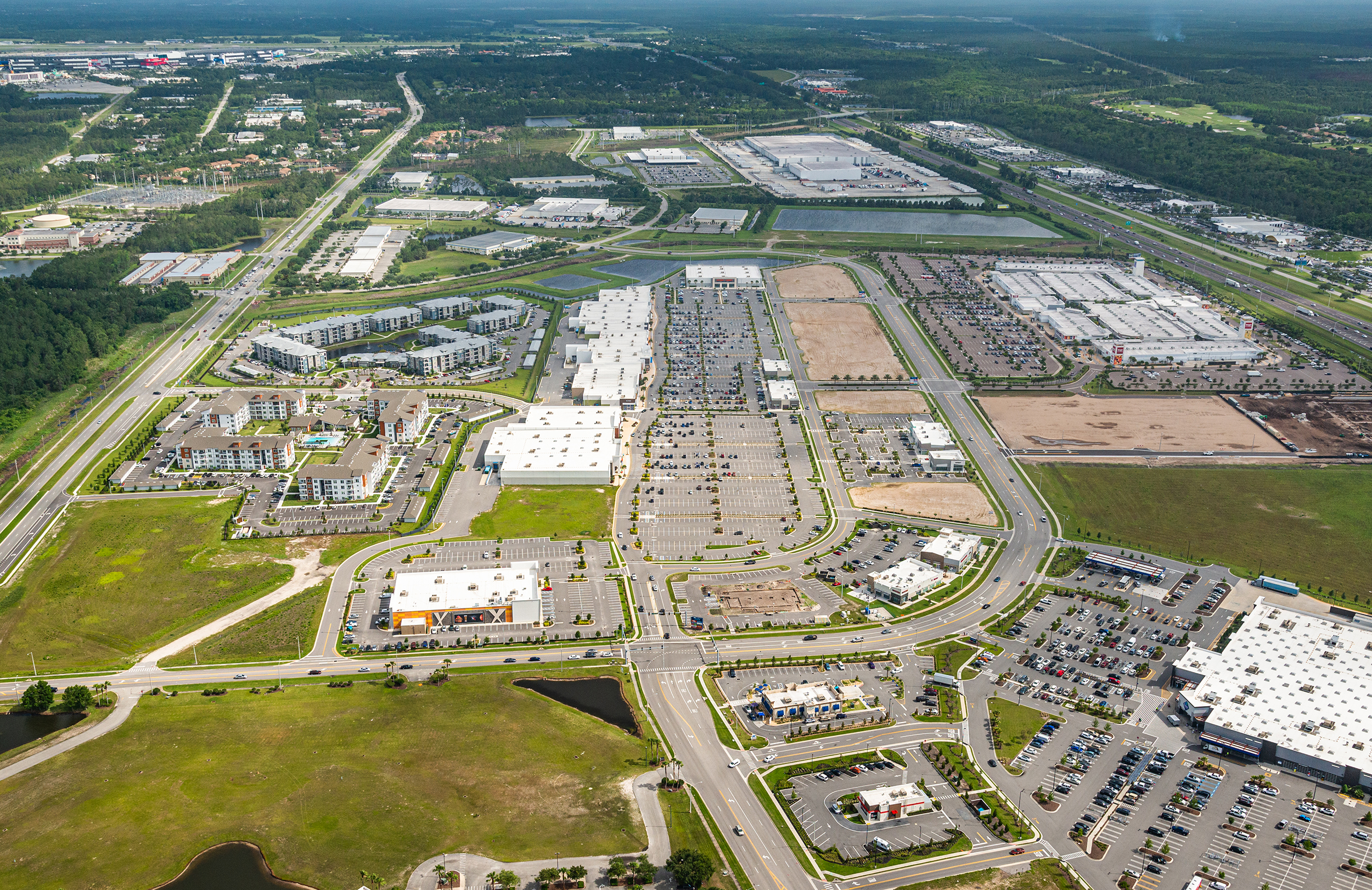
 Courtesy of NADG
 On any given weekend in Daytona Beach, Florida, the Tomoka Town Center is bustling: cars stream off Interstate 95, families move between restaurants and retail stores, residents walk their dogs, and visitors stop on their way to the beach.
What feels seamless today was engineered years before the first tenants arrived.
Further reading:
- How master planning helped design three communities in the Carolinas
- Seattle’s epic waterfront overhaul features new pier, playground sculpture
- Brazil’s Curitiba has been following its master plan for 60 years
Tomoka Town Center is a master-planned mixed-use development that includes about 1.2 million square feet of retail and nearly 600 residential units. Throughout a multiyear expansion, AVID Group, now part of McAdams, has supported the project through land use entitlements, site planning, and civil engineering across multiple phases, most recently for the development of a Trader Joe’s grocery store and PopStroke, an upscale miniature golf facility.
Today, the Tomoka Town Center is a thriving retail and entertainment corridor serving growing residential neighborhoods west of I-95 and visitors entering Daytona Beach, but its success rests on a backbone of infrastructure most people never see.
Large mixed-use developments rarely follow a static script. Over the life of Tomoka Town Center, market demand has shifted, residential components have expanded, and commercial uses have evolved. Planned development documents and development agreements have been amended multiple times to reflect those changes.
That reality shaped one of the earliest engineering priorities: designing an infrastructure framework flexible enough to accommodate unknown future tenants and phased construction over time.
Rather than designing infrastructure one phase at a time, the team installed most of the backbone utility network during the initial construction effort. Water, sewer, and reclaimed water lines were extended and stubbed to future outparcels, creating what the team refers to as “plug-in parcels” – sites preconfigured with utilities.
The approach allowed future tenants to connect directly into existing systems without requiring major redesign or disruption to completed portions of the site. Parcels could develop in varying sequences while maintaining system capacity and functionality. On a project with a 10-year development horizon, flexibility is an engineering decision, not just a business one.
Infrastructure and utilities at scale
From a civil engineering perspective, the scale of Tomoka Town Center amplified the complexity of basic systems. Stormwater management was one of the most significant design drivers, but the project also required coordinated planning for multiple systems, including:
- Regional access and internal circulation
- Water, sanitary sewer, and reclaimed water capacity
- Utility corridors beneath large parking fields
- Drainage infrastructure across more than 125 acres
Florida’s regulatory environment places strict requirements on stormwater treatment, attenuation, and discharge. Engineers had to account for pond storage volume, water quality treatment, downstream conveyance, and the performance of the system at full buildout while accommodating phased development.
One specific challenge involved balancing grading elevations across a large site while maintaining gravity flow throughout the stormwater system. With hundreds of acres draining to interconnected ponds and conveyance structures, even small elevation differences could affect system performance. The engineering team developed a coordinated grading strategy to ensure runoff moved efficiently through the network without requiring stormwater pumping infrastructure.
The final system relies on carefully modeled pond storage and gravity-driven conveyance, quietly managing runoff during Florida’s heavy rainfall events. On a site this size, every elevation matters.
One aspect the public rarely considers is the density of utilities beneath a mixed-use destination. Water, sewer, reclaimed water, gas, power, and telecommunications systems run underneath the roadways. These networks allow grocery stores to operate refrigeration, restaurants to function at peak hours, and residential buildings to serve hundreds of residents.
One notable coordination effort involved an existing municipal sanitary sewer lift station serving the area. The development’s projected wastewater flows required modifications and close coordination with the city’s utility department to confirm alignment with its master utility planning model.
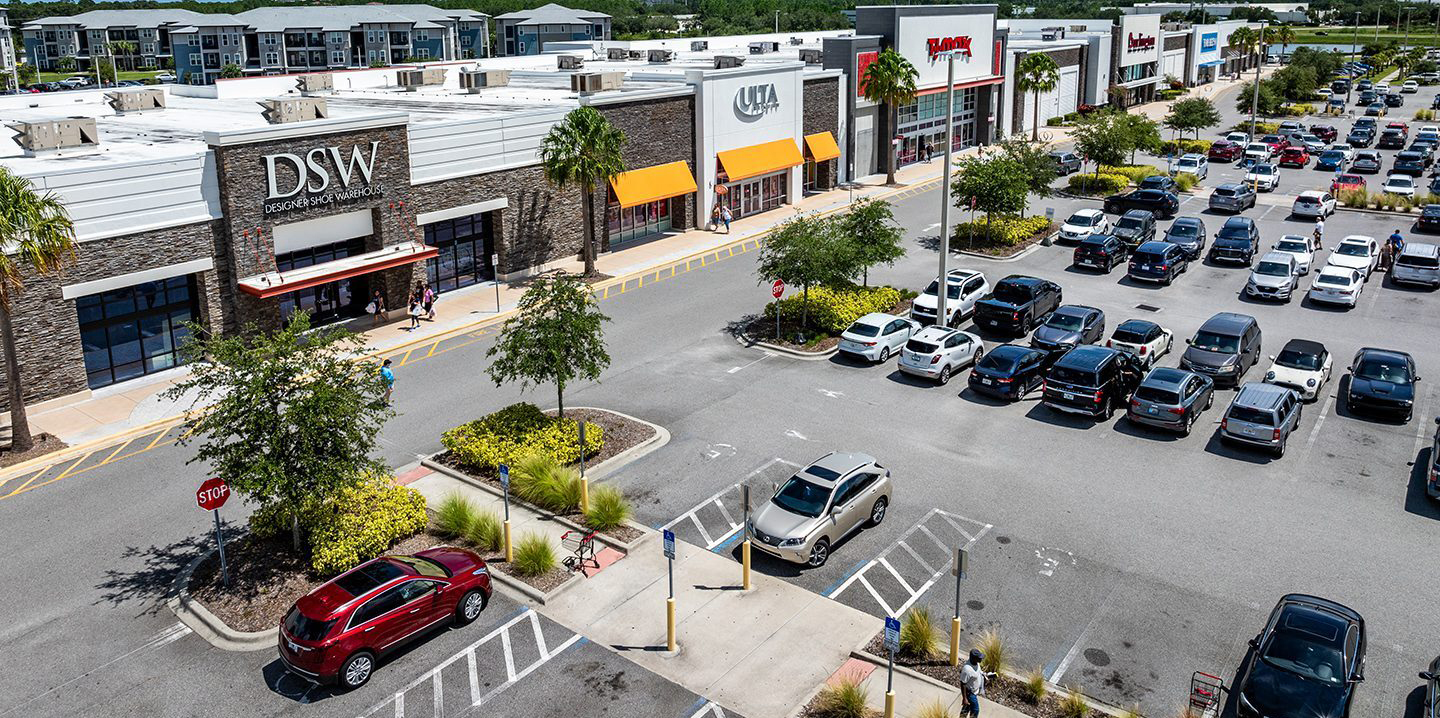 Courtesy of NADG
 Engineers worked directly with municipal staff to confirm that the downstream force main system could accommodate future capacity and to ensure the project integrated seamlessly with the city’s broader infrastructure network. The goal was not only to make the development function internally, but to ensure it operated reliably within the larger municipal system.
Tomoka Town Center is strategically positioned along a major interstate corridor to function as both a regional retail destination and a gateway into Daytona Beach.
Major arterial connections were already in place prior to full development, but the project required off-site roadway improvements and careful coordination of access points, including those along major corridors. Engineers evaluated long-term traffic patterns and established alignments that could support future signalization if needed.
Internally, circulation and pedestrian connectivity were designed to allow movement between parcels without forcing vehicles back onto major roadways. Sidewalk networks connect retail, dining, and residential areas across the site, which resulted in a development capable of absorbing significant activity without feeling fragmented or congested.
Large mixed-use projects are as much about coordination as they are about calculations. Tomoka Town Center required collaboration among engineers, planners, architects, contractors, and multiple reviewing agencies. Jurisdictional oversight included the city, the county, transportation departments, and regulatory agencies.
One particularly complex approval effort involved roadway coordination along a major artery during a period of concurrent regional development. Engineers navigated interim traffic conditions, long-term roadway planning, and multiagency review to secure necessary approvals.
Field coordination also played an important role.
As is common on large sites, existing conditions sometimes differed from available record drawings. However, engineers and contractors worked together to evaluate field conditions, adjust designs where necessary, and implement value-engineered solutions that maintained the project schedule. Communication was not just a project management tool but a technical one.
Lessons in data and design evolution
When asked what they would approach differently, team members pointed to one recurring lesson: the importance of accurate existing condition data.
On projects of this magnitude, survey data, subsurface utility information, record drawings, and as-built documentation form the foundation of new design. Incomplete or outdated data increases field risk and can introduce unexpected conflicts during construction.
The experience reinforced the importance of investing early in high-quality geomatics, subsurface investigation, and record verification. On projects of this scale, good data reduces downstream risk significantly.
The project also reflects broader industry evolution. Earlier residential components emphasized buffering and separation between uses. Today, mixed-use environments increasingly prioritize walkability and direct connections between residential, retail, and dining spaces.
From an engineering standpoint, success is measured in performance and longevity. Tomoka Town Center continues to thrive years after its initial phases opened. Tenants remain active, and residential demand has expanded beyond original projections. The development serves longtime residents and those affiliated with new growth along the corridor.
Its success is not accidental. It is the result of infrastructure planned for ultimate buildout, utilities coordinated within municipal systems, and a flexible framework capable of adapting to changing market conditions.
Civil engineering rarely headlines a destination, but the systems beneath it shape every experience above. These systems include the grading that moves stormwater away from buildings, the utility networks that power restaurants and homes, and the circulation patterns that keep traffic moving.
Most visitors never notice them but benefit from them every day. With projects like Tomoka Town Center, what you don’t see is exactly what makes everything work.
