An Engineered World: The Role of Engineers in Global Modernity, edited by Edward Beatty and Israel G. Solares. Cambridge, Massachusetts: The MIT Press, 2025; 320 pages, $70.
In terms of principles, ideas, projects, and goals, “engineering” stretches back millennia. “Engineering, in its broadest sense, encompasses humans’ strategic efforts to manipulate the environment and construct the means to do so more effectively,” Edward Beatty and Israel G. Solares write in An Engineered World’s introduction.
However, they note that for most of that time these efforts could be characterized as effective but informal by modern standards. With this book, the culmination of years of planning and research, they aim more specifically to explain the leap from a loose collection of ideas and practices to the modern profession of engineering.
Further reading:
- What business leaders need to know when it comes to climate change
- ‘Inevitable’ makes strong case that EVs will dominate global auto market
- Ithiel Town’s lattice bridge transformed American construction, book argues
To do so, An Engineered World examines important aspects of engineering’s evolution across the world, particularly during a time when it was truly “coming into its own” as a formal profession grounded in institutions, standards and ethics, publications, and many of the trappings that we take for granted today.
Beatty and Solares, the book’s editors – who also wrote, in addition to the introduction, the concluding chapter – peg the period of greatest initial transformation as 1870 through approximately 1920, with the book also stretching out to 1950 or so to capture additional development and expansion of “modern professional engineering.”
After a discussion in 2018 about the relative absence of engineers from historical literature on economics and business, the pair eventually obtained research funding and set about assembling “a network of scholars who work on the history of engineering in diverse global contexts and who think about an integrated (or interactive) global context.” Workshops helped identify the book’s themes and determine the authors and chapters.
The editors decided to sketch the period between 1870 and 1950 using eight case studies centered on engineers “working in distinct but interconnected spaces around the world.” This approach yielded coverage of a variety of types of engineering, as well as work happening not just in North America and Europe but also Asia, Africa, and Latin America – with significant attention paid to the many commonalities of how the profession developed in different places despite different cultural or economic climates.
The case studies that form the chapters each run roughly 25-30 pages, and all are copiously footnoted for references and further reading. The chapter topics range from an examination of engineers studying meteorology in Mexico to consulting engineers’ role in mass mining around the globe to a dive into the career of India’s most celebrated engineer, who also gained renown as a statesman and economic planner.
Because of the multiple-author format, the chapters tell these stories in different narrative voices – though they remain connected through the shared language and approach of historians.
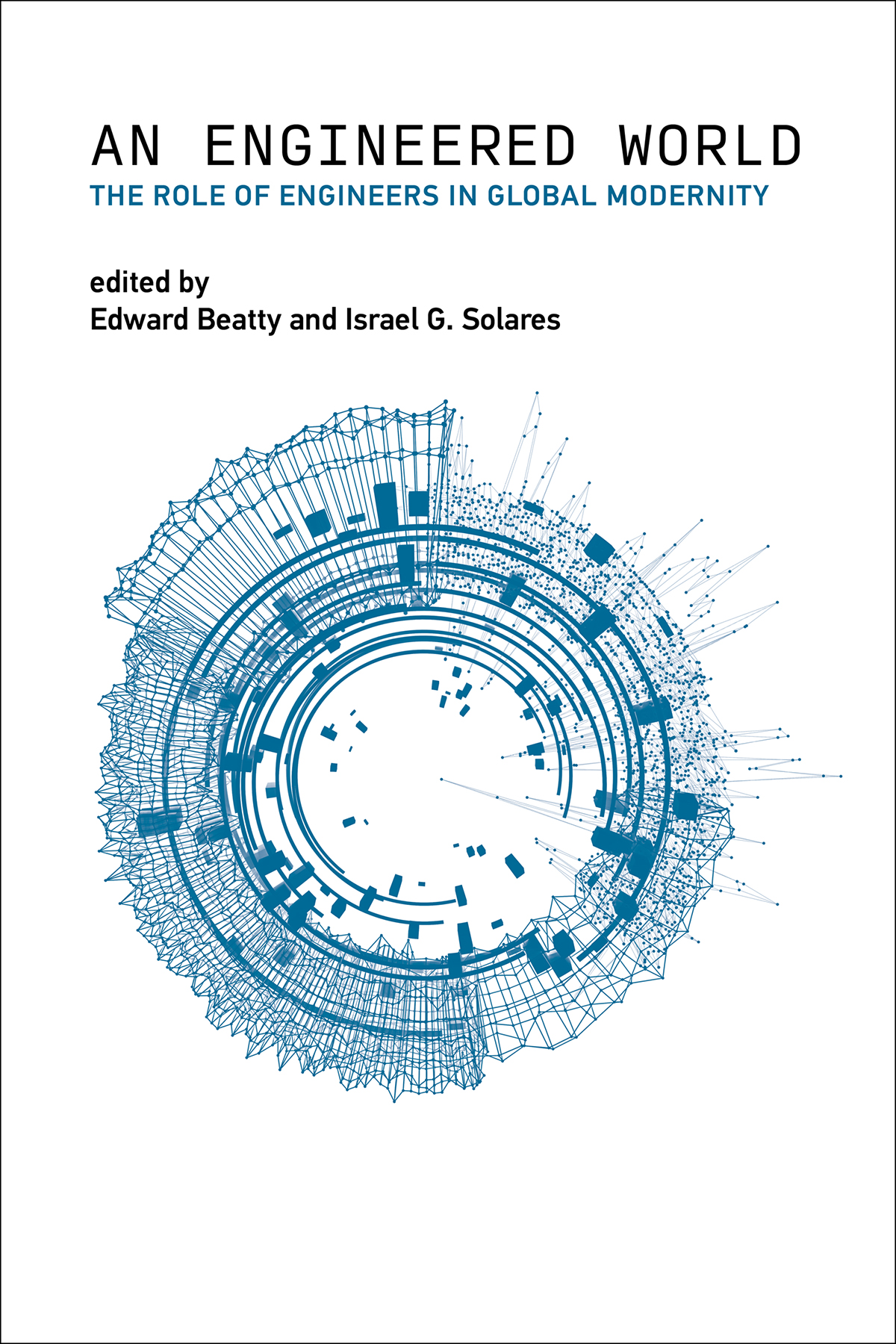
In addition to its broad coverage of a crucial time in the profession’s development, An Engineered World is also the seventh book in MIT Press’ Engineering Studies Series, which launched in 2016. An eighth book is due later this year.
The series is described as “research in historical, social, cultural, political, philosophical, rhetorical, and organizational studies of engineers and engineering, paying particular attention to normative directionality in engineering epistemologies, practices, identities, and outcomes,” with the subjects as varied as that implies.
Deeply researched and written with scholarly authority, An Engineered World will interest readers seeking specific examples of the engineering world growing into inarguably one of the world’s most important professions and those seeking a fuller accounting of engineering’s importance to a key period of globalization in human history.