
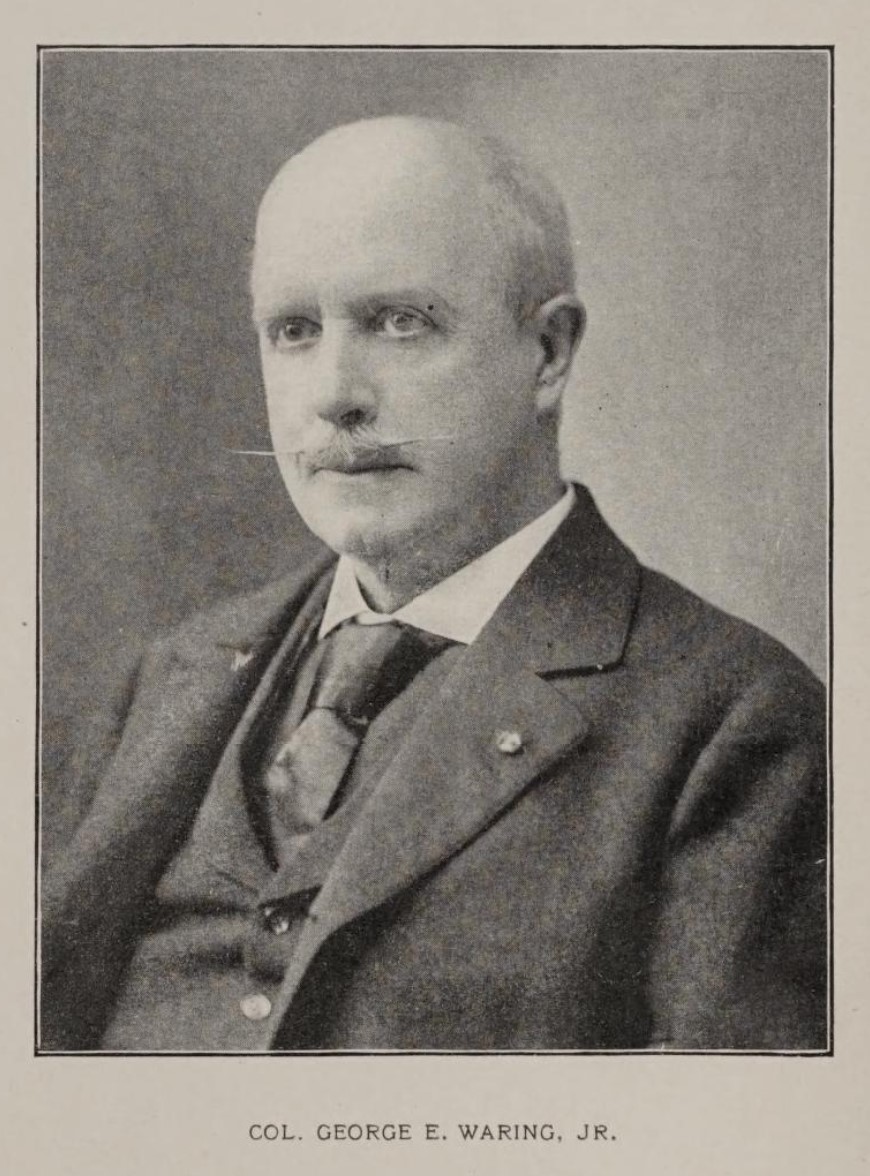
 George Edwin Waring, Jr.
1833 – 1898
George E. Waring, Jr. was born on July 4, 1833, in Pound Ridge, New York, the son of George E. Waring, Sr., a wealthy farmer and manufacturer of farm equipment and stoves. Waring was educated in public and private schools in Stamford, Connecticut, and in Charles Bartlett’s College Hill School in Poughkeepsie, New York, becoming trained in agricultural chemistry. Starting in 1850, he was employed in the hardware business, managed a country gristmill in Stamford, became a pupil of James J. Mapes at his Experimental Farm. Waring then lectured before farmer’s clubs throughout Maine and Vermont on improved methods of farming (agricultural science), during the winter of 1854. In 1855, Waring took charge of Horace Greeley's farm at Chappaqua, New York. In 1857, Waring was appointed agricultural and drainage engineer for the construction of New York City's Central Park. This effort was considered to be the largest drainage project of its time. Prior to this time, much of the area of the proposed park was a wetland. He designed and supervised construction of the drainage system that created the scenic lakes and ponds of the park. An enthusiastic equestrian, he and his horse "Vixen" would often use the park's construction as jumping obstacles.
In May 1861, near the beginning of the Civil War, Waring resigned from the Central Park project to accept a military commission as Major in the 39th New York Volunteers (the Garibaldi Guard). He departed New York in the early summer, and drilled for a month in Washington, D.C., occasionally meeting President Lincoln as he reviewed the troops. Waring fought in the
Battle of Blackburn's Ford (Virginia) on July 18, 1861. In August, he was appointed a Major of Cavalry and joined Gen. John C. Frémont and headed to St. Louis, where he raised six companies to form the Fremont Hussars. They were consolidated with the Benton Hussars to form the 4th Missouri Cavalry, with Waring commissioned its Colonel in January 1862. Waring then commanded a cavalry brigade under Brigadier General John Davidson in southern Missouri and northern Arkansas. Waring’s regiment then moved on to Union City, Texas in 1863 and he commanded the 1st Brigade of the Calvary Division of the Union Army’s 16th Corps in 1864, fighting principally in the Southwest.
After engaging in several unsuccessful enterprises after the war, Colonel Waring settled at the Ogden Farm near Newport, Rhode Island, in 1867 to manage the farm. At the Ogden Farm, he introduced Jersey cattle into the United States and founded the American Jersey Cattle Club. Waring is known to have laid clay drainage pipe there for field improvement, some of which still exists. In 1871, Waring worked on the sewerage system for Ogdensburg, New York, and then the main sewer for Saratoga Springs, New York in 1874. In 1876, William Smith patented a jet siphon water closet, an innovation that caught the attention of Waring, who further developed the design for larger pieces of sanitary ware (toilets). In 1877, drainage and sanitary engineering became Waring’s major preoccupation. In 1881, William Paul Gerhard, another historically important sanitary engineer, became Waring's chief assistant.
Memphis, Tennessee had suffered several severe cholera epidemics (1849, 1866, 1873) and yellow fever (1867, 1873, 1878 and 1879), with over 5,000 fatalities in 1878 alone. Sanitary conditions in the city were poor, with many domestic wells close by privies and drained by a fetid bayou. Many buildings had standing water underneath because of the poor-draining clay soil. Civic leaders recognized the need for better drainage and a sewer system that would keep domestic waste away from the wells, although they were wrong in their belief that yellow fever was spread by inadequate sanitation practices. It was, in fact, spread by the Aedes aegypti mosquito, which breeds in stagnant water. The financially strapped city and the state legislature were unable to raise sufficient funds for construction of a conventional combined sewer system, due to the mass exodus of residents for fear of yellow fever. The situation in Memphis aroused the sympathy of the nation and was largely responsible for the creation of the National Board of Health, a predecessor to the United States Public Health Service. In 1880, the Board sent Waring to Memphis, where he designed what he thought was a system Memphis could afford. Waring's design called for the separation of sewage waste from storm water runoff, an innovation that reduced the size of the pipes required to carry septic sewage. Waring’s system included small-pipe sewers, a strictly “separate” system, designed to receive nothing but household wastes, automatically flushed at regular intervals and with special provision for ventilation. Until this time, this idea had not been used in the United States on a large scale. Memphis constructed the separated sewer system (universally known as the “Waring’s System”) according to Waring's plans, and its era of epidemics came to an end.
In June 1879, Waring was appointed expert and special agent of the Tenth Census of the United States in charge of the social statistics of cities. Waring then worked on the Buffalo Trunk sewer and was a Member of the National Board of Health from 1882 to 1886. In 1887, he worked on the sewerage in Santiago, Cuba. In 1895, Waring was brought to New York City, where sanitary conditions had become intolerable. Horses were leaving an estimated 2.5 million pounds of manure and 60,000 gallons of urine on the streets every day, and their carcasses rotted in the streets. Garbage piles reached a foot or two deep, cleared only haphazardly by a "ragtag army of the unemployed." In 1895, as the new Commissioner of the New York City’s Sanitation Department, Waring began by securing a law requiring horses and carts to be stabled overnight, instead of being left on the street. Waring established a Street Cleaning Department, a white-uniformed corps of workers wearing pith helmets and pushing wheeled carts tasked with cleaning up city streets. Waring's men cleared a shin-deep accumulation of waste across the city. Horse carcasses were removed from the streets and sold for glue; horse manure was sold for fertilizer. Other refuse was sent to dumps along the waterfront. He introduced the three-part separation of refuse at the household (garbage, ashes, and rubbish) to facilitate their final disposition. Waring's crew even removed snow, packing it into trucks and dumping it into the rivers. The success of Waring's efforts was quick, dramatic, and much appreciated by New York citizens. A parade was held for the sanitation works in 1896. At the close of the Spanish– American War in 1898, President McKinley appointed Waring to make a study of the sanitary situation in Havana and other ports in Cuba.
While in Cuba, Waring contracted yellow fever and died shortly after returning to New York City on October 29, 1898. Waring was married three times: first in 1855 to Euphemia Johnston Blunt; second in 1865 to Virginia Clark; and third on July 20, 1898, to Louise Yates of New Orleans. Waring planned and supervised the sewerage of more than forty towns and cities in the United States, and invented numerous sanitary devices, chiefly in connection with the drainage of houses and towns. He was an Honorary Member of Holland’s Royal Institute of Engineers, was elected a Member of Great Britain’s Institute of Civil Engineers (ICE) on December 5, 1882, a Fellow in Great Britain’s Sanitary Institute, a Member of the American Public Health Association, and a Corresponding Member of the American Institute of Architects. Between 1872 and 1897, Waring authored 11 essays, books, and other publications on topics ranging from Jersey cattle and horses to sewage disposal. In 1886, Waring contributed a paper titled “Siphon-Outlet for a Low-Sewer District, Norfolk, Virginia, U.S.A.” to the ICE’s Proceedings. Waring Avenue in the North Bronx near Pelham Parkway was named in his honor. Memphis has Waring Road, running from Walnut Grove Road north to Macon Road at Wells Station Road, going through the Berclair neighborhood.
Resources:
“A Biographical Dictionary of American Civil Engineers”, Neal FitzSimons (Chairman), Clifford Betts, J.W. Briscoe, Charles Merdinger, and Joseph Rady, Committee on History and Heritage of American Civil Engineers, ASCE, 1972.
Life of Col. Geo. E. Waring, Jr. The Greatest Apostle of Cleanliness, as told by Dr. Albert Shaw, The Patriotic League, New York, 1899
“George E. Waring, Jr.”, Wikipedia (Wikipedia Foundation, Inc.), 2022.