
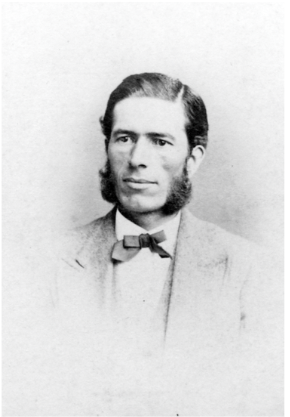
 Institute Archives and Special Collections, Rensselaer Polytechnic Institute, Troy, New York
 Leffert L. Buck was born in Canton, New York on February 5, 1837. After attending the local academy, he chose to learn the machinist trade. In 1858, he enrolled in the first class at St. Lawrence University in Canton, New York. After two years of study, the Civil War broke out and Buck left college before receiving a degree.
Buck enlisted as a private in October 1861 in the Sixtieth (60th) New York Infantry six months after the war began. The 60th just missed the Second Battle of Bull Run but did take part in the battles of Antietam, Chancellorsville, Gettysburg, and Lookout Mountain in the famous Battle Above the Clouds on November 24, 1863. The 60th was part of General William T. Sherman’s Army, which marched to the gates of Atlanta, one of the major railroad towns in the Confederacy. His major battles on that march were at Resca and Peachtree Creek. Later in the fall of 1864, Sherman selected his very best men to make the march to the sea and Savannah, Georgia. After taking Savannah, Sherman started north on January 27th and marched through South and North Carolina, and after Lee surrendered in mid-April on to Washington, D.C., where the 60th was mustered out of service on July 17, 1865. He was wounded twice and rose to the rank of Captain and received a Brevet rank of Major. Buck then attended Rensselaer Polytechnic Institute in Troy, New York and graduated with the degree C. E. on June 29, 1868.
After working several years on the Croton Aqueduct, Buck took an assignment in Peru, working on the railroad running from Calao to Orroya. In 1872, Buck was placed in charge of building the Verrugas Viaduct in Peru. The grade line of the bridge was 5,836 ft above sea level, and the nearest railroad was several miles away at San Bartolome. Buck determined the original plans of the bridge company to erect the bridge would be difficult to follow. He was asked to design a new erection technique to build the highest bridge in the world, in one of the most remote areas, and to build it quickly with inexperienced help. He wrote, “the time taken to erect the iron-work was three and one-half months. Everything worked satisfactorily. Not a man was seriously injured; and the only casualty was the falling of one piece of column by letting loose from the strap. It struck on a stone and was badly broken; but was, however, repaired in such a way as to be as strong as ever.” The Engineering Record reported that it was on this bridge that Buck “laid the foundation for the reputation he ever since had of accomplishing difficult tasks with so little flourish that their difficulty was only recognized by fellow engineers.” On March 23, 1889, Buck’s and the Baltimore Bridge Company’s Verrugas Viaduct was swept away after an “unusually rainy” season. Buck was retained as engineer for a new bridge at the site. He designed a cantilever structure with anchor spans of 140 ft and a central span of 235 ft, including a suspended span of 105 ft.
In 1877, Buck was asked to look at John A. Roebling’s famous railroad suspension bridge over the Niagara River, in service since 1855. As a result of increased traffic, the bridge was showing signs of wear, and the owners wanted to maintain its serviceability. He found the only defective wires were in the outer layers of the outer strands of the cables. He cut out the defective wires from the existing cable and replaced them. A Board of Engineers then determined the anchorages were undersized and additional chain anchorages were necessary and instructed Buck to install the necessary eyebar links and anchorages. He next replaced the original wood and iron deck structure with iron and finished up his rehabilitation of the bridge by replacing the masonry towers with iron; all of these modifications being done while the bridge was in service. By the early 1890s, Roebling’s bridge, as updated by Buck, with its single track, had outlived its usefulness and Buck received a commission to design and build a new two-level, steel arch, on the same site, with two tracks on top without interrupting traffic. Henry Tyrrell wrote in his History of Bridge Engineering “the opening of the Niagara Railroad Arch marked a new period in American bridge design.” With its 550-ft span, it was the longest railroad bridge in the world for three years. Amazingly, this bridge still stands after 100 years of serving railroad and vehicular traffic.
Buck had a 13-year involvement with the Niagara-Clifton Bridge at Niagara, New York. Samuel Keefer built the original suspension bridge at the site, just below the falls in 1868. In 1886, Buck was chosen as Chief Engineer when it was decided to widen the bridge without interfering with traffic during the rehabilitation. The cable and suspender work was completed by late April 1888. Deck replacement began shortly thereafter and was completed by June 12th. About 11:00 PM on January 9, 1889, however, one of the greatest storms known to the Niagara region blew down the gorge, and the deck was ripped away from the cables and crashed into the river below. The bridge was rebuilt by Buck in an amazingly short time of less than two (2) months and was opened for traffic May 7, 1889. By 1895, with the advent of the electric trolley, there was pressure to create a loop railway that would connect existing lines on both sides of the gorge with a bridge at the falls and one over the gorge at Lewiston-Queenstown. Buck was retained as Chief Engineer of the new bridge, which was to be an arched structure with a span of 840 ft. It would be built around the existing suspension bridge and not interfere with traffic throughout its construction. It was the longest iron/steel arch bridge in the world at the time.
Buck was next selected as Consulting Engineer, with his associate Richard S. Buck as Chief Engineer, for rebuilding the Lewiston-Queenstown Bridge, which was initially built by Edward Serrell in 1851. Serrell’s bridge lasted until 1864 when it blew down in a February windstorm and remained in its destroyed state until 1898. Its cable span was 1,040 ft with a deck span of 849 ft due to the fact that its short towers were located on bluffs back from the water’s edge and the roadway crossed at a level significantly below the elevation of the bluffs. Buck’s team used cables from the old Falls View (Clifton) Suspension Bridge and built new towers and anchorages, using much of the stone from Serrell’s bridge. It was opened for traffic July 21, 1899.
Buck’s last major bridge was the Williamsburg Bridge over the East River in New York City. Just before Christmas 1895, from the multitude of engineers applying for the position, the commissioners selected Buck as Chief Engineer for what would be the longest suspension bridge in the world at 1,600 ft. On July 22, 1896, his plans were approved by the commissioners, and the bridge opened in December 1903.
Buck died suddenly on July 7, 1909, and much was written about him by his colleagues. His Memoir in the ASCE Transactions noted he was “one of the heroic figures in the history of Engineering.... Few men have steered a more direct course in life, wavered less in the estimate of right and wrong, or made less effort to win friendship and applause; and yet few men have had a greater number of devoted and loyal friends, or received more spontaneous and generous applause.”
Sources:
Griggs, Francis E., Leffert Lefferts Buck - Bridgemaker, Journal of Bridge Engineering, ASCE, Vol. 5, No. 4, November 2000, pages 271-283.
Griggs, Francis E., Leffert Lefferts Buck, Structure Magazine, Joint Publication of NCSEA/CASE/SEI, December 2010, pages 38-39.
Griggs, Francis E., Leffert L. Buck and the Williamsburg Bridge (RPI Archives, Griggs Collection).
Griggs, Francis E., Leffert L. Buck - Bridge Maker (RPI Archives, Griggs Collection).