
Microbial Biofilms as Hidden Drivers of PFAS Fate
Abigail Mwin-nea Samwini, M.ASCE
PFAS, often referred to as "forever chemicals," are a stubborn problem in water systems. They don't break down easily, travel far, and conventional treatment methods struggle to remove or break them down. Most research has focused on technologies such as activated carbon filters and ion-exchange systems (Riegel et al., 2023). But there's another piece of the puzzle that hasn't gotten enough attention: microbial biofilms.
Biofilms are thin, sticky communities of microorganisms that form on underwater surfaces such as sediment, plants, pipes, and other infrastructure (Elumalai et al., 2024). They're held together by extracellular polymeric substances (EPS), which is a gel-like matrix of biological compounds (Sutherland, 2001; Yu et al., 2025). In short, they're everywhere in natural and engineered water systems, and they're far from passive.
The matrix that holds a biofilm together is chemically complex, and that complexity matters. Its components can bind to PFAS molecules, especially longer-chain compounds such as PFOS and PFOA, through a mix of chemical interactions (Zhang et al., 2025). This means biofilms can act like sponges, concentrating PFAS at interfaces like the boundary between sediment and water. That said, this trapping isn't permanent. When conditions shift, such as changes in acidity, salt concentration, water flow, or oxygen levels, biofilms can release the PFAS they've absorbed back into the water (Zhang et al., 2025). This makes biofilms a two-sided factor: sometimes a sink, sometimes a source. It's a dynamic that has real consequences for predicting how PFAS move through rivers, lakes, and treatment systems.
Full biodegradation of PFAS is still largely out of reach, but there are early signs that microbial communities within biofilms can chemically alter certain PFAS precursors, that is, the compounds that eventually become PFAS (Grgas et al., 2023; LaFond et al., 2023; Wackett, 2022). These partial transformations can sometimes produce even more persistent byproducts, which complicates cleanup efforts. Still, understanding these microbial pathways is an important step toward better remediation strategies.
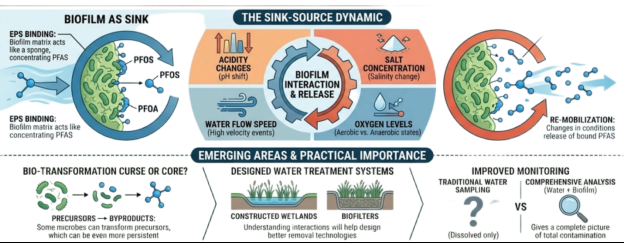
Biofilm-based systems like biofilters and constructed wetlands are already common in water treatment (Aguirre-Sierra et al., 2014; Saini et al., 2023). If we better understand how PFAS interact with biofilms, we can design these systems to capture PFAS more effectively. Current monitoring typically focuses on PFAS dissolved in water. But if a significant portion of PFAS is bound to biofilms or sediment, standard water sampling alone will undercount total contamination. Including biofilm analysis in monitoring programs would give a more accurate and complete picture of where PFAS actually are.
As the field progresses, integrating microbial ecology with environmental engineering will be crucial. Gaining insight into how biofilm composition, structure, and function affect PFAS interactions is an emerging area of scientific and practical importance. The bigger takeaway is that biofilms aren't just background biology. They actively shape where PFAS go, how long they stay, and whether they transform into something else. Treating them as a serious variable rather than an afterthought could meaningfully improve how we manage PFAS contamination in water systems.
References:
- Aguirre-Sierra, A., Bacchetti-De Gregoris, T., Berná, A., Salas, J. J., Aragón, C., & Esteve-Núñez, A. (2014). Environmental Science Water Research & Technology Microbial electrochemical systems outperform fixed-bed biofilters in cleaning up urban wastewater †. Cite This: Environ. Sci.: Water Res. Technol, 2, 984. https://doi.org/10.1039/c6ew00172f
- Elumalai, P., Gao, X., Cui, J., Kumar, A. S., Dhandapani, P., Parthipan, P., Karthikeyan, O. P., Theerthagiri, J., Kheawhom, S., & Choi, M. Y. (2024). Biofilm formation, occurrence, microbial communication, impact and characterization methods in natural and anthropic systems: a review. Environmental Chemistry Letters 2024 22:3, 22(3), 1297–1326. https://doi.org/10.1007/S10311-024-01715-5
- Grgas, D., Petrina, A., Štefanac, T., Bešlo, D., & Landeka Dragičević, T. (2023). A Review: Per- and Polyfluoroalkyl Substances—Biological Degradation. Toxics 2023, Vol. 11, Page 446, 11(5), 446. https://doi.org/10.3390/TOXICS11050446
- LaFond, J. A., Hatzinger, P. B., Guelfo, J. L., Millerick, K., & Jackson, W. A. (2023). Bacterial transformation of per- and poly-fluoroalkyl substances: a review for the field of bioremediation. Environmental Science: Advances, 2(8), 1019–1041. https://doi.org/10.1039/D3VA00031A
- Riegel, M., Haist-Gulde, B., & Sacher, F. (2023). Sorptive removal of short-chain perfluoroalkyl substances (PFAS) during drinking water treatment using activated carbon and anion exchanger. Environmental Sciences Europe 2023 35:1, 35(1), 12-. https://doi.org/10.1186/S12302-023-00716-5
- Saini, S., Tewari, S., Dwivedi, J., & Sharma, V. (2023). Biofilm-mediated wastewater treatment: a comprehensive review. Materials Advances, 4(6), 1415–1443. https://doi.org/10.1039/D2MA00945E
- Sutherland, I. W. (2001). Biofilm exopolysaccharides: A strong and sticky framework. Microbiology, 147(1), 3–9. https://doi.org/10.1099/00221287-147-1-3/CITE/REFWORKS
- Wackett, L. P. (2022). Nothing lasts forever: understanding microbial biodegradation of polyfluorinated compounds and perfluorinated alkyl substances. Microbial Biotechnology, 15(3), 773–792. https://doi.org/10.1111/1751-7915.13928;PAGE:STRING:ARTICLE/CHAPTER
- Yu, S., Lu, X., & Lu, H. (2025). Marine microbial biofilms on diverse abiotic surfaces. Frontiers in Marine Science, 12, 1482946. https://doi.org/10.3389/FMARS.2025.1482946/FULL
- Zhang, Y., Zhang, J., Zhang, L., Li, L., Pan, M., Zheng, M., Sun, S., & Liang, J. (2025). Binding stability of per- and polyfluoroalkyl substances to sludge extracellular polymeric substances drives increased environmental risks. Journal of Hazardous Materials, 496, 139320. https://doi.org/10.1016/j.jhazmat.2025.139320