
ASCE Government Relations Update
Matt McGinn, Senior Manager, Government Relations
EPA Repeals Greenhouse Gas Endangerment Finding
On February 12th, President Donald Trump, who has referred to climate change as a “hoax”, announced that the Environmental Protection Agency (EPA) would repeal its 2009 Endangerment Finding which allows the Federal Government to regulate greenhouse gas emissions. The 2009 finding determined that greenhouse gas emissions are a danger to public health and safety, setting a legal basis to regulate them as air pollution under the Clean Air Act. EPA had initially proposed repealing the finding in July of last year. Repealing the Endangerment Finding significantly curtails EPA’s ability to regulate greenhouse gas emissions from vehicles, and undermines the agency’s ability to regulate other sources of air pollution such as power plant emissions and methane emissions from oil and gas production. It also limits the agency’s ability to regulate fossil fuel emissions in the future. ASCE supports efforts and strategies by the public and private sector “to achieve significant reduction in greenhouse gas emissions through planning, design, construction, renewal, renovation, operation, maintenance, and decommissioning of existing and future infrastructure systems.”
House T&I advances bill reauthorizing water pollution programs
On February 11th, the House Transportation & Infrastructure Committee held a markup and advanced legislation reauthorizing programs under the Clean Water Act that help prevent local water pollution. H.R. 7376, the Local Water Protection Act, reauthorizes non-point source pollution management programs which provide grants that help local communities address runoff from agriculture, mines, and other types of sources that contaminate waterways. H.R. 7376 now awaits consideration by the full House of Representatives.
ASCE supports efforts to mitigation non-point source pollution into surface and ground water and recommends strengthening public education programs on non-point source pollution, development of best management practices, and increasing funding for research to evaluate the impacts of non-point source pollution.
House and Senate hold hearings on administration’s WRDA priorities
In February, the House and Senate each held hearings with the U.S. Army Corps of Engineers to discuss the Trump Administration’s priorities for this year’s Water Resources Development Act (WRDA). On February 24th, the House Transportation & Infrastructure Committee’s Subcommittee on Water Resources and Environment held its second hearing on the upcoming legislation authorizing water resources projects for the U.S. Army Corps of Engineers (USACE), while the Senate Environment and Public Works Committee met on February 25th to hold its first hearing on WRDA 2026.
Appearing before both hearings were Assistant Secretary of Defense for Civil Works Adam Telle, and Lt. General William H. Graham, Jr., Chief of Engineers and Commanding General of USACE. In their testimonies, Assistant Secretary Telle and Lt. General Grham spoke about concerns regarding implementation of previous WRDA legislation and project delivery. Telle stated his view that USACE works best without having to worry about red tape and bureaucratic delays. In addition, he spoke of the importance of building a pipeline of non-federal partners to help move projects along, supported additional funding for ongoing projects, and discussed a need for reforms to the permitting system. Lt. General Graham expressed appreciation in both hearings for the WRDA process moving along in a timely manner and emphasized the certainty provided to USACE by passing WRDA on time every two years. Graham joined Telle in supporting efforts to reduce red tape and move projects along, expressing support for an initiative referred to by Telle as “Building Infrastructure, Not Paperwork.”
ASCE has submitted its 2026 WRDA priorities to Congress and has met with Members in both the House and Senate in support of these priorities. Among those priorities is the need to address the growing water resources project backlog at USACE which has grown to over $100 billion.
House Energy & Commerce subcommittee holds hearing on drinking water
On February 24th, the House Energy & Commerce Subcommittee on Environment held a hearing examining access to safety and reliability of the nation’s drinking water. Among the challenges highlighted were available federal resources, increasing rates, aging infrastructure, and regulatory compliance. Republicans and Democrats focused their questions on these challenges, as well as the need to address emerging contaminants, removal of lead service lines, and growing cybersecurity concerns. The committee’s Ranking Member, Representative Frank Pallone (D-NJ), specifically cited ASCE’s 2025 Report Card for America’s Infrastructure and the grade of “C-” given to the nation’s drinking water infrastructure.
Appearing before the committee were officials representing all levels of government, including Erin Murley, the Deputy Inspector General of the Environmental Protection Agency; Eric Hill, with the Russellville, AL Water & Sewer Board, representing the National Rural Water Association; Lindsey Rechtin with the Northern Kentucky Water District, representing the Association of Metropolitan Water Agencies; and Erik Olson with the Natural Resources Defense Council. Witnesses noted many of the same concerns expressed by subcommittee members, including access to federal financing and addressing emerging contaminants.
Witnesses also emphasized the role of water utilities as “passive receivers” of PFAS contamination and the cost challenges to addressing PFAS contamination, emphasizing the role of polluters. Eric Hill noted his concern that smaller rural communities bear the brunt of higher water rates while larger communities with a larger customer base generally pay less.
ASCE leaders champion infrastructure issues on Capitol Hill at 2026 Legislative Fly-In
Over 265 ASCE members from 48 states, the District of Columbia, and Puerto Rico advanced ASCE’s legislative priorities in Washington during the 2026 Legislative Fly-In on March 17th – 18th. Featured speakers at the event included U.S. Representative Bruce Westerman (AR-04), U.S. Representative Dina Titus (NV-01), and National Journal Editor in Chief Jeff Dufour. Attendees gained greater insight into the 2026 Fly-In asks with panelists representing American Water, Xylem, National Association of Clean Water Agencies, American Road & Transportation Builders Association, American Association of State Highway and Transportation Officials, AECOM, Great Lakes Dredge & Dock Company, Maryland Department of the Environment, Knight Piésold USA, and the U.S. House Committee on Transportation and Infrastructure’s Subcommittee on Water Resources and Environment.
Fly-In attendees used their civil engineering expertise, personal stories, and briefings on ASCE’s legislative priorities to advocate for infrastructure and civil engineering issues during meetings with over 265 House and Senate offices. They urged their Senators and Representatives to protect the municipal tax exemption, reauthorize critical infrastructure programs expiring in 2026, such as surface transportation programs and state revolving funds, timely passage of the Water Resources and Development Act of 2026, and invest in resilient infrastructure by adopting the most up-to-date building codes and standards.
ASCE hosts World Water Day event
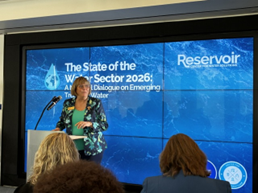
On March 24th, ASCE joined with the Reservoir Center for Water Solutions and United for Infrastructure to host, “State of the Water Sector 2026.” Held in Washington, D.C., the event recognizes World Water Day which was celebrated on March 22nd and featured a series of water policy leaders and experts engaging on the latest trends and topics central to water quality and access. ASCE’s Interim Executive Director Maria Lehman provided opening remarks with a focus on recommended policy reforms for improved outcomes in the water sector. Additionally, Carol Haddock, ASCE president-elect, moderated a session on the innerworkings of EPA and its water-based programs.
ASCE returned to the Reservoir Center on May 6th for its Infrastructure Innovation Forum.
 Josh Shumaker